

A family called on a Tuesday afternoon, three weeks after they lost their father in Mesquite. The house had sat empty for months. The mortgage kept running. One of the four adult children wanted to sell right away, and the other three were not sure. Nobody knew who held the legal authority to do anything. Calls like that come in far more often than people realize.
Can an Estate Administrator Sell Property in Texas?
Before that Mesquite family could move an inch, one question had to be answered. Does the estate fall under independent or dependent administration? Those two words decide whether a property can be sold on a single signature, or only after a judge signs off.
Under Texas law an executor can usually sell property without beneficiary approval, provided the will grants independent administration powers. That is the short answer. The longer one has layers, and those layers matter, because getting them wrong costs money, months, and sometimes family relationships.
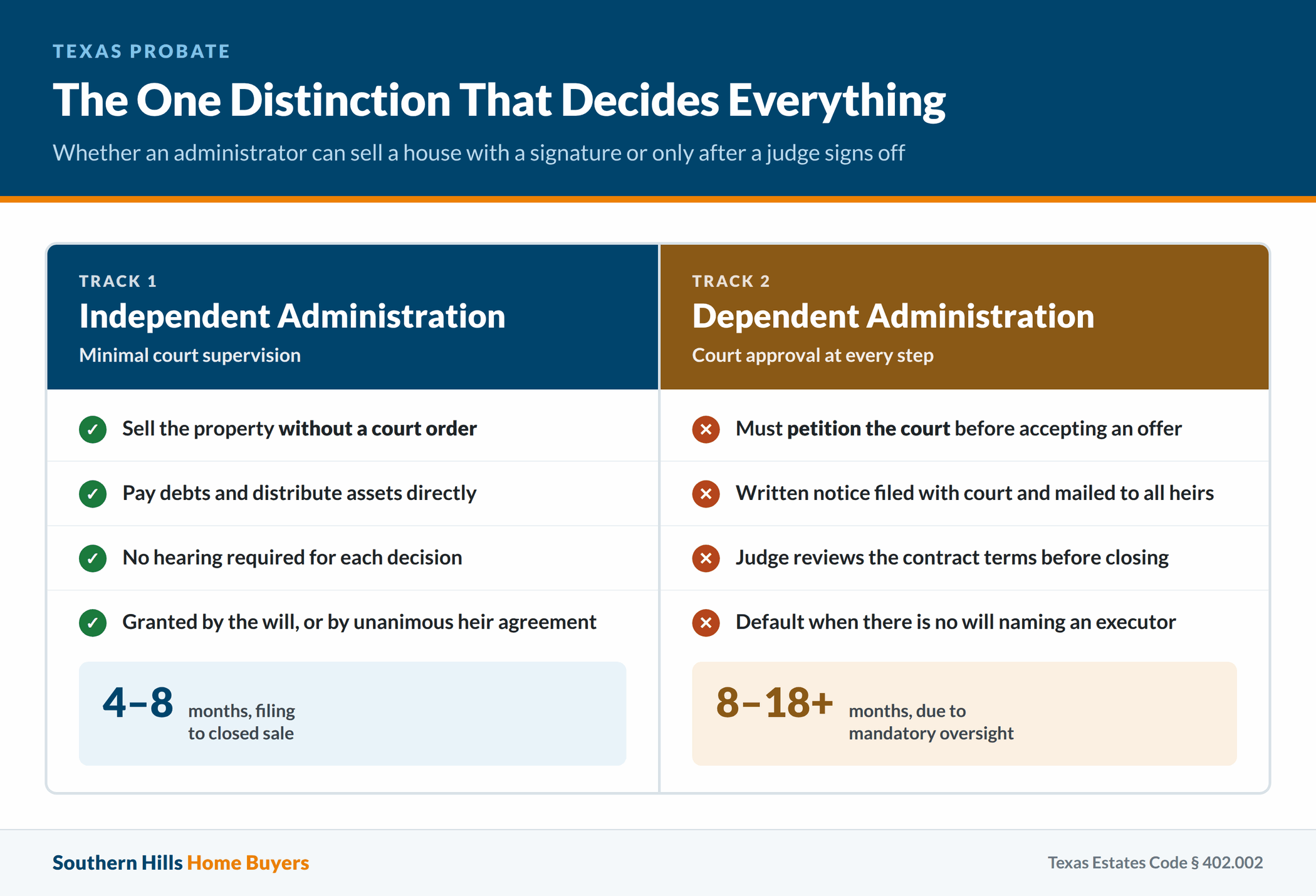
Dependent administrators have to petition the court for approval before they accept a buyer’s offer. Texas law also requires written notice of the sale, filed with the court and mailed to every heir. One house, under two different administration types, either closes in a few weeks or drags on for most of a year. Sorting out which situation you’re in is the first real task.
Worth knowing before you spend a dollar on legal help. Several kinds of Texas assets carry built-in transfer mechanisms, and they pass outside probate entirely. If the property was held in joint tenancy with right of survivorship, the probate court may have no role here at all.
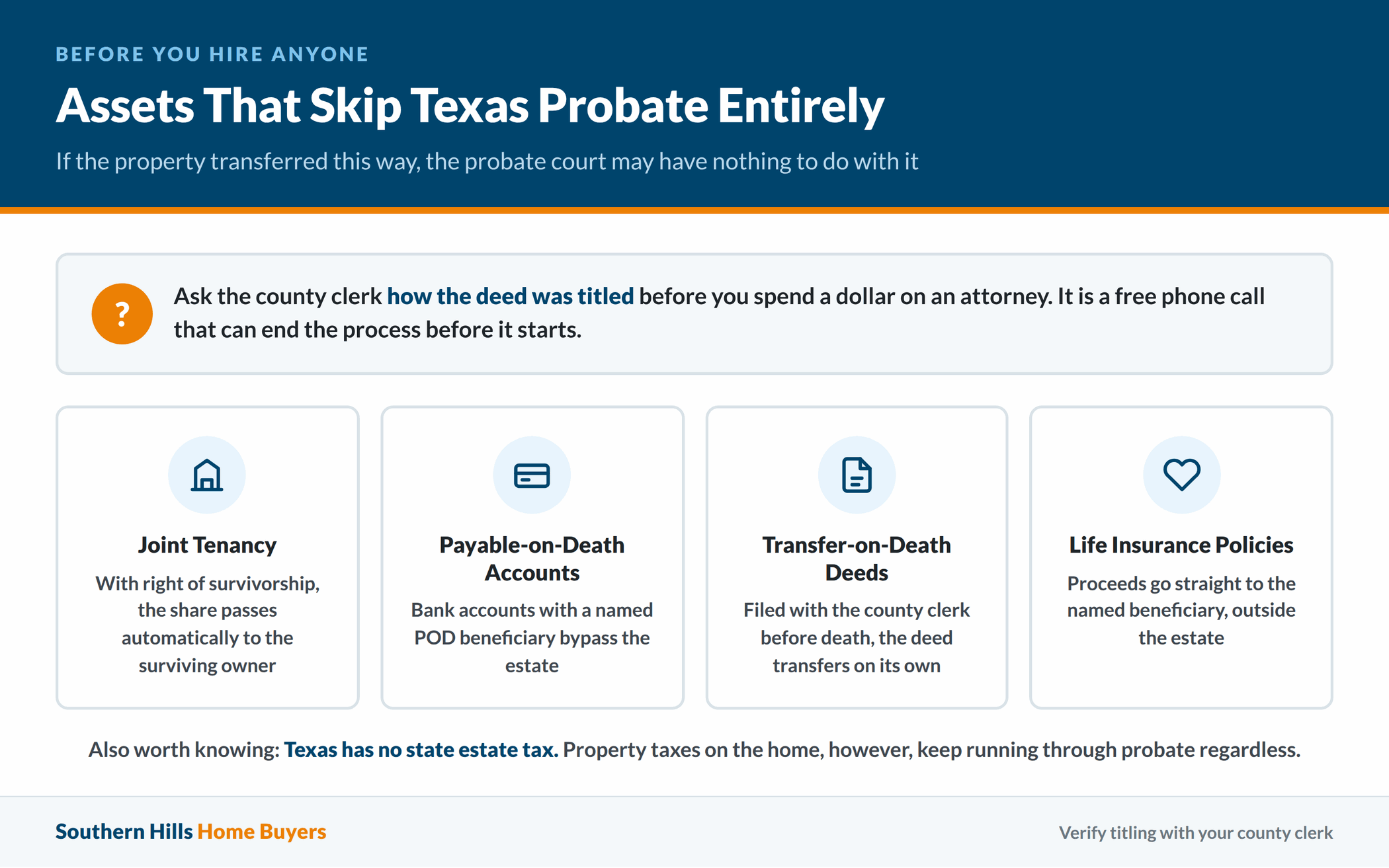
Your county clerk’s office can confirm how the deed was titled, and that call costs nothing. Make it before you hire an attorney. For families who need to move fast once the authority question is settled, how Southern Hills Home Buyers works is worth a look. We work directly with estates and administrators across Texas, so we know the paperwork on the buyer’s side. Experience counts when a closing has to line up with court schedules.
Who Can Serve as an Estate Administrator in Texas?
An administrator gets appointed only when there is no will, when the will names no executor, or when the named executor cannot or will not serve. That last one happens more often than estate planning attorneys like to admit. If you’re earlier in the process and still working out whether you qualify, our guide on how to become the administrator of an estate in Texas walks through the filing steps in order.
The probate court holds the appointing authority, and Texas courts generally prefer someone with a financial interest in the estate. Early last year I worked with a family in Garland whose designated executor had moved to Colorado and never updated his address. The estate sat for nearly two months while the family sorted out whether he could legally serve. They petitioned for a local administrator, which added cost and delay nobody had budgeted for. Tools filled the garage, and the family could not list the property until someone cleared it out. That is the point where cash home buyers in Garland usually get a call.
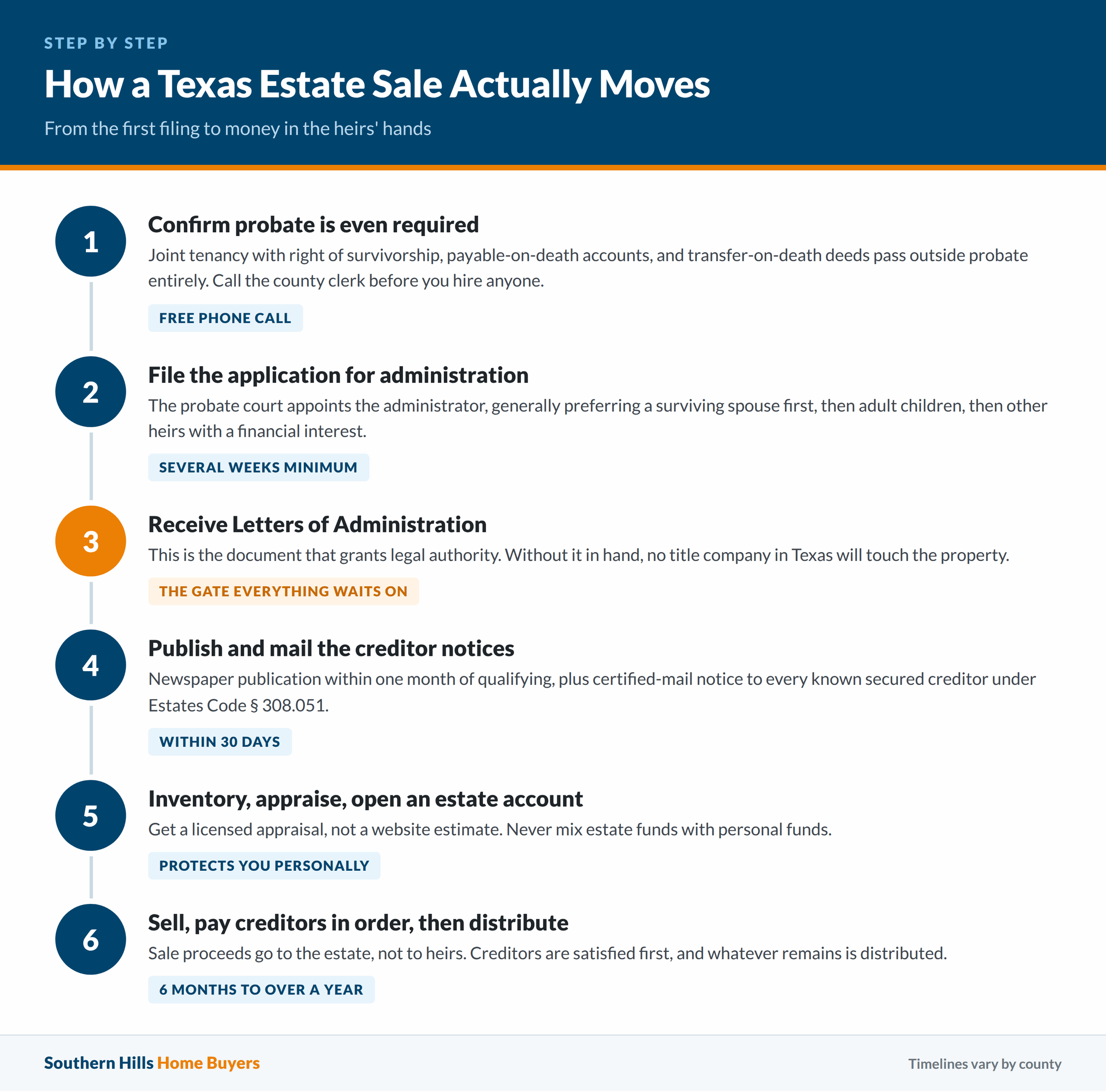
Once appointed, the administrator receives letters of administration from the probate court. Those are the legal documents granting authority to manage the deceased person’s estate. Without those letters in hand, no title company in Texas will touch the property.
How Does the Texas Court Appointment Process Work for Estate Administrators?
Skip the formal appointment, try to manage or sell estate property without letters of administration, and a sale can be rendered void. Title companies catch it. Lenders for the buyer flag it. The estate can face legal challenges long after closing.
Estate administration is the most formal probate method. The court validates the will if one exists, then appoints someone to handle the assets and debts. That person collects the property, pays off debts and taxes, and distributes what remains to the people named in the will, or by Texas intestacy law.
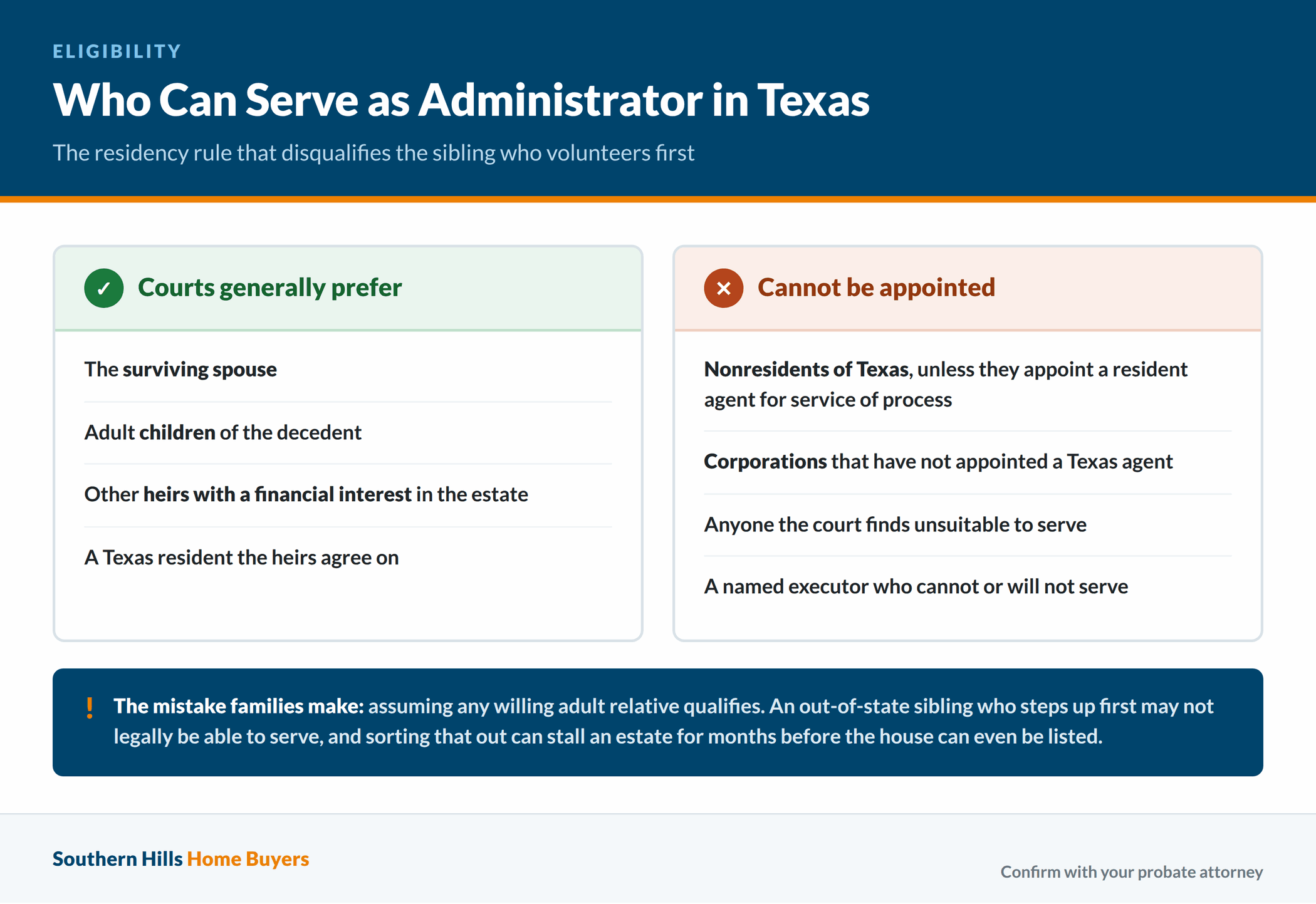
Filing the application, sitting through the hearing, and receiving letters of administration takes several weeks at a minimum. Every court runs its own calendar. The Dallas County Probate Courts operate three separate courts out of the George Allen Courts Building downtown, and between them they handle thousands of estates a year. Tarrant, Collin, and Denton counties keep their own dockets on their own timelines. Patience is part of the process.
Most title companies will not underwrite a buyer’s loan until the letters are issued and recorded with the county clerk. List before that point and an accepted offer can fall apart, because the buyer’s lender cannot verify clear title. Sellers make this mistake over and over. They land a strong offer, sign a contract, then lose the buyer while court paperwork they should have gotten first crawls along.
What Is the Difference Between Independent and Dependent Administration in Texas?
The appointment process runs straight into one of the biggest decisions in any Texas probate. Which type of administration governs the estate?
Most Texas wills are written to allow independent administration, a distinctive feature of state law meant to make probate faster and cheaper. Set it against how other states handle the same job, and Texas probate looks good here.
Under Texas Estates Code Section 402.002, an independent executor can take any action a court-supervised representative could take, minus the court order. Sell the house. Pay the bills. Distribute assets to heirs. All of it, without walking back in front of a judge each time. Beneficiaries who feel cut out of that process often ask whether an executor can sell without every beneficiary approving, and the answer turns on this same clause.
Dependent administration works differently in every meaningful way. Each sale needs a court order, formal notice to heirs, and strict reporting before closing can happen. Say your estate sits under dependent administration and you want to sell a house in Arlington or Plano. Expect the process to stretch across multiple hearings and filings, and expect that timeline to add up faster than most sellers anticipate.
If the will specifies independent administration and names an independent executor, the executor can manage and sell estate assets, real estate included, without court approval for most actions. Unanimous agreement among all beneficiaries opens the same door. That second pathway is worth remembering when the will itself says nothing on the matter, because heirs who agree can sometimes reach the same place without an independent administration clause.
What Are the Legal Duties of a Texas Estate Administrator?
For a long time I thought an administrator’s main job was getting the house sold. The actual job runs much wider than that, and the sale is one piece of it.
As administrator of a decedent’s estate, you represent interests that are not your own. You answer to beneficiaries and to creditors, which puts people on both sides of the balance sheet counting on you. Acting for the benefit of somebody else is a fiduciary relationship.
This duty has real teeth. An administrator who sells a property to a close friend for half its market value has likely breached it. The job is to obtain a fair price, so beneficiaries inherit as much as possible. Fall short of that and beneficiaries can bring legal action in probate court, holding them personally liable for the loss. I have watched beneficiaries do exactly that, more than once.
Selling below market value is not just a bad business decision. It is a personal legal risk. A proper appraisal from a licensed real estate appraiser before listing is not optional when you are wearing a fiduciary hat, and it protects you. Want a second data point on what the property would bring in its current condition? Cash home buyers in Fort Worth and across the Metroplex can put a written number in front of you at no cost.
When a property sells during probate, the proceeds go to the estate, not straight to heirs. The administrator spends those funds on debts and costs first, which leaves heirs without a dollar until creditors are satisfied. What survives that gets distributed under the will or intestate succession law.
What Steps Must a Texas Estate Administrator Take Immediately After Appointment?
Most administrators expect to start managing property right away. The law has another sequence in mind, and property management comes after a set of mandatory notices.
Within one month after qualifying for letters of administration, the attorney publishes notice to creditors in a local newspaper. Publication is not optional. Most families never think about it, because they are focused on getting the house sold.
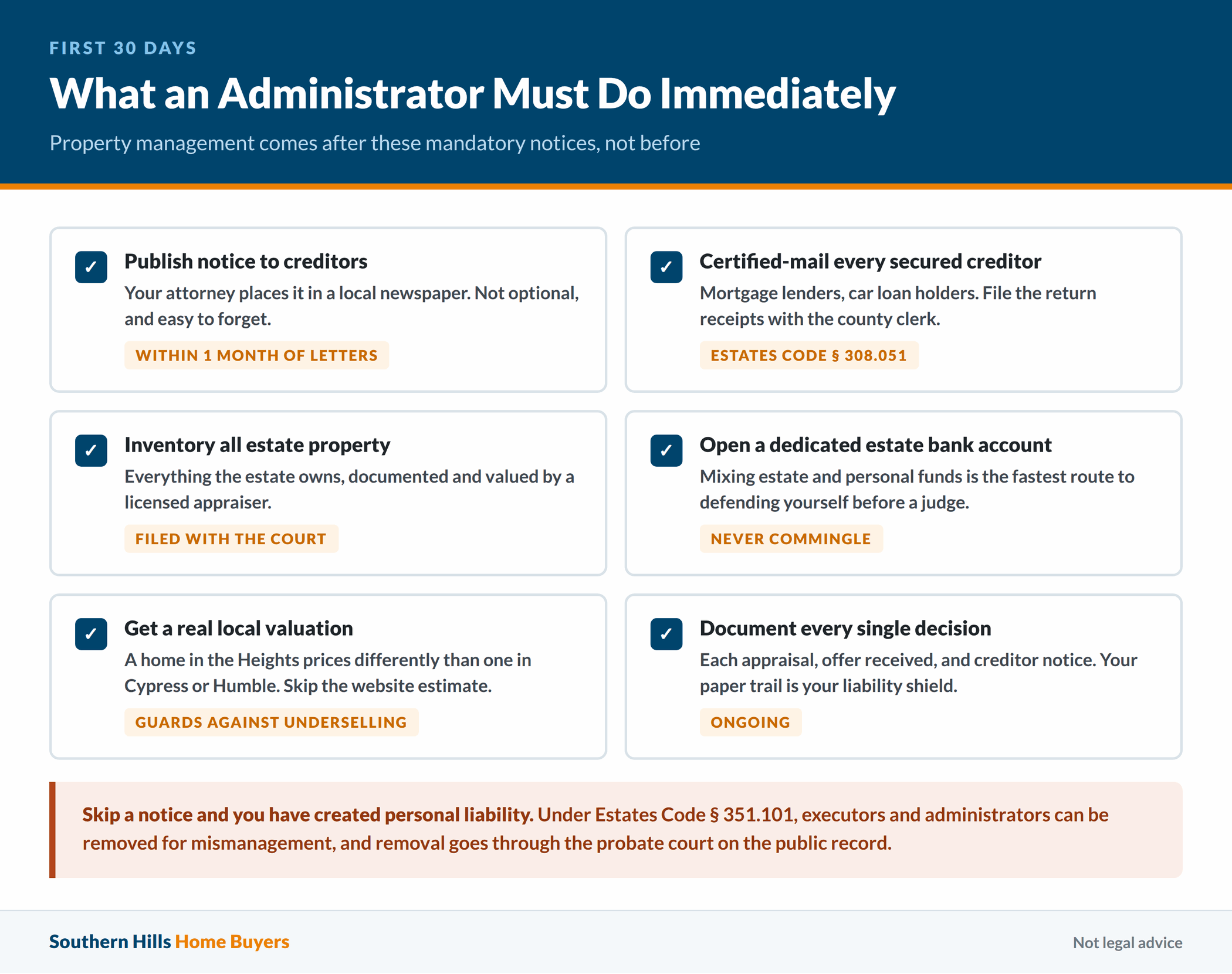
Under Texas Estates Code 308.051, personal representatives must notify every known secured creditor, mortgage lenders and car loan holders included, of their right to present claims. Each notice goes out by certified mail with return receipt, and copies of those receipts get filed with the county clerk. Skip that step and you have created personal liability exposure.
Where the property sits matters too. A home in Lakewood near White Rock Lake carries a different market value than one out in Mesquite or Grand Prairie. A valuation from someone with real knowledge of the local neighborhoods, rather than a zip code estimate off a website, protects the administrator from accusations of underselling. Sellers weighing that choice often start by comparing a traditional listing against what a company that buys homes in Plano would pay outright.
How Does a Texas Estate Administrator Protect the Interests of Heirs and Creditors?
One heir wants to sell fast. Another wants to keep the property. Now what?
The honest answer is that neither preference wins on its own. An administrator does not serve one side over the other. The administrator serves the estate as a whole. That means a fair price, a legal process followed properly, and creditors paid before any heir sees a dollar. The mechanics show up step by step in our walkthrough on selling a house in probate in Texas.
Any beneficiary named in the will can petition the probate court to force an accounting, or to compel a sale when the administrator sits on the property for no stated reason. This cuts both ways. An heir who wants to sell faster can push through the court. An heir who thinks the sale is being handled improperly can challenge it there too. Courts take those petitions seriously.
An administrator’s best protection is documentation. Every decision recorded. Every appraisal, every offer received, every creditor notification. When a beneficiary later asks whether the house went for a fair number, that paper trail is what stands between the administrator and personal liability. A written offer from a cash for houses company in Dallas can go into the record too, documenting the estate’s diligence on market value, which helps when heirs are watching closely.
What Happens If a Texas Estate Administrator Fails to Notify Unsecured Creditors?
Some administrators figure a creditor who does not already know about the estate does not need to be told. That reasoning gets expensive fast.
Creditors who were never informed can assert claims later, and that leads to costly litigation. Under Texas Estates Code 355.001, valid debts get paid before assets are distributed to heirs. A creditor who proves they never received proper notice can send the whole thing backward. The court may require the estate to settle that debt after distributions have begun, forcing heirs to return assets they already spent.
Heirs handing back money they have already spent and cannot recover is one of the uglier outcomes in probate. It is also completely avoidable.
The published notice to unsecured creditors tells them to present their claim before the 121st day after they receive notice. Once that window closes properly, the administrator stands on much cleaner ground while distributing what remains. Under Texas Estates Code 351.101, administrators can be removed for mismanagement, and failing to notify creditors can count as a breach of those duties. Removal does not happen quietly. It runs through the probate court and creates a public record.
What Tax Obligations Does a Texas Estate Administrator Have?
As of July 2026 the median listing price across the Dallas-Fort Worth-Arlington metro sat at $439,000, according to Federal Reserve Economic Data. Most estates here hold real property worth serious money, so how that asset gets taxed matters.
Texas has no state estate tax, a genuine advantage for Texas families going through probate. Federal estate tax thresholds are set federally and change periodically, so a probate attorney or CPA should confirm current figures. What the administrator absolutely must handle is the decedent’s final federal income tax return for the year of death, plus an estate income tax return if the estate earns income during administration.
Property taxes keep running regardless of probate status. Dallas County, Tarrant County, Collin County, and Denton County will all mail bills to the property address, and those bills attach to the property itself. An administrator who lets property taxes pile up is shrinking the net proceeds heirs receive.
If the estate sells real property at a gain, federal capital gains may come into play, though heirs often benefit from a stepped-up basis at the date of death. Your county appraisal district records show assessed value. A licensed appraiser should establish fair market value at the date of death for tax purposes, because assessed and market value can differ by a wide margin. Check the appraisal district for assessed value, then let a tax professional handle the rest.
What Happens When a Texas Estate’s Debts Exceed Its Assets?
A landlord I worked with in Fort Worth had inherited a rental property from a parent, then spent two long years handling tenants, repairs, and city code notices on a house they never wanted. By the time we talked on a Thursday afternoon, the roof needed work and an old HVAC unit sat rusting in the backyard. He had had enough, and the estate was barely solvent after all the carrying costs.
An estate becomes insolvent when its debts exceed the value of its assets. That happens when someone leaves large medical bills, credit card balances, or other debts and few financial resources. It is more common than families expect. A long illness before the death does it, because hospice and care costs add up fast.
Even then the administrator has to keep going. Identify assets, review creditor claims, work out the estate’s total value. Once the financial position is clear, they can start paying valid debts under probate rules, taking creditors in a specific statutory order rather than first come, first served.
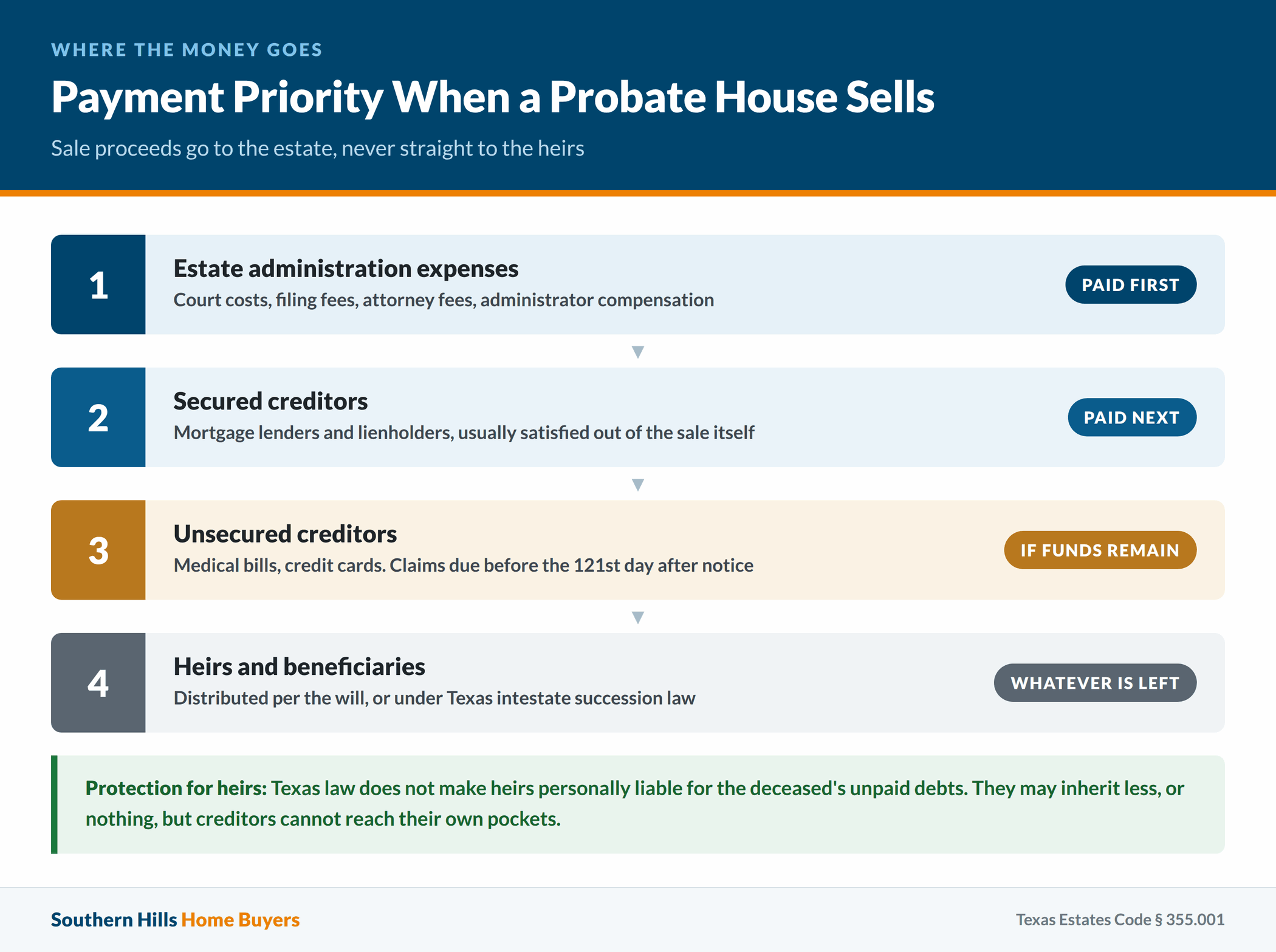
One relief for heirs: they are not liable for the deceased’s unpaid debts out of their own pockets. Texas law protects heirs from inheriting debt. They may inherit fewer assets, or nothing at all, when the estate is buried in obligations, but creditors cannot come after them personally. Heirs who receive the property itself rather than cash will want our guide on selling an inherited house in Texas.
For administrators running an insolvent or near-insolvent estate, selling the real property quickly at fair market value is often the most responsible path available. Homes across the Dallas-Fort Worth metro spent a median of 54 days on the market in July 2026. Add the weeks a probate closing can require on top of that. A faster direct sale lets an administrator close cleanly, pay priority creditors on schedule, and stay ahead of the carrying costs that eat an already thin estate. We buy Mesquite homes and properties throughout the Metroplex in exactly these situations, with no repairs and no commissions.
Frequently Asked Questions
What power does the administrator of an estate have?
An administrator in Texas can collect estate assets, pay valid debts in the legally required order, manage estate property, and distribute whatever remains to heirs. How far that authority reaches depends on whether the administration is independent or dependent. An independent administrator acts without returning to the probate court for every decision. A dependent administrator needs court approval before major actions, selling real property included.
Can an executor sell property without the consent of the heirs in Texas?
Yes, under certain conditions. When the will specifically grants the executor a power of sale, that executor generally does not need permission from beneficiaries and does not need a judge to sign off. They can list the house, find a buyer, and sign the deed. Under dependent administration the rules flip. The court must approve the sale, and heirs must receive formal notice before anything closes.
How long does an executor have to sell a house in Texas?
Texas law sets no single fixed deadline for selling estate property, though the probate process creates its own time pressure. The timeline for selling a house in Texas probate usually runs from six months to over a year. Creditors, carrying costs, and court calendars all add urgency. An independent administrator can list and close far faster than one working under dependent administration.
How much power does an administrator have?
An administrator’s power is broad, but always bound by the fiduciary duty to act in the estate’s best interest. They can sell real property, open and close accounts, pay debts, hire professionals, and manage estate assets. They cannot engage in self-dealing, sell assets below fair market value without court approval, or ignore the legally required payment priority. Under Texas Estates Code 351.101 they can be removed for mismanagement, so the authority arrives with accountability attached. Working through a probate sale? Our answers to the questions we hear most cover more ground.
Talk Through Your Situation With Someone Who Has Done This Before
Maybe you are an administrator trying to figure out the next move. Maybe you are a beneficiary wondering whether a sale is being handled properly. Either way, we are glad to talk it through, with no pressure and no obligation. The Southern Hills Home Buyers team has worked with families across the Dallas-Fort Worth Metroplex and the rest of Texas through probate sales, insolvent estates, and properties nobody in the family wanted to manage. We can tell you where things stand, what a fair cash number looks like on the property, and what your options actually are.
Ready to start? Reach out to Southern Hills Home Buyers and we will send you a no-obligation cash offer, usually within 24 hours, with no repairs, no cleaning, and no agent commissions. Fill out the form below and tell us what you are up against.
Get Cash For Your Texas House Today
We buy houses in Texas without the hassle and red tape. Get your no-obligation cash offer for your home and just be done. Selling in as-is condition has never been easier.