


The closing date is set. Now you’re squinting at a list of line items, half of which mean nothing to you, and near the bottom sits “attorney fees.” Is that $200 or $2,000? Who owes it? Did you even need a lawyer? That kind of fog costs Texas sellers real money, week after week.
Attorney Fees and Closing Costs: Why This Gets Complicated in Texas
A family I sat with a few years back had been renting out a small house in Mesquite for years. Landlording was never really the plan. They’d inherited the place, waded through a rough tenant situation, and by the time we talked they just wanted out. Out back sat a nice covered patio and a two-car garage stuffed with old lawn equipment nobody had touched in years. When we laid out the closing cost breakdown, the attorney line item alone set off a thirty-minute debate. Nobody had spelled out what they were paying for, or why. That attorney fee confusion comes up more often than you’d guess.
Two hours of plain explanation would settle most of it. Instead the transaction turns into a guessing game, because nobody sits down and names the parts. Texas runs closings its own way, and it looks nothing like what your cousin in Georgia or South Carolina went through. Understand the structure and the numbers stop feeling arbitrary. Want a shortcut through the fog? The team at Southern Hills Home Buyers will walk you through what closing looks like on your specific property, with no sales pressure.
What Are Closing Costs in Texas?
Closing costs, by the textbook definition, are the fees paid to finalize a real estate transaction. That framing hides how many separate buckets those fees fall into. Sellers often walk in assuming they owe a commission and nothing else (title fees surprise them most).
In Texas those charges run well past the agent’s commission. Title company fees, escrow setup, recording fees, prepaid interest, insurance premiums, property tax prorations, survey fees, and any concessions you hand the buyer all land on the same page. The lender stacks on its own layer. Origination fees, discount points if the buyer bought the rate down, credit report charges, appraisal costs, and that last one catches sellers off guard. Closing costs on the seller’s side also include owner’s title insurance, which shields the buyer from title defects already attached to your property.
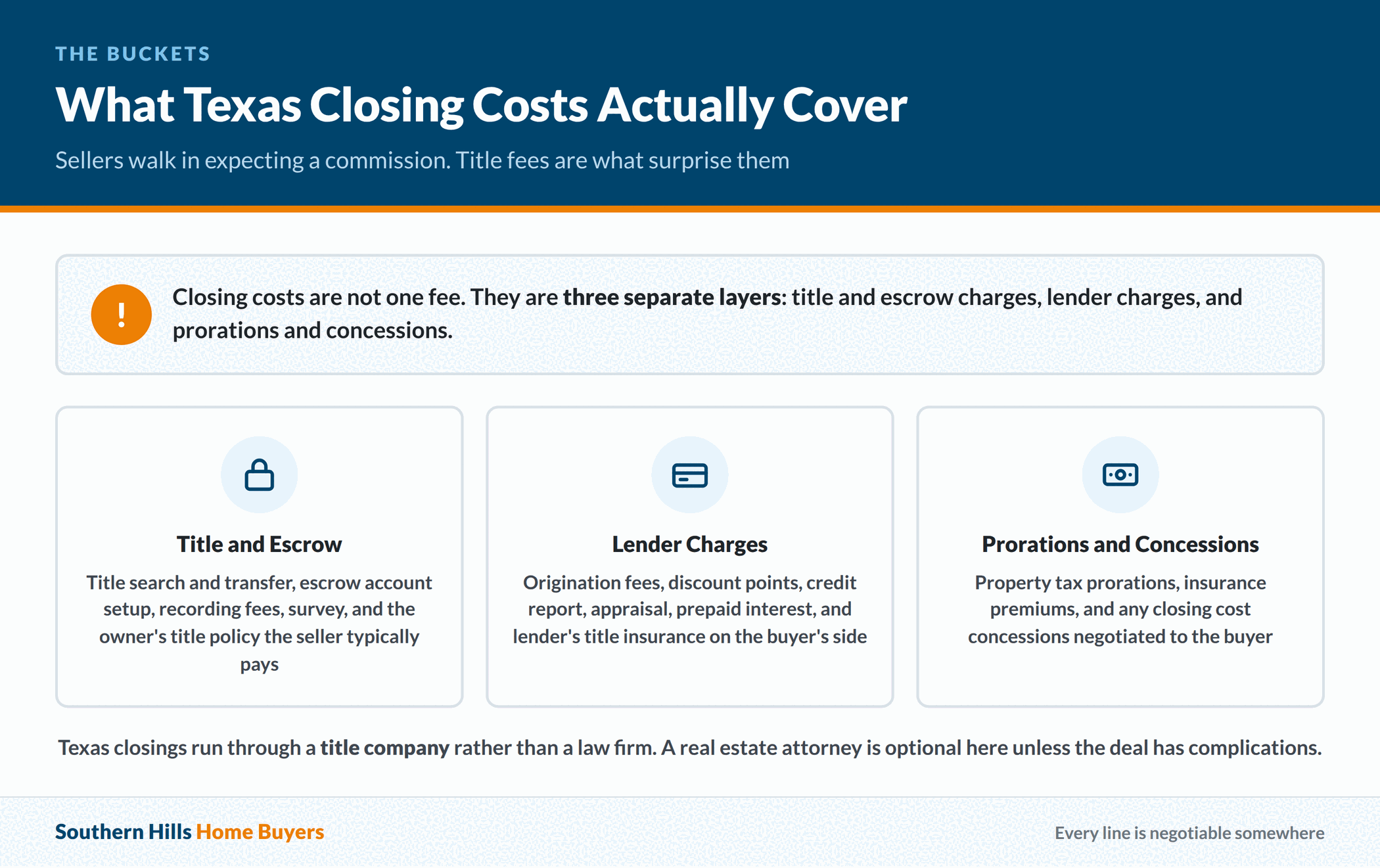
Real estate transactions in Texas usually get finalized through either a real estate attorney or a title company. That split matters, because in most other states an attorney has to be at the closing table. Texas went a different way. Most closings here run through a title company instead of a law firm. A real estate lawyer still has a role, just an optional one, unless complications show up (title disputes are the most common).
How Much Are Closing Costs in Texas?
Sellers who guess low here show up short at the table. Worse, they turn down a fair offer because the net proceeds look wrong once the real costs land. Nobody enjoys that phone call.
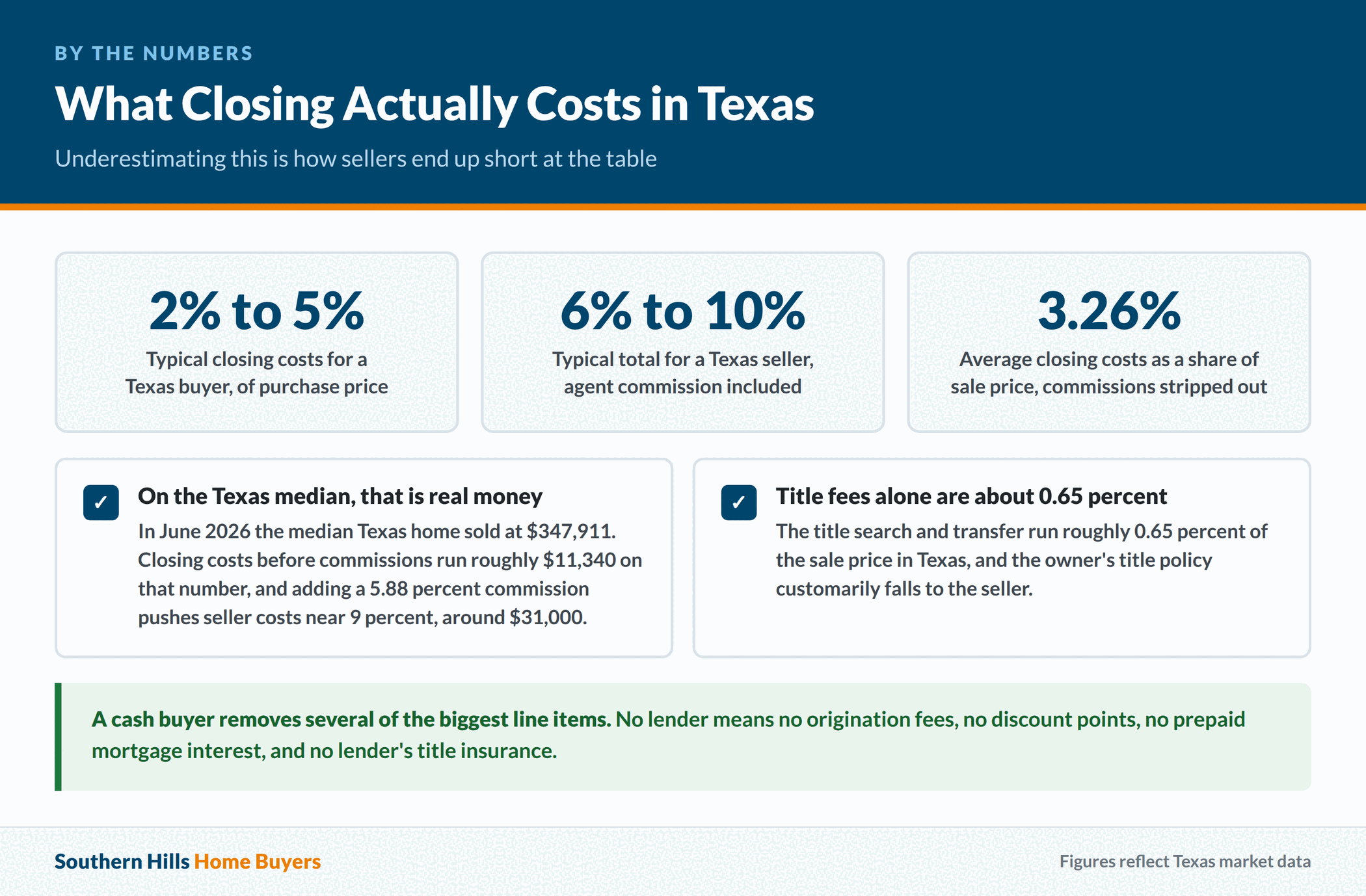
Average closing costs in Texas run 2% to 5% of the home’s purchase price for buyers, and 6% to 10% for sellers. The seller’s range is wider because it folds in agent commissions. Those are negotiable, and they still swallow most of the total. Strip the commission out and the pure closing cost burden gets manageable. Closing costs average about 3.26% of a home’s sale price in Texas.
Market context matters. Averages shift month to month, so treat these as a starting point. In June 2026 home prices in Texas were selling at a median price of $347,911. That works out to roughly $11,340 in closing costs before commissions. Layer on a 5.88% agent commission and the seller side approaches 9% of the sale price. On a home at that median price, about $31,000 walks out the door before you pocket a dime.
Cash buyers change the math. No lender means no loan origination fees, no discount points, no prepaid mortgage interest, and no lender’s title insurance, which alone saves hundreds. That is not a rounding difference. Sellers who close with a direct buyer like Southern Hills Home Buyers skip several of the priciest line items on that list.
What Type of Home Loan Affects Your Texas Closing Costs?
For years I underestimated how much the buyer’s loan type reshapes what a seller ends up paying. I used to look at the purchase price and ignore the financing. That was a mistake. Financing shapes who pays what.
A conventional loan closing looks nothing like a VA or FHA closing, and each one shifts which fees land on whom. VA loans restrict which closing costs the veteran buyer is allowed to pay. Sellers in a VA transaction sometimes absorb fees they’d never see with a conventional buyer. FHA loans bring their own upfront insurance premiums and appraisal requirements that stretch the timeline, along with a different cost structure. With an FHA or VA loan, the buyer’s lender also wants an escrow account set up for taxes and insurance, and that deposit adds to the closing calculation.
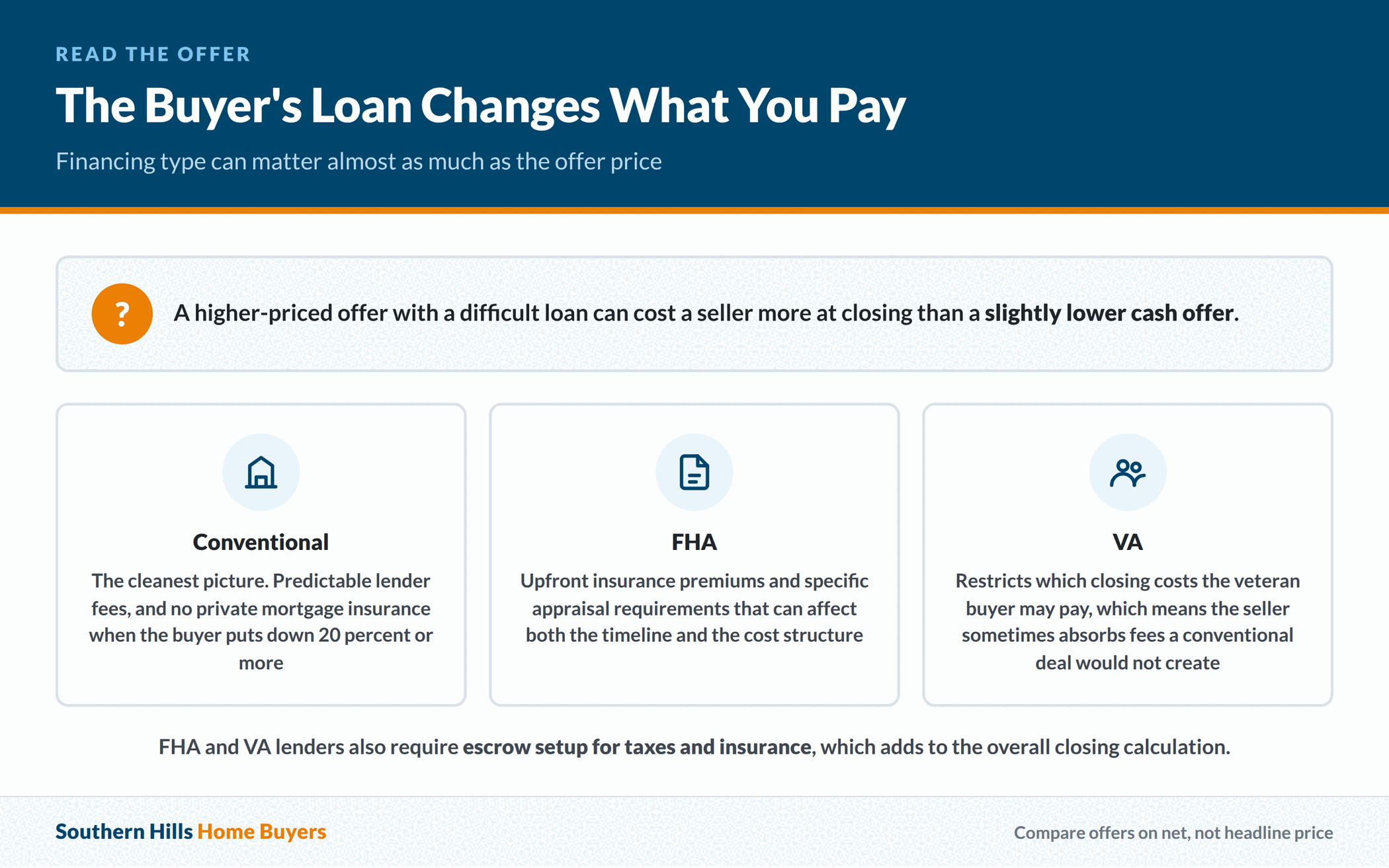
Conventional financing with a strong down payment produces the cleanest closing cost picture for buyers. They skip private mortgage insurance at 20% down or more. Their lender fees also stay predictable. A seller reviewing offers should weigh the financing type almost as heavily as the price. A higher-priced offer riding a fussy loan can cost more at closing than a slightly lower cash offer. That surprises people.
Who Pays Closing Costs in Texas?
What I tell a seller at their kitchen table is simple. Almost every line costs money. The only real choice is whose check covers it.
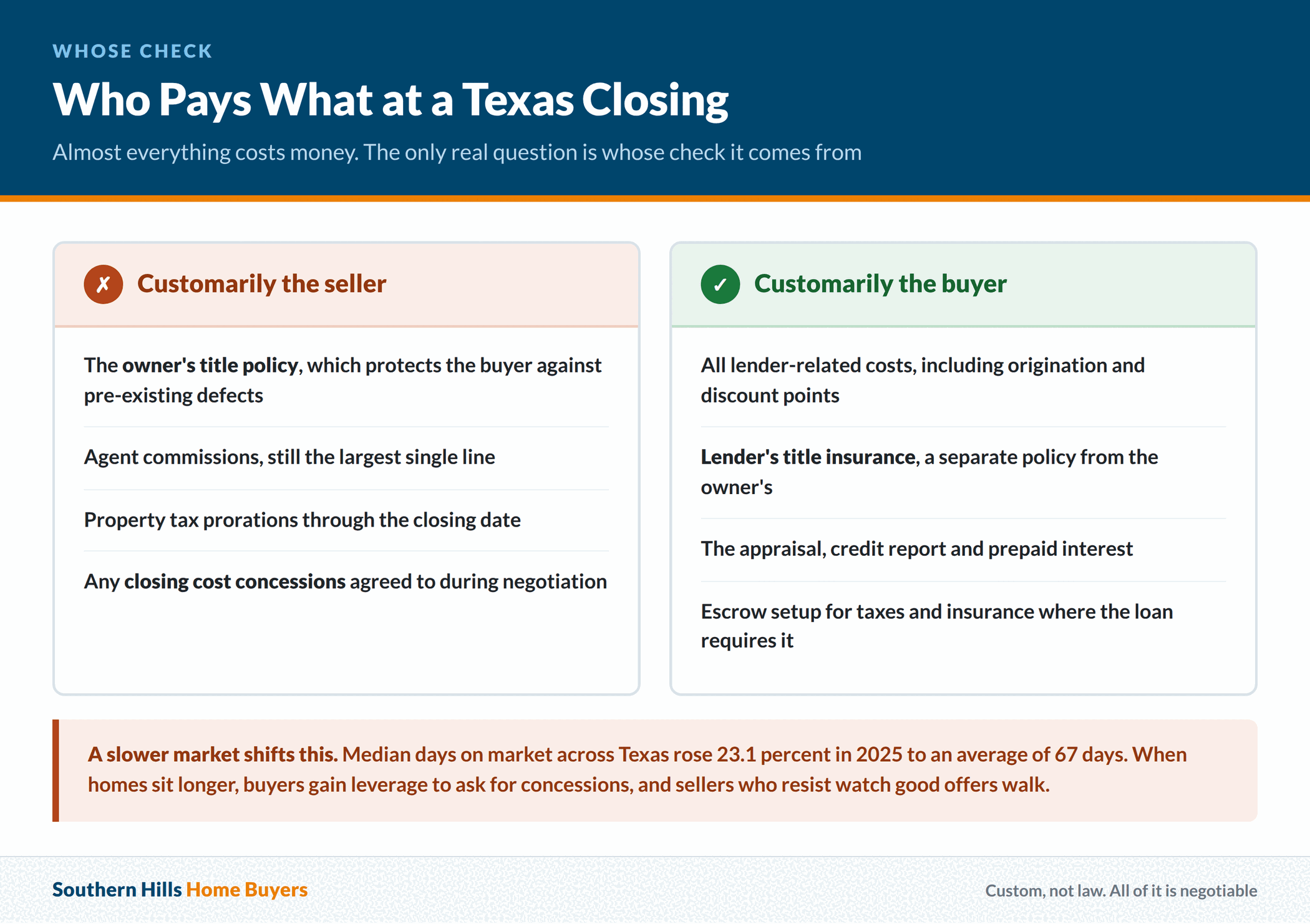
In Texas the seller carries most closing costs, though not every one. Owner’s title insurance most commonly lands on the seller. Custom varies a little by county, but that is the pattern. Buyers handle their own lender-related costs, and they usually pay for lender’s title insurance, which protects the institution holding their mortgage. Title fees, meaning the cost of the title search and transfer, run about 0.65% of the home sale price in Texas.
Who pays what is also a negotiation point. Sellers in a slow market sometimes offer concessions, covering part of the buyer’s closing costs to get it signed. Median days on market across Texas jumped 23.1% in 2025, hitting an average of 67 days. When homes sit longer, buyers gain leverage to ask. The real damage of digging in shows up later, when a seller in Arlington watches good offers walk. Nobody likes hearing it.
Do sellers need an attorney in the room? No. An attorney is not legally required for a real estate closing in Texas, because licensed agents here use the TREC promulgated contract forms. Title complications, probate situations, and inherited properties are the cases where a real estate lawyer earns the money, reviewing documents before anyone signs.
What Are Attorney Fees for Closing a House in Texas?
What does a real estate attorney actually cost in Texas?
It depends on how you engage one and what you hand them to do. The hourly rate for real estate lawyers in Texas runs $150 to $500 per hour. Veteran attorneys, and those working high-demand markets like Dallas or Houston, sit toward the top of that band. Most sellers never touch hourly billing, though, because these transactions rarely work that way. Plenty of real estate attorneys offer a flat fee for closing services, roughly $750 to $1,250 for straightforward closings. Attorney fees move with location, the services required, and how complicated the closing turns out to be.
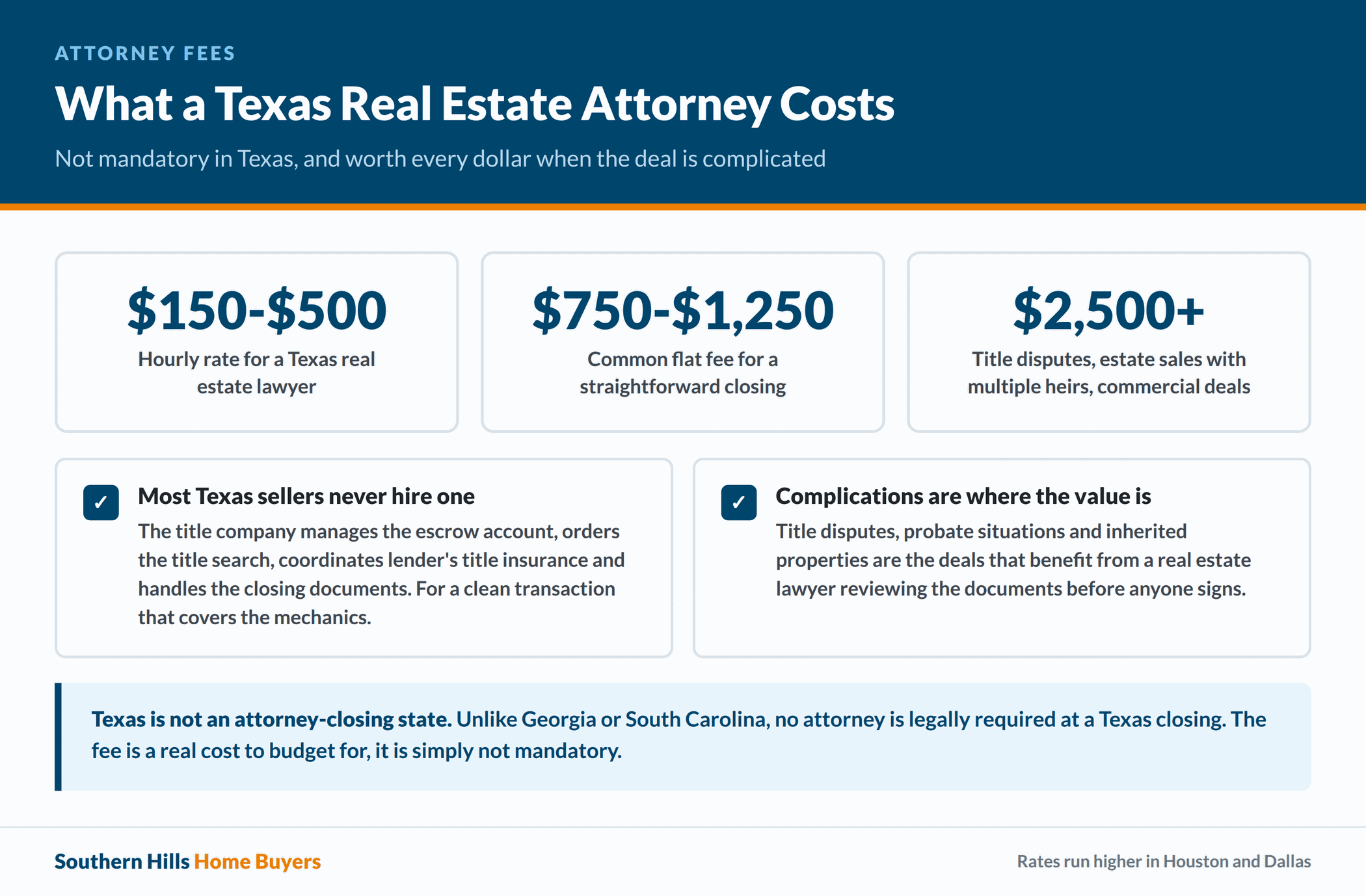
A closing tangled up in a title dispute, an estate sale with several heirs, or a commercial transaction can run $2,500 or more in legal fees. Once litigation enters the picture, you’re in hourly territory and the budget gets slippery.
One thing trips sellers up. Texas title companies handle much of the work attorneys handle elsewhere. The title company runs the escrow account, orders the title search, coordinates lender’s title insurance, and assembles the closing documents. That overlap explains why so many Texas sellers close without ever hiring a real estate lawyer. Ask any escrow officer in the Metroplex. A title company isn’t practicing law, but on a clean transaction they cover the mechanics. Attorney fees at closing are a real cost to budget for. They just aren’t mandatory here the way they are in attorney-closing states like Georgia or South Carolina.
How to Save on Closing Costs in Texas
Negotiating the closing costs beats chasing individual fee reductions, and most sellers never bother trying. It is worth the awkward conversation.
Closing fees in Texas aren’t usually the biggest expense for sellers. The real lever is finding a real estate professional who charges lower listing fees (our breakdown of closing costs without a realtor in Texas runs those numbers). That is where the leverage actually sits, and most people look right past it. Agent commissions on both sides of the transaction claim a large share of your sale price, which dwarfs most individual closing line items. Shave 1% off that commission and you save more than zeroing out the attorney fee entirely.
A few other moves are worth making. Shop several title companies, because Texas doesn’t mandate which title company you use, and pricing varies between firms. Ask whether the real estate attorney’s flat fee is negotiable before you engage them. Getting the fee arrangement in writing before you hire an attorney is a good habit regardless. On the lender side, buyers can shop loan origination fees and sometimes negotiate discount points, which saves real money at closing. Sellers can fold that into how they judge an offer.
Selling straight to a cash buyer skips the lender fee stack. Both sides can also dodge the title company’s full menu of charges. The net proceeds surprise people who’ve only run numbers on a traditional listing. Run both versions before you sign anything.
How Much Can You Afford When Buying a Home in Texas?
A buyer came to me once after falling for a house in Frisco. The offer looked solid and the price fit their budget. Then the closing disclosure landed and they were short. Nobody had walked them through the full cash-to-close number. That is a hard afternoon.
Buyers in Texas budget for more than the down payment. Buyer closing costs bundle mortgage-related costs: a loan origination fee, other lender-related fees, private mortgage insurance, the down payment, an appraisal fee, and a home inspection fee. Prepaid interest covers what accrues from the closing date through the end of that first month, and it comes due at closing. Property tax prorations mean you may owe a slice of the annual bill, depending on when in the year you close. An escrow account, set up by the lender to collect monthly tax and insurance payments, needs an upfront deposit of two to three months’ worth of those costs at closing. That number rattles most first-timers. None of it is optional.
The median sale price in Texas sits at $350,000 as of July 2026, with properties listed 63 days on average. At that price point, a buyer using conventional financing should realistically set aside 3% or more of the purchase price for closing costs, on top of the down payment. On a home at that price, that is another $10,500 to $17,500 sitting liquid and ready before the down payment is even touched. Buyers close to the edge on affordability often find a cash sale or a direct-buyer transaction cleaner, since the closing cost picture is simpler and faster. Liquidity beats a bigger number on paper.
I’ve worked with sellers in Denton, Mansfield, and Rockwall who assumed the only offer worth taking was a financed one at top dollar. Sometimes that holds. Other times the financing collapses in underwriting three weeks before closing, and the top-dollar offer has cost them more than a slightly lower cash offer would have. Running the real numbers matters. It takes ten minutes.
One couple I worked with in Carrollton was three months behind on their mortgage, with an auction date set for a Thursday. Nobody plans for a Thursday auction. They had a three-bedroom house and a workshop in the garage they’d built out themselves, a real labor-of-love property, and the payments had piled up after a job change. We moved fast because there was no lender on our end, no appraisal contingency, no waiting on underwriting. They walked away with enough to clear the debt and start over, which is genuinely the outcome I most want for someone in that spot. That is what a flexible closing timeline and a cash offer look like under real pressure.
If any of that sounds familiar, Southern Hills Home Buyers works with sellers across Texas who want a fast, plain closing without the traditional fee stack eating what’s left.
Frequently Asked Questions
Who Pays Attorney Fees at Closing in Texas?
In Texas each party generally covers their own attorney fees if they hire legal representation. The seller isn’t required to pay the buyer’s lawyer, and the buyer isn’t on the hook for the seller’s. Since Texas doesn’t mandate an attorney at closing, plenty of transactions carry no attorney fees at all, and a licensed title company handles the closing instead. When title complications or an estate situation show up, call your county’s bar referral service and find a real estate lawyer nearby.
How Much Are Closing Costs on a $400,000 House in Texas?
At the state average of about 3.26% for pure closing costs, excluding agent commissions, a $400,000 sale in Plano puts the seller’s closing cost burden near $13,000 before any commission enters the math. Add a buyer agent commission at the current average and total seller costs can reach $35,000 or more on a home at that price. Buyers using conventional financing should budget another $8,000 to $20,000 in closing costs and prepaid items on top of the down payment.
What Are Common Closing Cost Fees in Texas?
The most common closing cost fees in Texas include title search and transfer fees, owner’s title insurance, and lender’s title insurance paid by the buyer. Recording fees, escrow account setup, property tax prorations, and prepaid interest follow. So do appraisal fees, home inspection fees, and loan origination charges. Sellers also pay the real estate agent commissions, which make up the largest share of their out-of-pocket costs. Attorney fees are optional in Texas, though they show up when either party retains a real estate lawyer for contract review or closing oversight.
If you want to know what you’d actually net from selling your Texas home, once attorney fees and title costs and the rest come off the top, we’ll run those numbers with you. No obligation. No pressure. Just a straight conversation about your situation and your options. Reach out to Southern Hills Home Buyers whenever you’re ready.
Closing Costs Across the Dallas-Fort Worth Metroplex
The Metroplex sits above the statewide median, which changes the arithmetic. As of July 2026 the median listing price across the Dallas-Fort Worth-Arlington metro ran about $439,000, with a median of roughly 54 days on market, according to Federal Reserve Economic Data. Every percentage point above counts for more here than it does against the Texas median. That is why sellers in DFW should run their net proceeds before they accept an offer, not after.
We close on houses throughout the Metroplex and cover the costs a traditional sale would push onto you. When the property sits inside the city limits, we’re the cash home buyers in Dallas local title officers already know. We also buy in Fort Worth, Plano, Irving, Garland and McKinney.
Want To Know What You Would Actually Net?
Trying to work out what a sale leaves in your pocket after title fees, commissions, prorations and the rest? That conversation happens here every week, and it costs you nothing. Southern Hills Home Buyers has closed on properties across the Dallas-Fort Worth Metroplex carrying title problems, probate gaps, unpaid taxes and liens, and we’ll tell you plainly what we see. Our page on how Southern Hills Home Buyers works walks through the process end to end, and you can read other frequent questions here.
Ready when you are. Reach out to Southern Hills Home Buyers or fill out the form below, and we’ll come back with a straight answer, usually the same day.
Get Cash For Your Texas House Today

Author: Brandon Beatty
Brandon Beatty’s passion is buying income producing properties and building businesses. He focuses on buying houses and small multi family buildings in Texas that have an opportunity to add value through proper management and renovations while helping property owners sell quickly and without the hassles of a traditional sale.
Brandon is the founder of Southern Hills Home Buyers and has been featured on real estate news sites, including Zillow, Redfin, Realtor.com, HomeLight, List With Clever, Offerpad, and OpenDoor.