


You kept making the payments. Both of them. The old mortgage on the house in Rockwall and the rent on the apartment you moved into after the job change. A couple I worked with did exactly that for almost a year, grinding through two housing costs because they couldn’t figure out how to exit a home worth less than what they owed. They’d bought in early 2022, right at the peak, and by early last year the math had flipped on them completely. We walked through their garage on a Tuesday afternoon, still stacked with boxes nobody had unpacked since the move, a detail I’ve seen in nearly every overleveraged house. That garage is where we started untangling it.
If that’s where you are right now, this article is for you.
What It Means to Be Underwater on Your Mortgage in Texas
Negative equity is not a character flaw. It’s arithmetic. You bought at one price, values moved against you, and the payoff on your loan now sits higher than what a buyer would actually hand you at closing. That difference is your negative equity position. More Texas homeowners are staring at that number than at any point in the last several years, and the gap is usually bigger than they expect.
Elsewhere in the state the picture is already ugly. San Antonio came in at 8.8% negative equity and Austin at 9.2% in data compiled through late 2025, so roughly one in eleven mortgaged homeowners there owed more than the property was worth. Zip codes like 78704 and 78250 aren’t abstractions. They’re neighbors.
Over 90 percent of homeowners currently underwater on their mortgages took out loans within the past three and a half years, according to ICE’s Mortgage Monitor report. The problem sits almost entirely with buyers who closed between 2022 and 2025, usually with smaller down payments at prices near the top. First-time buyers who stretched to get into the newer subdivisions around McKinney and the outer Collin County suburbs are feeling it hardest, which makes sense given how little equity they started with.
Being underwater doesn’t automatically mean foreclosure is coming, but it does close off the most obvious exit. You can’t just list the house, sell it, pay off the lender, and walk away with a check. Your lender has to be part of the conversation one way or another, so you’re negotiating with your lender on top of negotiating with a buyer. Knowing that early keeps you from burning months on strategies your numbers won’t support, and it leaves room to keep a foreclosure from starting.
How to Calculate Your Negative Equity Position Before You Act
A seller I worked with had been running on a rough guess for months. She figured she was about $18,000 underwater. When we finally pulled the real numbers together, the gap was closer to $40,000, and that changed everything we could realistically pursue. The difference mattered because it changed which options were actually open to her.
Your starting point is a current market value estimate, not what Zillow says and not what your neighbor got two years ago. Order a formal appraisal or ask a local agent who actively sells in your specific neighborhood for a comparative market analysis. Statewide, the median home price in Texas was $340,000 in Q2 2026, but that figure blends Lubbock with Frisco and El Paso with Plano. Your home’s value is a street-by-street question rather than a statewide average, and I’ve watched two houses on the same block appraise thousands apart.
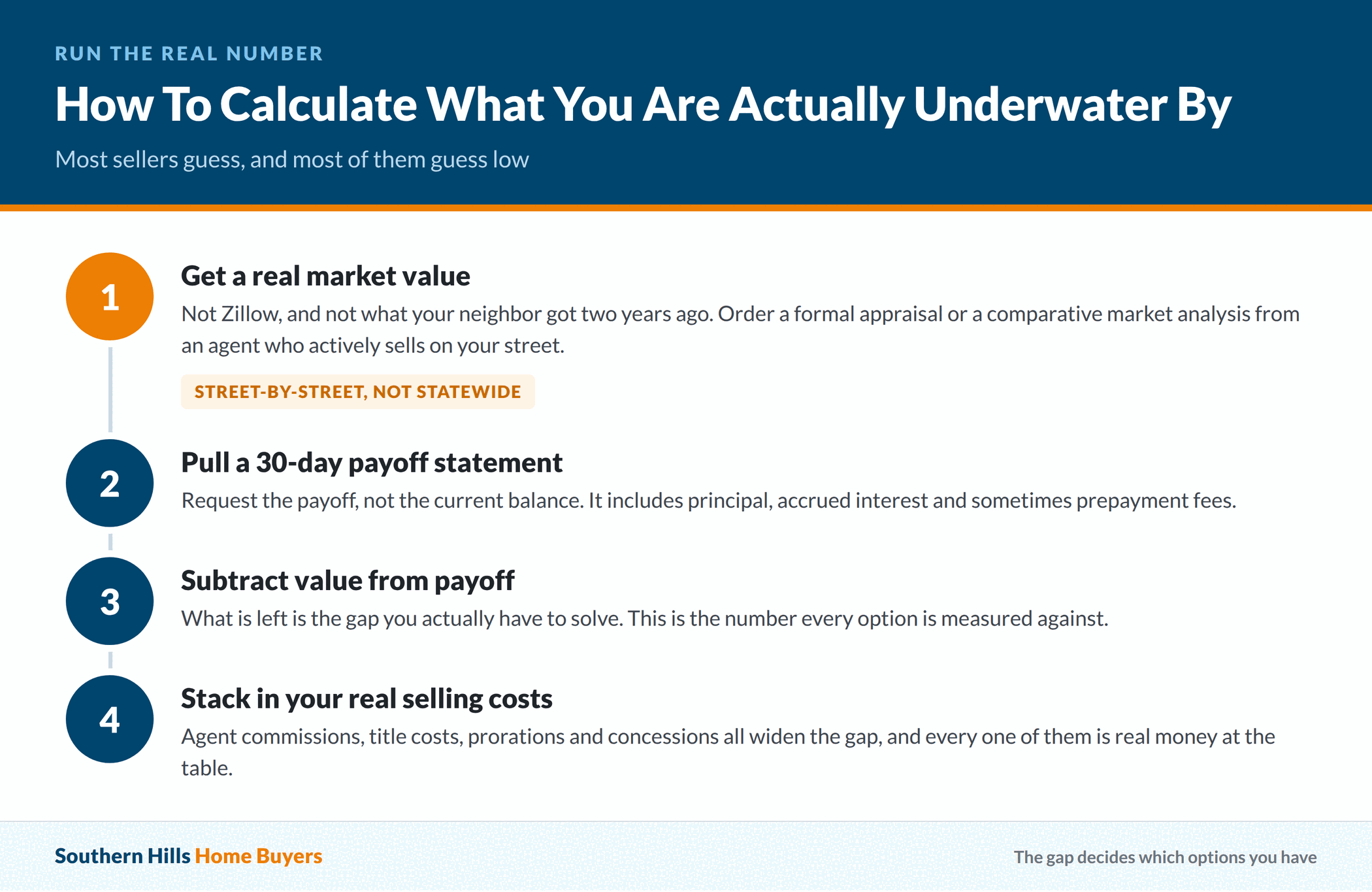
Once you have a realistic market value, pull your current mortgage payoff statement from the lender. That payoff figure includes principal, accrued interest, and sometimes prepayment fees, so request a 30-day payoff rather than a current balance. Subtract the market value from the payoff. What’s left is the gap you have to solve.
From there, stack in your real selling costs. Agent commissions typically run 5 to 6 percent of the sale price. Add title fees, any repairs a buyer will demand, and the concessions you may end up covering at closing. With 30.3% of listings carrying price reductions and homes selling at a 97.1% sale-to-list ratio as of early 2026, buyers are negotiating hard. Set money aside for that. Once every real cost is counted, your true shortfall usually runs bigger than the equity gap alone.
Texas Regions Where Negative Equity Is Rising the Fastest
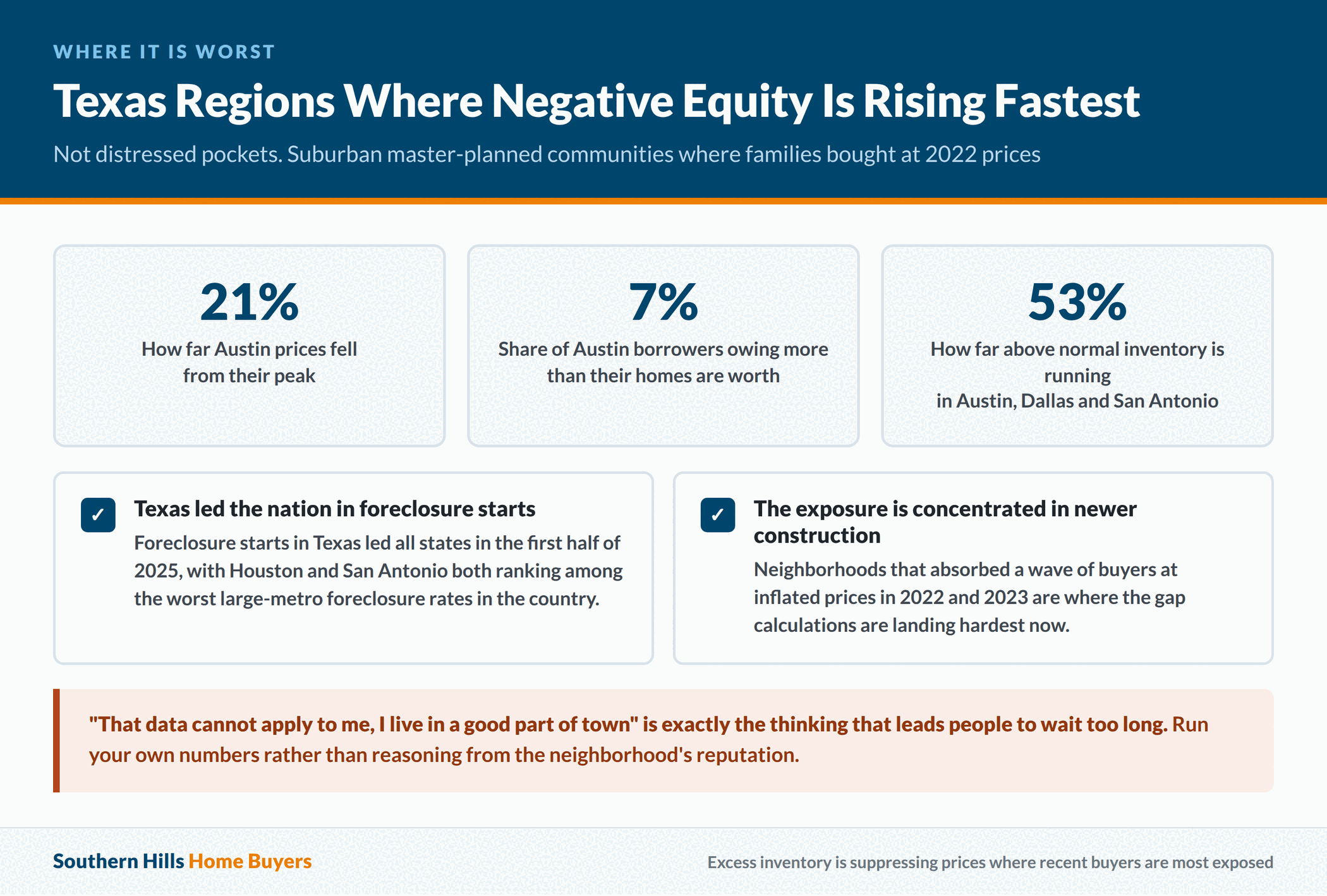
A seller once told me the data couldn’t possibly apply to her because she lived in a good part of town. That’s the thinking that leads people to wait too long. The neighborhoods carrying the most negative equity right now aren’t distressed pockets. They’re suburban master-planned communities where families bought new construction at 2022 prices.
Foreclosure starts in Texas led all states in the first half of 2025, and inventory in Dallas and other large metros has been running 53% above normal levels. Excess inventory suppresses prices in exactly the places where recent buyers are most exposed, the ones who stretched to close in 2022 and 2023. Sellers in those subdivisions have the least cushion when values slip.
The deepest market correction in the state hit Central Texas, where prices fell 21 percent from their peak and 7 percent of borrowers now owe more than their homes are worth. That’s nearly one in fourteen mortgaged properties in a metro that size. The Metroplex hasn’t fallen as far, and the same wave of buyers landed here. Subdivisions in Frisco and across northern Collin County filled up at inflated prices, and those buyers are running gap math they never planned for.
Up here the damage looks quieter, and it’s every bit as real. New construction poured into Denton County and the far edges of Collin County between 2021 and 2023. Many of those houses are now worth less than the original purchase price plus closing costs. If your home sits in one of those corridors, the market isn’t going to bail you out fast, and waiting another year won’t move the math much.
Can You Sell a Texas Home When You Owe More Than It Is Worth
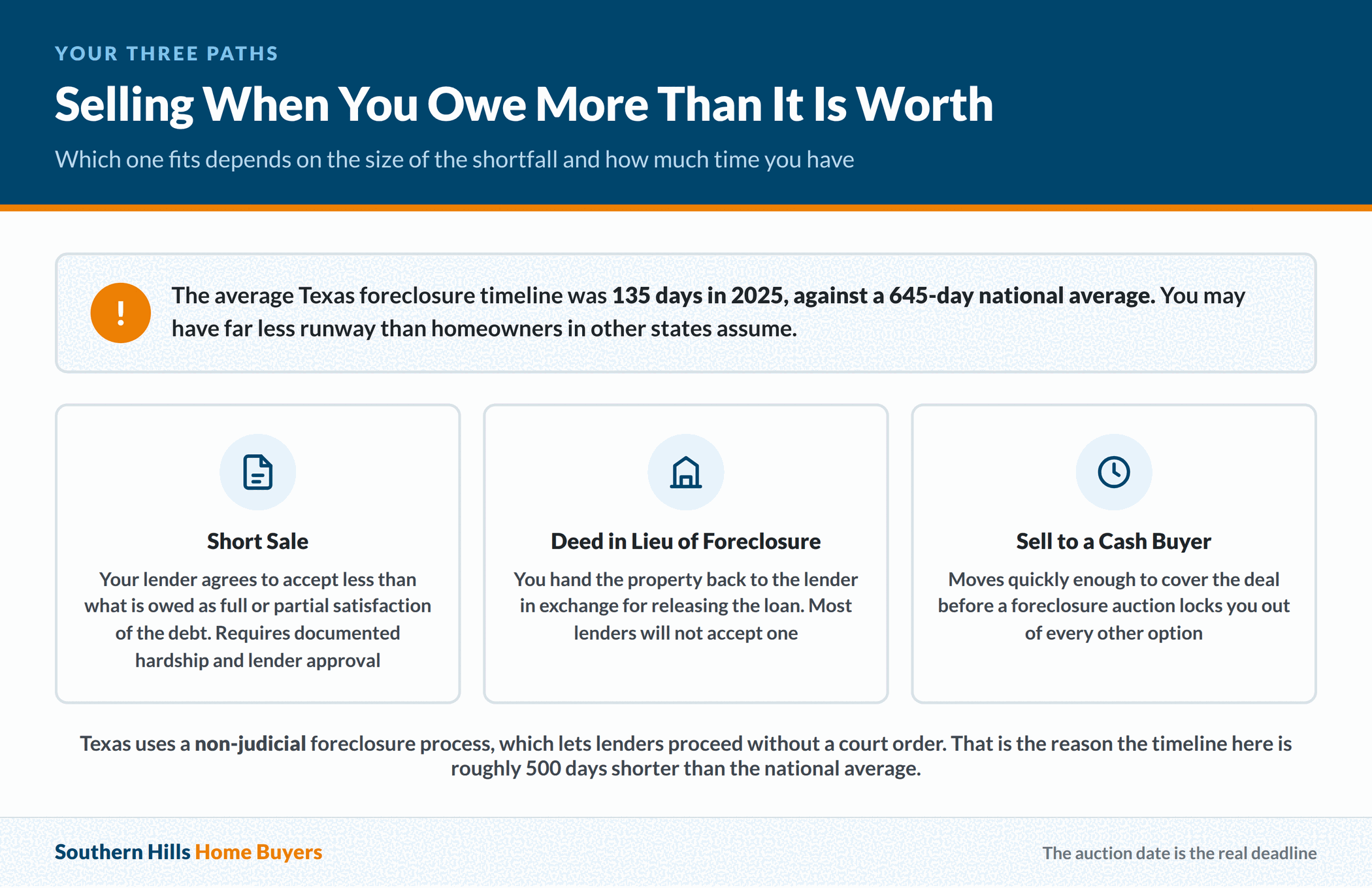
Trying to sell an underwater home without a plan costs you time you often don’t have. Texas uses a non-judicial foreclosure process, which lets a lender proceed without a court order. The average foreclosure timeline in Texas was 135 days in 2025, against a 645-day national average. You may have far less runway than homeowners in other states assume, and that gap of over 500 days is not theoretical.
Yes, you can sell. How you sell depends on the size of the shortfall and the time you have left. Three real paths exist for most underwater sellers in Texas.
A short sale is the first option. Your lender agrees to accept less than what’s owed as full or partial satisfaction of the debt. A deed in lieu of foreclosure is the second option, where you hand the property back to the lender in exchange for releasing the loan. The third is selling to a cash buyer who can move quickly and close before a foreclosure auction locks you out. That auction date is the real deadline.
Do you know exactly which path fits your situation? Sellers I talk to think they do, and most are wrong about at least one major detail. The gap size, the loan type, your lender’s policies, and the time you have left all decide which option makes sense. Getting that wrong is expensive.
Talking to a local buyer like Southern Hills Home Buyers early in this process helps you run the numbers honestly, before a deadline is doing your thinking for you.
How a Short Sale Works in Texas When You Are Underwater
That path doesn’t start with finding a buyer. It starts with your lender.
The lender has to approve the transaction, and you have to document a legitimate hardship. Unlike a foreclosure, a short sale is started by the homeowner and requires proof of financial distress. Job loss, divorce, a medical event, relocation, income reduction. Lenders want paperwork: bank statements, tax returns, a hardship letter, a recent appraisal, and a proposed purchase contract. Get the appraisal ordered early.
Once the package is in, the lender’s loss mitigation team reviews it. Short sales require patience. Approvals can take several months. During that wait the foreclosure clock in Texas keeps running, so you’re racing two deadlines at once. A Texas short sale can have two active clocks: the lender approval deadline and the final closing timeline. Approval is a milestone, not a finish line. The file still has to close before that approval expires, and a short sale is not the same event as a foreclosure.
On the liability side, don’t assume a short sale wipes out your debt. Texas permits deficiency judgments after short sales. The lender isn’t required to waive deficiency rights as a condition of approving a short sale, though many approval letters do include a deficiency waiver. Get that waiver in writing, negotiated into the approval letter before you sign anything. A real estate attorney or a HUD-approved housing counselor can help you push for that language. Free housing counselors are available through the HUD hotline at 1-800-569-4287, as listed at americandefault.org.
Deed in Lieu of Foreclosure vs Loan Modification in Texas
Many sellers arrive thinking a deed in lieu of foreclosure is a quick clean escape, then learn their lender won’t accept one. The handshake version sounds simple. You give the bank the keys, the bank cancels the debt. Reality has more friction than that.
Most mortgage companies will not accept a deed in lieu of foreclosure. If you owe money to a mortgage company, a deed in lieu is rarely an option. Lenders worry about subordinate liens, title complications, and their own internal policies. For a deed in lieu to move forward, title usually has to be clean, meaning no second mortgages, no judgment liens, and no unpaid property taxes clouding the transfer.
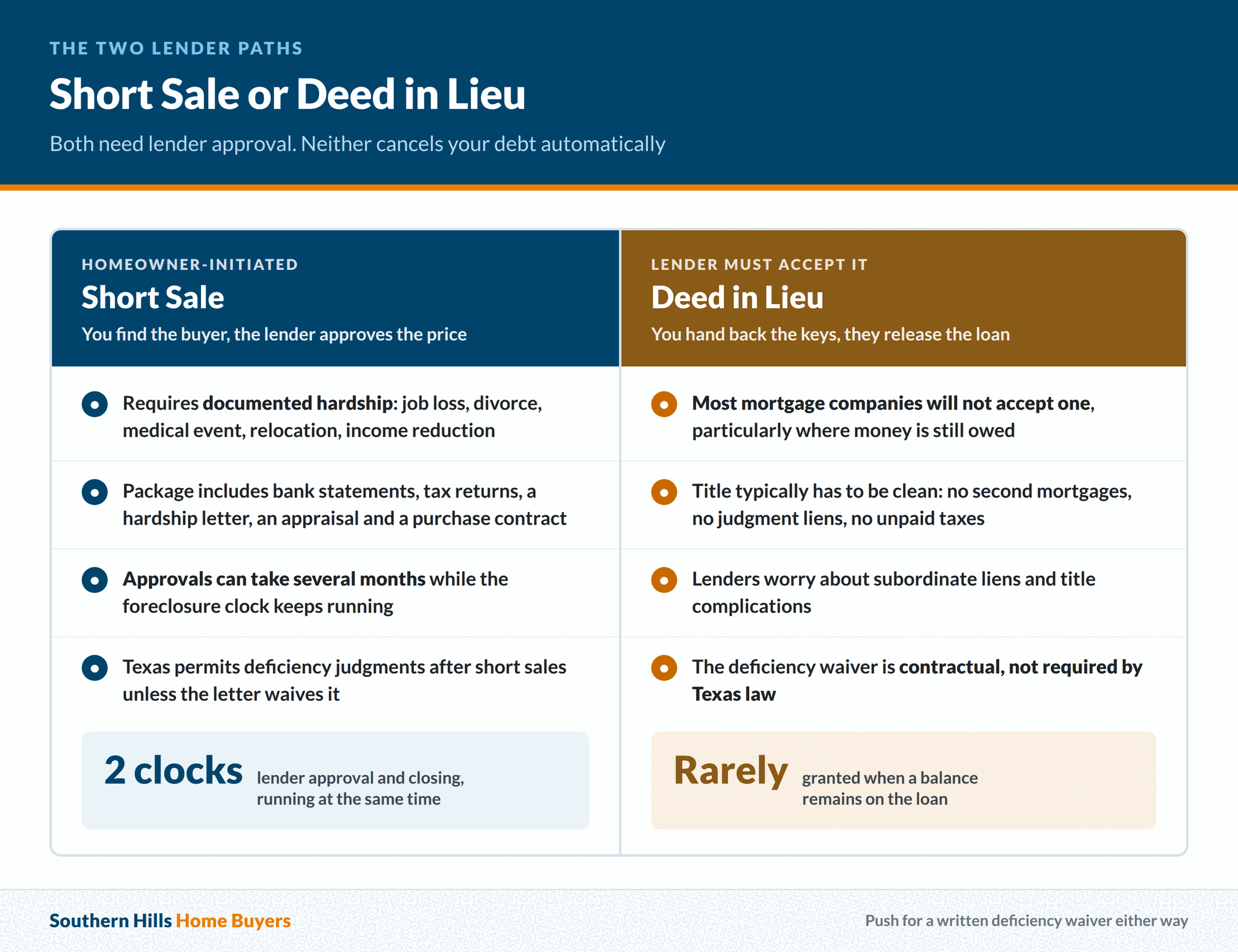
A deed-in-lieu agreement often includes a deficiency waiver, but that waiver is contractual, not something Texas law requires. Push for it the same way you would in a short sale. Without a written waiver, you could hand over the property and still face collection on the remaining mortgage debt.
Loan modification is a different tool entirely. Rather than exiting the property, you’re asking your lender to restructure what you owe, lower the interest rate, extend the term, or in rare cases reduce the principal. Texas Law Help recommends talking with your lender about a payment plan, a temporary forbearance, or a loan modification as early steps before things escalate. Forbearance can pause payments while you regroup, which keeps you from making permanent decisions during the worst month of a hardship. Modification is permanent restructuring. Neither one solves negative equity by itself, though both can buy time if your hardship is temporary. A Texas-licensed real estate attorney can review which of these options your loan servicer has to consider before moving to foreclosure.
Should You Rent Out the Home Until Equity Recovers
Sit across from me at a kitchen table and say you’re thinking about renting the house until prices recover, and I’ll ask two things. How long are you prepared to wait? Can you afford to be a landlord while you wait?
Renting sounds like a sensible holding strategy, and sometimes it is. The Texas rental market has its own headwinds right now. More inventory and more competition from new apartment communities around Lewisville, Mansfield, and north Fort Worth mean rental income may not cover your full mortgage payment, taxes, insurance, and maintenance. When the rent check doesn’t cover debt service, you haven’t solved the problem. You’ve deferred it and added landlord liability on top.
A woman I helped settle her father’s estate in Mesquite landed in exactly this spot. Her father had rented the home to a tenant who left midway through the lease. By the time she called me on a Thursday, there was yard equipment abandoned in the garage, a leaky water heater nobody had budgeted for, and an auction date already on the calendar. She was three months behind on the mortgage and thought renting had bought her time. What it bought was a longer fall.
Refinancing is worth exploring if your credit score has held up and rates shift favorably, though refinancing an underwater property is hard. Most lenders won’t write a new loan where the balance exceeds current market value. The Consumer Financial Protection Bureau outlines loss mitigation options worth reading if you’re weighing every angle.
If renting genuinely pencils out after you run the real numbers, vacancy months and repair reserves included, it may buy time for equity to recover. Base that decision on math instead of hope. And if the market data above says anything, it’s that a quick rebound isn’t guaranteed anywhere in the state. Southern Hills Home Buyers works with sellers in exactly these situations and can help you weigh the rent-and-hold math honestly against a clean exit.
Frequently Asked Questions
Can I Sell My House If I Owe More Than It’s Worth?
You can sell, but not the traditional way without your lender’s involvement. A short sale requires the bank to approve the transaction and accept less than the full payoff. A cash buyer may also be able to work with you on creative structures depending on the size of the gap. The first step is knowing your actual shortfall before you choose a route.
What Happens If I Sell My House but Still Owe Money After Closing?
If the sale price doesn’t cover your full mortgage payoff, the remaining balance is called a deficiency. In Texas your lender can pursue a deficiency judgment, but under Texas Property Code Section 51.003 the lawsuit has to be filed within two years of the foreclosure or short sale. Negotiating a written deficiency waiver into your short sale approval letter or deed-in-lieu agreement is the strongest protection you have. Always have an attorney review the approval terms before you sign.
What Can I Do If My House Is Worth Less Than I Owe?
Your realistic options are a short sale, a deed in lieu of foreclosure, or a loan modification or forbearance agreement with your lender. You can also sell to a cash buyer who closes before a foreclosure auction. Which one fits depends on your loan type, how far underwater you are, and how much time is left before your lender acts. Start by pulling your actual payoff figure and a current market value estimate, then set those against your timeline.
What Does Dave Ramsey Say About Selling Your House to Pay Off Debt?
Ramsey’s general position is that selling a home to clear mortgage debt is a sound decision when the numbers support it. Staying in a property you can’t afford, or can’t sell at a profit, is often worse than taking the short-term hit. The advice lines up with what most financial counselors tell distressed homeowners. Don’t let pride or inertia keep you in a losing position longer than you have to. His framework assumes positive equity, though. If you’re underwater, the short sale and deed-in-lieu options this article covers fill the gap his general advice leaves open.
If you want to talk through your options with someone who has actually bought houses in this situation across Texas, we’re here. No pressure and no obligation. Reach out to Southern Hills Home Buyers and let’s look at the real numbers together.
Underwater in the Dallas-Fort Worth Metroplex
DFW inventory running above normal is the same pressure showing up statewide, and it lands hardest on 2022 and 2023 buyers in the newer suburbs. As of July 2026 the median listing price across the Dallas-Fort Worth-Arlington metro was about $439,000, with a median of roughly 54 days on market, according to Federal Reserve Economic Data. Set 54 days plus a financed closing against a 135-day foreclosure timeline and the math on a traditional listing gets uncomfortable fast.
We buy underwater and near-underwater houses across the Metroplex, and we can work directly with your lender on a short sale when that’s the right path. If the property sits inside the city, we’re the cash home buyers in Dallas handling these every month. We also buy in Fort Worth, Frisco, McKinney, Princeton and Denton.
Find Out How Big the Gap Really Is
Most sellers we talk to are wrong about at least one number in this calculation, usually in the direction that hurts. We will look at the property, give you an honest value on it as it sits, and walk through what that means against your payoff. Then you can choose between a short sale, a deed in lieu, or a direct sale using real figures instead of estimates. Southern Hills Home Buyers has worked with homeowners across the Dallas-Fort Worth Metroplex at every stage of this. No pressure and no obligation. You can also read other frequent questions here.
Ready to get started? Reach out to Southern Hills Home Buyers or fill out the form below and we’ll get back to you with a straight answer, usually the same day.