

A house your family has owned for forty years can still need a judge’s sign-off before anyone can legally sell it. I’ve watched families lose months in the gap between “the deed has our family name on it” and “we can actually close a sale.” They miss chances. They spend money nobody budgeted. Heir property in Texas is real, it’s common, and the rules are specific enough that a wrong guess costs you.
Roughly one in thirteen property transfers in the United States now involves an inherited home. Texas probate rules pile on a layer of complexity that families in Texas routinely fail to anticipate. What follows walks through how heir property works, what the law actually requires, and what your real options are once you’re ready to sell.
Yes, Heir Property Can Be Sold in Texas, but the Path Matters
I used to think the hardest part of selling inherited property was finding a buyer. Wrong. Title is the real obstacle. You can line up a willing buyer, a fair price, and a signed contract, then watch the whole sale collapse at closing because the deed never properly transferred out of the deceased owner’s name.
A couple of years ago I worked with a family out of Garland whose mother had passed. She’d owned a modest three-bedroom on a quiet street in that part of Dallas County. The family had been paying the property taxes for nearly two years, figuring that was enough to establish ownership. It wasn’t. Paying the property taxes on a house never transfers title, and it never makes you the owner of record. When a buyer’s title company ran the search, the deed still showed the mother’s name. We helped them sort through a muniment of title filing before the sale could move forward. Four siblings all wanted different things that week. Grief makes people say things they later wish they could take back. The only reason it didn’t blow up completely was that somebody called an attorney early.
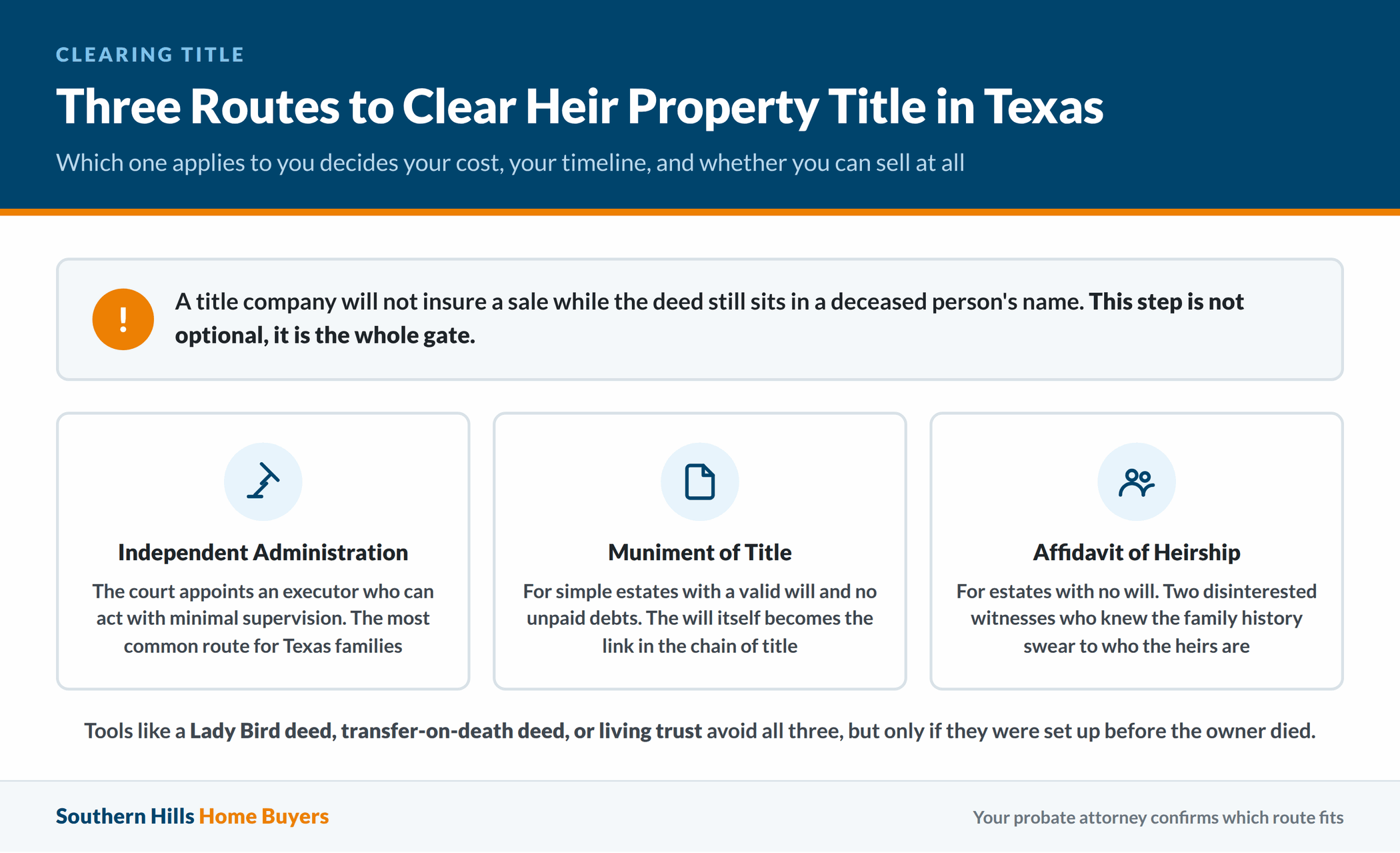
Texas law gives heirs several paths for handling inherited property. Independent administration is the most common. Muniment of title fits simple estates with a valid will and no unpaid debts. An affidavit of heirship covers estates with no will at all. Each path carries its own timeline, its own cost, and its own requirements. Cost matters here too, since each process carries its own filing fees and its own attorney time. Which one applies to you determines everything else.
Independent administration deserves a closer look, because most Texas families end up there. The court appoints an executor who acts with minimal court supervision. You don’t have to go back to the judge every time you pay a bill, sell an asset, or make a call about the house. That independence keeps the process manageable for families who’d rather not sit in a courtroom every few weeks. Dependent administration is the alternative, and it requires court approval at nearly every step. Judges reserve it for situations where the heirs can’t agree on an executor, or where creditor fights make close oversight necessary.
So the short answer is yes. Heir property can be sold in Texas. Whether it sells easily is a completely different question.
What Is Heir Property and How Does It Work in Texas?
Sellers often push back at the phrase “heir property” because they figure ownership is already settled. A will names them. Their mother signed paperwork. Somebody has lived in the house for years. That reading is fair enough, and it still sidesteps the legal reality a Texas court cares about. A title company will not take the family’s word for who owns the property.
Heir property is real estate that passes to family members after the owner dies, either under a will or under Texas intestacy law, without a complete legal transfer of title. The word “heir” just means somebody who inherits. Property turns into heir property the moment ownership is in question, or uncleaned title sits in the deceased person’s name, or several beneficiaries share undivided interests. That’s more common in Texas than most families expect. You see it constantly in older neighborhoods like South Dallas, in east Fort Worth, in older parts of Mesquite, and in rural East Texas communities where houses passed informally for generations. Heir property shows up in every price bracket, from a small rental to a paid-off family home.
That informal pattern runs deepest in communities where getting to a lawyer was hard or flat out impossible. A grandparent dies. The family stays in the house. Somebody pays the property taxes, and thirty years go by with nothing filed anywhere. By the time a third generation wants to sell, the chain of title may run through two or three deceased owners, none of whom went through probate. Untangling it means tracing heirs across several generations, finding people who have no idea they hold a legal interest, and sometimes handling heirs who’ve died themselves along the way. It’s a solvable problem. Each missing heir adds cost and adds weeks to the process. It is not a quick one.
A Transfer on Death Deed, a Lady Bird Deed, joint tenancy, a revocable living trust, or an affidavit of heirship can move title without full probate. Each one only helps if it was already in place before the owner died. When none of them exist, the property sits frozen until the estate goes through some court process. That’s the baseline every heir starts from.
Even a will that says “I leave my house to my son” carries no legal force until a court validates it and grants somebody, usually an executor, authority to transfer title. Title companies and lenders accept nothing less. With no will at all, things get messier, because Texas intestacy law takes over and splits ownership among surviving relatives by statutory formula. That formula doesn’t always match what the family assumed. Under Texas intestacy rules, a surviving spouse does not automatically inherit everything when children from an earlier relationship are in the picture. Those children may hold a legal interest in the property even if the spouse has lived there for years and believed she owned all of it.
How Texas Inheritance Laws Define Tenants in Common Vs. Joint Ownership
Does every co-owner have to sign before a sale can close? That depends entirely on the kind of ownership you hold. Co-ownership isn’t one thing in Texas, and the form yours takes decides whether the sale needs everybody’s signature.
When property passes to several heirs in Texas and no deed says otherwise, those heirs usually land as tenants in common. Each one owns a share, described as an “undivided interest,” but nobody holds a specific room or a specific corner of the lot. Owning an undivided interest means you legally own a percentage of the whole. Every heir on the property holds an interest in all of it, not a slice of the lot. Two siblings who each inherit half of an Arlington bungalow both have full rights to use the entire property. Neither one can sell a half share to an outside party without complications, and title companies flag that arrangement immediately.
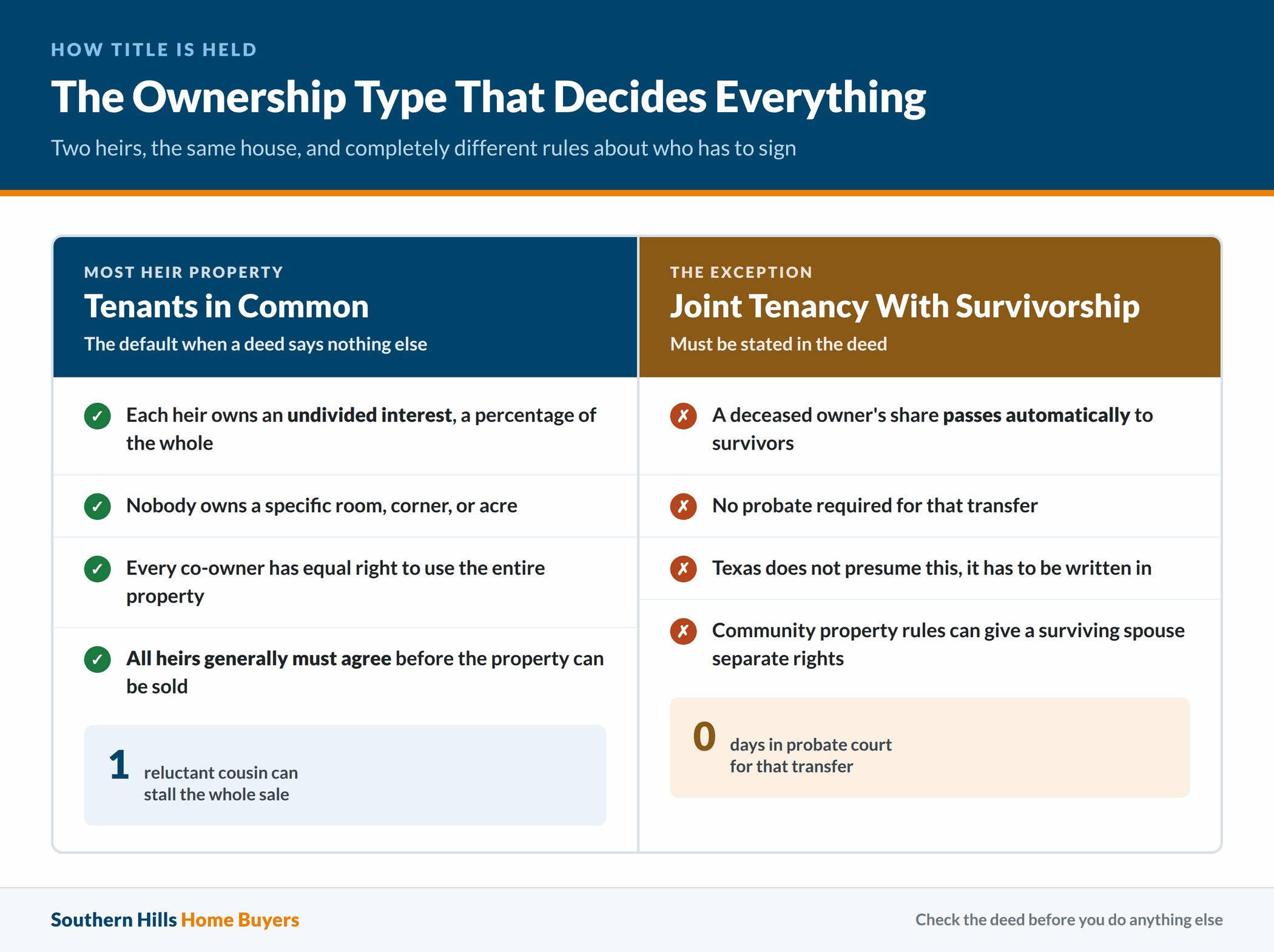
Pay attention to that word “complications.” A tenant in common technically can sell or transfer a partial interest without asking the other co-owners. Finding somebody willing to buy a fractional undivided interest in a single-family home is close to impossible. Most buyers want the whole house, not a percentage of it shared with strangers. Most title companies won’t insure a sale of a fractional interest without clear documentation of the full ownership picture, and I’ve run into that wall more than once. The legal right to transfer exists. The practical market for it barely does.
Joint tenancy with right of survivorship works differently. When one co-owner dies under that arrangement, the share passes automatically to the survivors and skips probate entirely. Texas is also a community property state, so spouses own most income, assets, and debts acquired during the marriage equally. Community property status matters here. A surviving spouse in Texas often holds specific rights to the marital home that override what a will says or what other heirs assume. Community property rules can also shift who has to sign the listing agreement.
In Texas, all heirs generally must agree to sell an inherited property if they own it as tenants in common. The rule sounds simple until five cousins scattered across Denton, Rockwall, and Dallas each hold a small share and haven’t spoken in years. One reluctant heir stops the whole transaction cold. This isn’t an edge case. Heirs who never speak still control the property, and no court will force a conversation. It’s a pattern I see constantly, and Texas law does provide a remedy when agreement breaks down. We’ll get to that shortly.
How the Probate Process Works for Inherited Property in Texas
Most families walk in expecting probate to be a rubber stamp. You file, a judge signs, you’re done in a few weeks. Reality rarely cooperates.
Probate is the legal process where a probate court validates a will and makes sure assets get distributed under the Texas Estates Code. The court identifies heirs, confirms title isn’t clouded, checks that debts are paid, and oversees what’s left. All of that takes time. Probate in Texas often runs a year, longer in contested estates, and that timeline can wreck a planned sale.
County makes a real difference. Dallas County, Tarrant County, and Collin County all run dedicated probate courts with experienced judges and reasonably efficient dockets. Smaller counties handle probate alongside a regular civil caseload, and they can move slowly. A straightforward independent administration in a big urban county might wrap in six to nine months. The same case in a rural county can stretch to eighteen months or more, especially if the estate holds real property in several counties. Each county needs its own ancillary proceeding. Property in two counties means two processes and twice the paperwork. There are no shortcuts on that.
At the first hearing, the court admits the will to probate and appoints the executor. That executor receives Letters Testamentary, the documents that authorize action on behalf of the estate. Texas then requires an inventory of every asset, real estate included, plus notice to any known creditors. Creditors get a statutory window, and the executor cannot rush that part of the process. Only after creditors have had their window and debts are settled can the executor move toward transferring the deed.
Estates with no unpaid debts and a valid will get a shorter route called muniment of title. The court admits the will as a muniment, which becomes a link in the chain of title, and no executor gets appointed. That can run from filing to court order in as little as 30 days. Attorney fees and court costs land somewhere around $1,500 to $3,000. It won’t work if the estate still needs active administration.
With no will, an affidavit of heirship becomes an option for establishing who the legal heirs are. Two disinterested witnesses have to sign it, people who knew the decedent and the family history for a long stretch, often ten years or more. After notarization it gets filed in the deed records of the county where the property sits, and filing fees start at $15 for the first page. A five-year seasoning rule matters here too. Under Texas Estates Code Section 203.001, an affidavit of heirship on file in the deed records for more than five years serves as prima facie evidence of the facts stated in it. Before those five years run, many title companies won’t rely on it alone to insure a sale. Some will insure over a recent affidavit if they can get an indemnity agreement, or if the heirs agree to buy an enhanced owner’s title policy. That’s a negotiation, not a guarantee. It comes down to the individual underwriter.
Can You Sell Inherited Property While It Is Still in Probate in Texas?
Selling before probate wraps up can unravel a transaction completely. Get precise about where you stand before you ever put a sign in the yard.
During probate, everything the deceased person owned stays part of the estate until the case closes. That sharply limits your ability to transfer ownership or sell the house outright. Living in the house while probate runs is usually fine. Selling it is another matter. Title companies won’t insure a transaction without clear authority to sell, and most financed buyers won’t close without title insurance. A cash buyer has more flexibility. Even then, unresolved probate on a title creates genuine risk that careful buyers refuse to take. Heirs who list a property mid-probate often lose the buyer and the earnest money.
If the estate has an independent executor appointed under the Texas Estates Code, that executor can sell property without heir approval, but only inside the scope of authority the probate court granted. That distinction matters more than people expect. An executor’s power to sell exists to satisfy estate debts, cover estate expenses, or carry out specific instructions in the will. Selling the house to split cash among heirs while the estate is still open may need a court order.
The practical answer is to get an estate attorney involved before you list. I’ve watched what happens when families skip that step. A buyer walks a week before closing because the title company flagged a problem that should have surfaced in month one. Everybody loses time, money, and goodwill. For a straightforward independent administration in Texas, attorney fees for the estate work run between $2,500 and $7,500, depending on how complicated the estate is and what the attorney charges by the hour. Real money, sure. Far cheaper than a failed closing or a partition suit. Estate attorneys who handle heir property daily spot the title gap in the first week.
Not sure whether your estate is technically still open? The county probate court clerk can tell you where the case stands. That’s a free phone call, and it’s worth making early.
How to Sell Inherited Property After Probate Is Closed in Texas
Once probate closes and the deed carries the right name or names, selling inherited property looks a lot like selling any other house in Texas. A few things still catch sellers off guard.
The executor or administrator has to record a deed of distribution in the county where the property sits. Once debts are handled and the court gives a green light, the executor drafts that deed and transfers the property to the rightful heir or beneficiary. It gets recorded with the county clerk’s office, and only then does ownership officially move. Recording the deed of distribution is the last court step in the process. Without the recorded deed there’s no clean chain of title, and the transaction stalls.
After recording, the heir or heirs can sell whichever way suits them. Listing with a realtor is the obvious route, though it isn’t always the fastest or the most practical one. As of June 2026, the median home sale price in Texas was $347,911, and the median days on market was 69 days. For a family carrying grief, coordinating from out of state, and holding a house that needs work, months on the market feel very long. Meanwhile the estate keeps paying. Property taxes in Texas rank among the highest in the nation, averaging around 1.6 percent of assessed value each year. A home at the statewide median piles up roughly $460 per month in tax alone. That’s before insurance, utilities, or a single repair. Carrying costs on an empty property keep running while the listing sits. Worth holding in your head when you compare a quick sale against a longer listing.
That’s one reason families call us at Southern Hills Home Buyers. A direct sale can close in weeks. No repairs, no showings, no waiting around.
Condition matters too. Plenty of inherited homes in Texas, especially older houses in Oak Cliff in Dallas or the aging streets of Grand Prairie, carry deferred maintenance that needs work before a traditional MLS listing makes sense. Selling as-is is a legitimate option, and heirs overlook it more than they should. Repairs on a fifty-year-old property compete with everything else the family is paying for.
Do All Heirs Have to Agree to Sell an Inherited Property in Texas?
A family in Rockwall came to us after a frustrating year. Their father had left a paid-off house to three adult children in roughly equal shares. Two wanted to sell right away. One wanted to rent it out and hold. The two who wanted out couldn’t move, the mortgage was long gone, the property taxes kept climbing, and nobody was happy. Three heirs, three opinions, and one property nobody could sell.
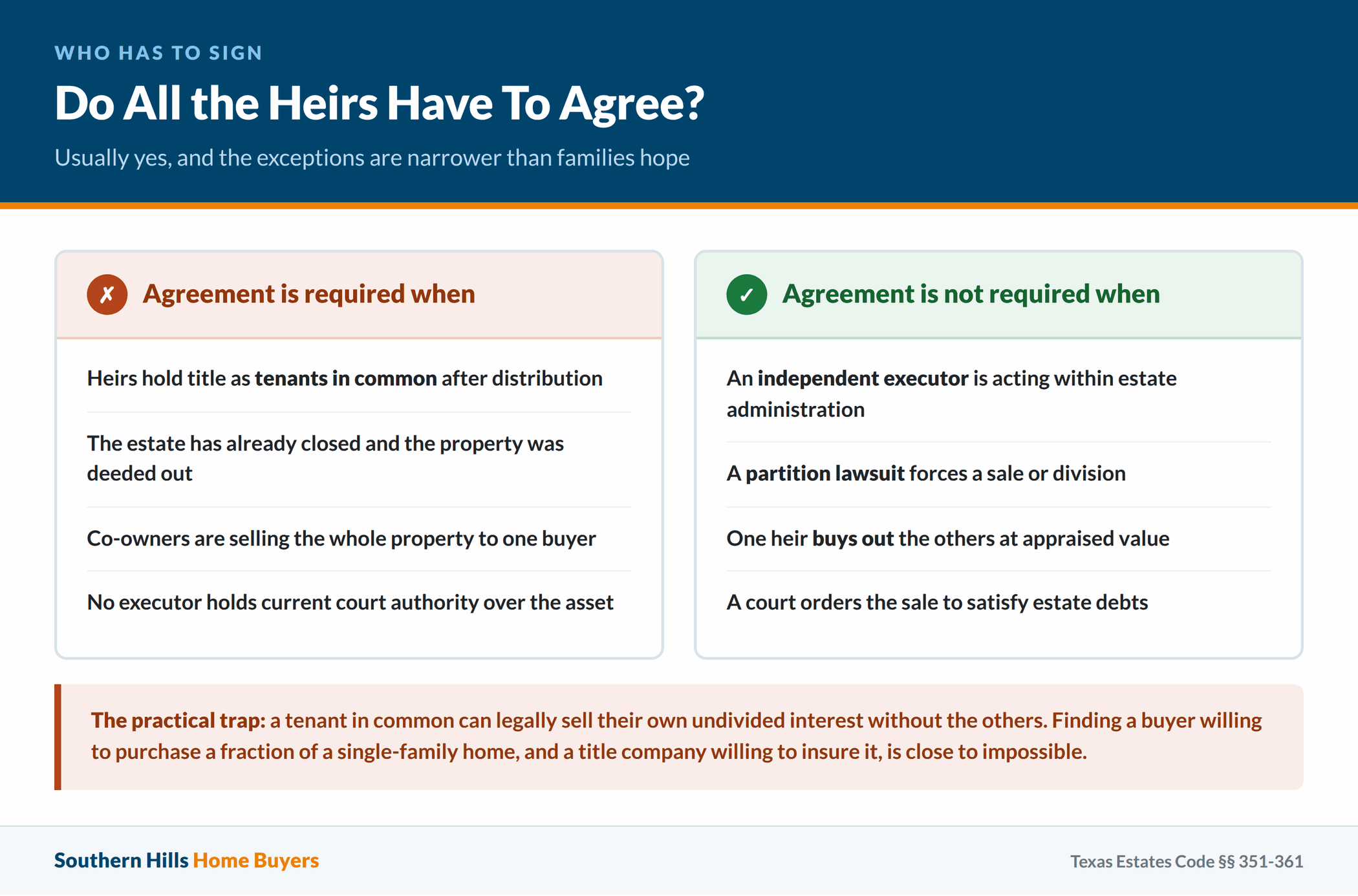
In Texas, all heirs generally must agree to sell an inherited property when they own it as tenants in common. That consensus requirement causes more delayed sales and more family conflict than anything else in inherited property. When everybody lines up, a sale moves smoothly. When one heir digs in, the rest are stuck. A single holdout can freeze a property for years.
Heirs who want to sell have to agree on the decision and then coordinate the whole process. That means agreeing on price, on terms, on which agent to use, and on how to handle repairs or condition discounts. Every one of those points is a place where a family already carrying grief can break apart. Selling with multiple owners gets easier when somebody brings in a mediator early, before positions harden. A skilled mediator in Texas charges between $150 and $300 per hour, and most heir property disputes that reach mediation settle in one half-day session. Compare that to a partition fight and the hourly rate stops feeling steep. Mediation costs a fraction of what a contested partition costs.
The exception worth knowing is the independent executor. An independent executor appointed under Texas Estates Code Section 351-361 can sell property without heir approval. That authority applies during estate administration, not after the property has been distributed to the heirs as co-owners. Estate administration and co-ownership are two different legal worlds. Once distribution happens and the heirs hold title as tenants in common, everyone has to agree, or somebody has to go to court.
Which brings us to what that court action actually looks like.
What Is a Cotenant Buyout and When Does It Apply in Texas?
One heir wants to keep the house. Can she buy the others out?
Yes, and it’s usually the cleanest fix when one co-owner has a genuine attachment to the family home and the rest just want their money. A cotenant buyout is what it sounds like. The heir who wants to keep the house buys out the ownership interests of the others. Price rides on fair market value, with an appraisal settling most disputes, and each heir takes a payout proportional to the share they hold.
A clean buyout takes a few things. First, everybody has to agree on what the house is worth, and an independent appraisal is the standard way to settle that. Money well spent. Second, the buying heir usually needs financing, since these aren’t small transactions. A house in the Kessler Park neighborhood of Dallas or out in Frisco can carry a value that requires a real mortgage. Third, the transaction needs proper documentation, a deed conveying the other heirs’ interests to the buying heir, recorded with the county clerk. Lenders treat a buyout like any other property loan and will want an appraisal.
When one heir genuinely can’t afford to buy the others out, a structured arrangement sometimes works, with the retaining heir paying the rest over time and interest accruing on the balance. That’s more complicated, and it really needs an attorney to structure so everybody’s interests stay protected. A missed payment, or no clear paperwork, turns a family agreement into a lawsuit faster than almost anything. The promissory note and deed of trust that formalize this kind of arrangement should spell out the payment schedule, the interest rate, and what happens on default. It should also say whether the retaining heir has to maintain the house and keep the taxes current. Vague handshake agreements between siblings rarely survive the first disagreement.
Absent a buyout, and with the heirs still unable to agree, partition is the harder path the law offers.
What Happens When Heirs Disagree and a Partition Sale Is Ordered in Texas?
Court-ordered partition sales eat money that should have reached the heirs. Anyone telling you otherwise hasn’t sat across a table from a family that lived through one.
Partition is the legal process for co-owners who cannot resolve their differences. In Texas, any co-owner can file a partition lawsuit asking the court to divide the property, even one holding the smallest slice. A single heir with a 10 percent interest can drag the other 90 percent into litigation just by filing, and courts have to take the filing seriously.
Texas recognizes two kinds of partition. The first, partition in kind, has the court physically divide land into separate tracts. Partition in kind suits large acreage and is nearly impossible for a single-family home, where dividing the property would gut its value. Partition by sale is the other route. The court orders the whole property sold, with proceeds split by each heir’s ownership share. For whoever wanted to keep the family home, a court-ordered sale is a bitter pill.
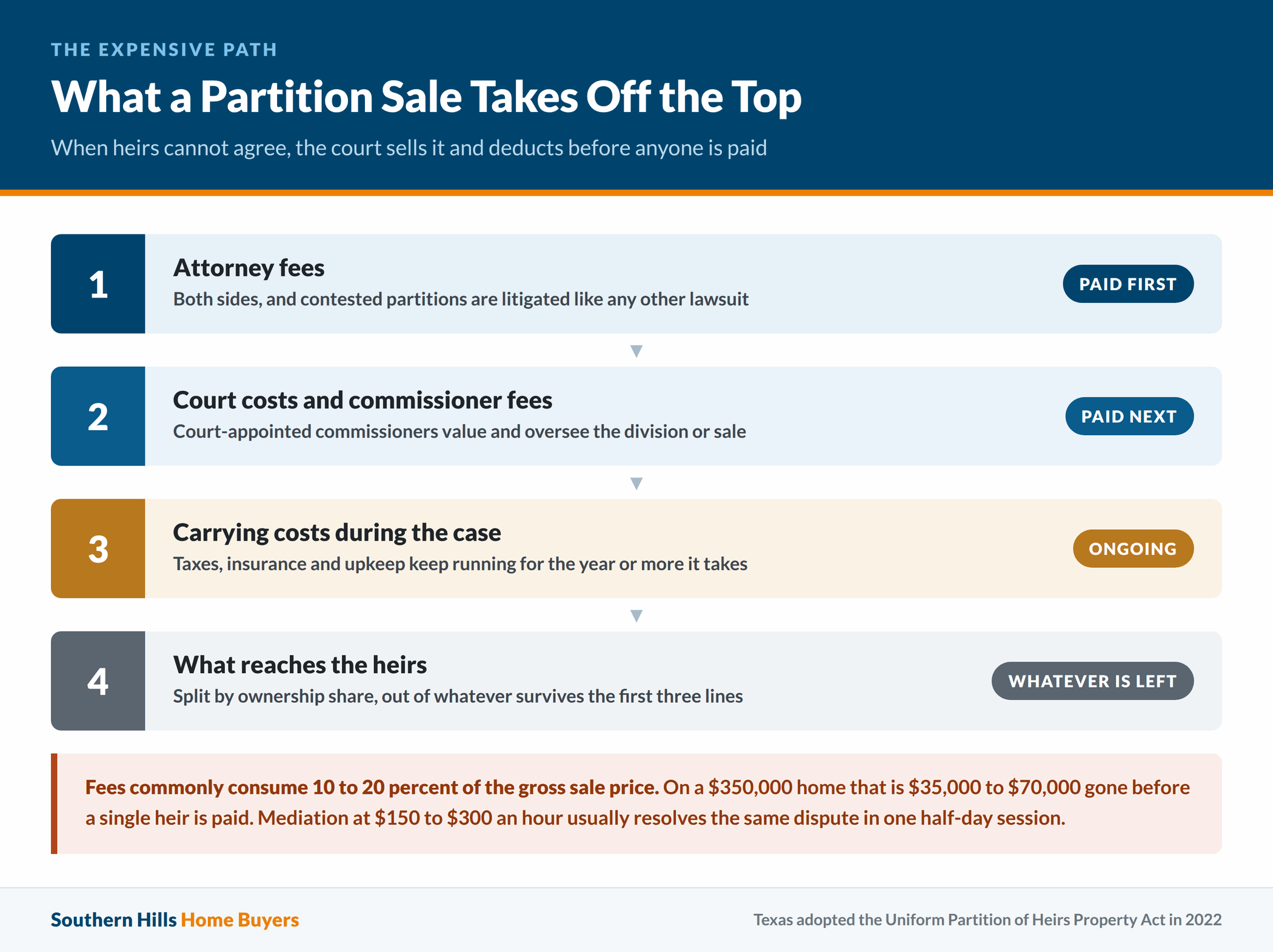
The court deducts sale costs first, including attorney fees, court costs, and commissioner fees. Those expenses can run between 10 and 20 percent of the gross sale price, which cuts straight into what reaches the heirs. Real money, gone. A $350,000 home going through partition can burn $35,000 to $70,000 in fees before a single heir sees a check. The process is slow, too. Litigation timelines in Texas vary by county, and contested partition suits routinely take over a year. All that time the property sits, still carrying costs, still exposed to a market nobody controls.
Texas passed the Uniform Partition of Heirs Property Act, which took effect in 2022 and added protections for heirs in partition proceedings. One of them is the right to buy out a co-owner who filed for partition, before the court orders a sale. That buyout right hands heirs one more chance to settle privately before a judge takes over. The Act treats heir property differently from ordinary co-owned property. It has to be exercised inside a specific window, at a price the court finds to be fair market value.
Reaching a private agreement, even an imperfect one, almost always leaves more money in everyone’s pocket. That’s not just my opinion. Any estate attorney in Texas will tell you the same thing. When a family is drifting toward partition and a direct buyer can step in with a fast, fair cash offer that everybody can live with, that outcome beats letting a court run the sale.
What Are the Tax Implications When You Sell Inherited Property in Texas?
Right behind the probate questions comes the tax anxiety. This is one area where Texas heirs hold a real advantage, and most of them don’t know it.
Texas collects no state inheritance tax, and most ordinary homes fall well under the federal estate tax threshold anyway. The federal estate tax exemption for 2025 sits at $13.61 million per individual, so the vast majority of Texas families owe nothing there either. The state has no income tax, which means no local capital gains bill on the sale. Stack those together and Texas heirs come out ahead of heirs in states with several layers of taxation.
Federal tax turns on the stepped-up basis rule, the single most powerful advantage available to an heir selling real estate. When you inherit, the IRS resets the cost basis to fair market value on the original owner’s date of death. Say your grandmother bought her house in Irving in 1971 for $30,000, and it was worth $280,000 the day she died. Your basis is $280,000. Sell for $285,000 six months later and you owe capital gains tax on the $5,000 difference, not on a quarter million dollars of appreciation that piled up across fifty years. Stepped-up basis is why inherited property rarely produces a large tax bill.
Inherited property counts as a long-term capital gain automatically, no matter how fast you sell. List the home and close two months after the owner’s passing and you still get the long-term treatment. Federal long-term rates currently sit at roughly 0%, 15%, or 20%, depending on total income. A married couple filing jointly with taxable income under about $94,050 would owe zero federal capital gains tax on a sale where the gain is small. That describes a large share of Texas heir property sales.
Get a qualified appraisal as close to the date of death as you can. Leaning on an outdated tax assessment or a listing service estimate produces a shaky baseline figure, and that creates IRS problems later. A licensed appraiser’s report is the documentation that holds up. Our guide on keeping capital gains tax down in Texas covers the rest.
How to Determine the Fair Market Value of Inherited Property in Texas
A seller in Mansfield reached out after listing a parent’s house at a price built on what a neighbor got two years earlier. That listing sat four months with no offers while the family’s frustration grew by the week.
Inherited homes need a fresh appraisal, not a guess. The Texas real estate market keeps shifting, and stale comparables mislead sellers in both directions. As of June 2026, a statewide median sale price tells you almost nothing about one specific house on one specific street. A home two blocks off a Plano cul-de-sac prices differently than the same floor plan in Waxahachie. Local conditions, condition of the house, lot size, and recent sales nearby drive the actual number. A house in a shifting neighborhood like South Dallas or west Fort Worth might beat its tax appraisal by a wide margin, and I’ve watched that gap surprise heirs. A rural property in a county losing population can be worth less. Two properties on the same street can appraise thirty thousand dollars apart.
An independent appraisal from a licensed Texas appraiser is the most reliable place to start. It does double duty. The appraisal establishes fair market value for the stepped-up basis calculation, and it gives the heirs a defensible number for negotiating among themselves or with a buyer. Licensed appraisers in Texas charge between $400 and $700 for a residential appraisal, more for larger homes, unusual properties, or rural spots where comparables are thin.
Comparative market analysis from a local realtor can supplement the appraisal, though agents have an interest in listing, and that sometimes nudges an estimate toward the optimistic. A cash offer from a direct buyer like Southern Hills Home Buyers reflects actual net proceeds, with no deductions for commission, staging, or carrying costs. That makes the comparison against a listing price more honest than it usually looks on paper.
Median days on market across Texas in 2025 was 67 days, and inherited homes that need updating tend to sit longer than that. Pricing accurately from day one, rather than aspirationally, separates the sales that close from the ones that drag. Every extra month on the market is another month of costs on the property.
What Are the Biggest Challenges of Selling Inherited Property in Texas?
Forty-one thousand active listings sat unsold across Texas in late 2025, and inherited properties are overrepresented in that number.
Condition is the most immediate challenge. Many inherited homes haven’t seen a real update in years, sometimes decades. A house kept up by a retiree on a fixed income in Denton may have plumbing from the 1970s, original single-pane windows, and a roof an inspector will flag on sight. Buyers using FHA or VA financing often can’t buy those properties at all until somebody addresses the issues. That leaves the heirs choosing between repairs they don’t want to fund and a much smaller buyer pool. Repair estimates for roof replacement, HVAC updates, and plumbing work reach $40,000 to $80,000, and coordinating contractors from out of state adds cost and complexity. A property that fails an FHA appraisal narrows your buyer pool overnight.
Managing an estate sale from a distance piles on another layer. More than half the heirs I’ve worked with don’t live near the property. They live in Plano while the house sits three hundred miles east, or they’re out of state entirely. Every showing, every contractor estimate, every utility bill needs coordinating from far away. That friction adds up, and it’s a main reason families end up selling for less than they’d have gotten with more time and less distance. Distance turns a simple property decision into a week of phone calls.
Title complications blindside sellers more often than anything else. I mentioned the Garland family earlier, and that story is far from rare. Unpaid liens, property tax delinquencies, old judgments against the deceased owner, and murky deed chains all have to clear before a sale can close. A title company will surface every one of them, but only after you’ve sunk time into a listing. Ordering a preliminary title report early, before you list, saves an enormous headache. A preliminary title search costs a few hundred dollars depending on the company and the county, which makes it one of the best investments a seller can make.
Family disagreements compound every other challenge. What one heir calls a reasonable price another calls leaving money on the table. What one heir calls a needed repair another calls a waste. Those tensions don’t dissolve on their own. They take honest conversations and sometimes a mediator or an attorney, which can run several hundred dollars. Sellers who treat the agreement process as seriously as the listing process do far better.
What Are Your Options for Selling Inherited Property in Texas?
For a long time I thought listing with a realtor was always right for inherited property, because the highest possible price looked like the obvious goal. Experience taught me that highest price and best outcome aren’t the same thing, especially once you count the time, the coordination, the repairs, and the family stress.
Heirs have three main options: a traditional sale through a licensed realtor, a for-sale-by-owner approach, or a direct cash sale to a buyer like Southern Hills Home Buyers. Each carries trade-offs.
A traditional listing gives you the widest buyer pool and, priced well, the highest gross sale price. Costs eat into that. Agent commissions, buyer concessions, inspection repair credits, and carrying costs across those 69 average days on market all reduce what you net. Texas buyer’s agent commissions are more explicitly negotiated now, after recent industry changes. Sellers should still budget for total transaction costs around 8 percent or more of the sale price, once you add up fees, concessions, and closing costs. If the property needs work, you may be funding repairs out of pocket before an offer ever arrives.
For-sale-by-owner works best when the heirs live locally, the house is in strong shape, and at least one heir has the time and the experience to run showings, negotiations, and paperwork. Most inherited property situations don’t line those three up at once.
A direct cash sale skips most of the friction. No repairs, no agent commissions, no showings, and a closing timeline that bends to what the heirs actually need. The trade-off is a sale price that reflects the buyer absorbing those costs and those risks. Families who value certainty and speed over maximum gross proceeds usually find the trade worth making. The ones I’ve seen regret a direct sale almost always had plenty of time, a pristine house, and a unified group of heirs who agreed from day one. For everybody else the math gets more complicated.
Hybrid approaches work too. Get a cash offer first, treat it as a baseline, then decide whether a traditional listing is worth the effort for the price difference. That comparison is genuinely useful information to hold.
How to Prepare Inherited Property for a Fast and Smooth Sale in Texas
Some heirs push back on doing any preparation at all, arguing a buyer should take the house as-is and price it accordingly. That’s a fair position. It doesn’t follow that every property benefits equally from a completely hands-off approach. A property in decent shape rewards a little preparation.
A few low-effort steps meaningfully change how fast a property sells and how smoothly closing goes. None of them require renovation. The first is title clarity. Order a preliminary title search from a local title company early, before you commit to a listing or a buyer. Any liens, tax delinquencies, or deed problems that surface can then get handled on your timeline instead of under contract deadline pressure.
Pull your documents together before you start talking to buyers. The death certificate, the will or probate court orders, Letters Testamentary if the court issued them, recent property tax statements, and any mortgage or lien paperwork should all be collected and organized in advance. Buyers move faster when heirs can answer basic questions on the spot, whether that buyer is a realtor’s client or a direct buyer. If the house was ever a rental, gather the lease agreements too, because an occupied property with a tenant in place takes extra steps before it can be sold or transferred vacant.
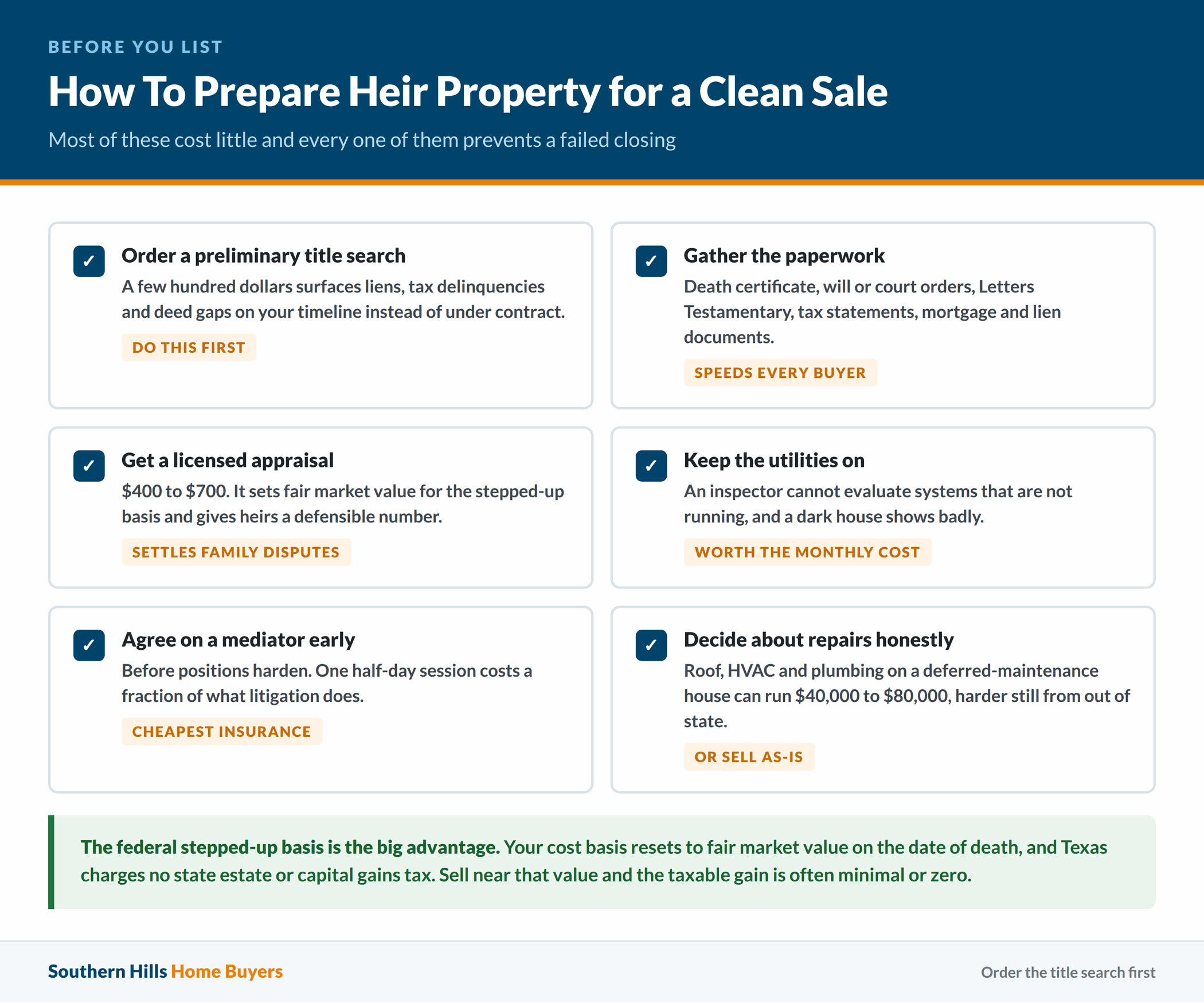
Utilities get overlooked constantly. A house that goes dark and hot during a Texas summer inspection shows badly, and an inspector can’t evaluate systems that aren’t running. Keep the electricity and the water on even for a vacant property. A working home also shows better in photos. The monthly cost is worth it.
A man in Mesquite called me on a Tuesday afternoon a couple of years back. He was splitting assets in a divorce settlement that included an inherited rental property. The garage was still full of the previous owner’s tools and equipment, and nobody had cleaned the place professionally in over a year. He didn’t want to handle the coordination. He wanted the asset settled cleanly so he and his ex could finalize the paperwork. We closed quickly, he walked away with a fair number, and the whole thing took less time than his attorney had estimated for the traditional route. Sometimes the fastest solution is the right one.
Families going the traditional listing route can help themselves with a light cosmetic refresh: fresh paint in neutral tones, cleaned carpets, personal belongings cleared out. Professional photography matters more than most sellers realize, particularly for out-of-state buyers starting their search online. Homes marketed with quality photos sell faster and command better prices, even when the house shows some age and wear. A professional real estate photographer in a Texas metro charges up to $350, which makes it one of the highest-return expenditures a seller can make before listing.
Delay at the beginning slows more inherited property sales than anything else. Every week the property sits unsettled costs money in taxes, insurance, and utilities, and Texas is currently a buyer-leaning market, so waiting for conditions to improve isn’t a reliable strategy. Making a decision, even an imperfect one, and moving on it almost always beats waiting for perfect clarity that rarely shows up. Every heir I know who waited wishes the process had started sooner.
Frequently Asked Questions
How Can You Avoid Capital Gains Tax When Selling Inherited Property in Texas?
The federal stepped-up basis rule resets your cost basis to fair market value on the original owner’s date of death, which effectively erases any taxable gain built up during the decedent’s lifetime. Texas imposes no state-level capital gains tax, so only the federal rules matter to you. Sell the property shortly after inheriting it, at a price close to the date-of-death value, and your taxable gain may be minimal or zero. A CPA who knows Texas estate situations can confirm your specific numbers before you sign anything.
Can Heirs Force a Sale of Property in Texas?
In Texas, any co-owner can file a partition lawsuit asking the court to divide the property, even one holding the smallest percentage. If dividing the property isn’t practical, the court can order the whole thing sold and split the proceeds among the heirs according to their ownership shares. That partition process takes time and costs money in legal fees. Reaching a private agreement among the heirs is almost always faster and cheaper.
How Long Does an Heir Have to Claim Their Inheritance in Texas?
Texas law sets no single deadline for claiming an inheritance, and the timeline depends heavily on whether there’s a will, whether probate gets opened, and which legal pathway the estate follows. Your best source for the specifics is a Texas probate attorney or your county probate court. Waiting a long time can create title problems that make a future sale harder, so acting sooner rather than later usually works in your favor.
Do All Heirs Have to Agree to Sell Inherited Property in Texas?
In Texas, all heirs generally must agree to sell an inherited property if they own it as tenants in common. The exception arrives when an independent executor with court authority over the estate has been appointed and is acting inside the scope of estate administration. Once the property has been formally distributed to the heirs as co-owners, everyone holding an interest has to sign off, or the holdout can be forced into a partition proceeding.
If you’re sitting on an inherited property in Texas and trying to work out your next move, the team at Southern Hills Home Buyers is happy to talk it through. No obligation and no pressure. Sometimes just knowing the options makes the decision clearer.
Selling Heir Property Across the Dallas-Fort Worth Metroplex
Most of the heir property we handle sits in the Metroplex, and the local numbers matter. As of July 2026 the median listing price across the Dallas-Fort Worth-Arlington metro was about $439,000, with a median of roughly 54 days on market, according to Federal Reserve Economic Data. Those 54 days start after title is already clear and every heir has signed the listing agreement. That’s why families on a deadline look hard at a direct sale. Metroplex heir property moves faster when the title is already clean.
We buy heir property in every condition across the Metroplex. If the house sits in the city, we’re the cash home buyers in Dallas that local probate attorneys already know. We also buy in Fort Worth, Plano, Lewisville, Carrollton, Keller and Mesquite.
Talk Through Your Situation With Someone Who Has Done This Before
If you’re sitting on inherited property and can’t tell whether you’re three weeks or three years from being able to sell, we’re glad to talk it through. No pressure and no obligation. Southern Hills Home Buyers has worked with families across the Dallas-Fort Worth Metroplex and the rest of Texas. We’ve handled heir property, unprobated estates, missing siblings, and houses nobody in the family wanted to manage from four states away. Our page on how Southern Hills Home Buyers works lays out the process end to end, and you can read other frequent questions here.
Ready to start? Reach out to Southern Hills Home Buyers or fill out the form below, and we’ll get back to you with a straight answer, usually the same day.