

Texas foreclosure timelines move fast once a lender decides the relationship is over. No drawn-out court drama. No months of back-and-forth hearings. The state’s non-judicial foreclosure process can strip a home from its owner in as little as 41 days from the first required notice. That makes Texas one of the swiftest foreclosure states in the country. Maybe you’re reading this in Plano, or from a rental in Garland, or somewhere off I-30 in Fort Worth. Speed matters here more than almost anything else you’ll learn today, and it moves faster than it sounds.
I’ve bought houses all over the Dallas-Fort Worth Metroplex from homeowners in exactly this spot, and the pattern repeats. People wait too long because nobody explained the clock that’s already running.
When Can a Lender Start Foreclosure in Texas?
Lenders don’t get to pull the trigger the moment you miss one payment, and that distinction hands you a real window to act.
Under federal law, a servicer generally can’t officially begin foreclosure until your loan is more than 120 days past due. That four-month buffer exists so homeowners have time to work through options with the servicer before the process locks in. One detail gets left out of most conversations about this. Smaller lenders can sometimes start foreclosure even if you are only one day late on a payment, so your protections depend heavily on who holds your mortgage. Borrowers who took a loan from a community bank or a private lienholder sit in a different spot than someone with a large servicer. Have an attorney read the loan terms before assuming the full 120-day window applies. I’ve watched that assumption cost people weeks.
Not long ago I met a family in Mesquite whose elderly mother’s home had been quietly sliding toward foreclosure. Her adult children had covered two mortgages for almost a year, juggling it alone instead of asking anyone for help. By the time they called me on a Thursday, the notice of sale was already filed. They had equity. They had options. Two of those options had closed, though, because they waited.
Default on your mortgage payments in Texas and the lender may foreclose using either a judicial or nonjudicial method. Most foreclosures in Texas run through the non-judicial process, because most loan documents carry a “power of sale” clause. That clause lets the lender move forward without a court, and it’s probably sitting in your deed of trust right now. Pull the document out and read it. A real estate attorney can confirm whether your loan is built that way. Texas law requires the servicer to mail you a notice of default and intent to accelerate by certified mail. The letter gives you at least 20 days to cure the default before any notice of sale can be issued.
What Is the Texas Foreclosure Process Step by Step?
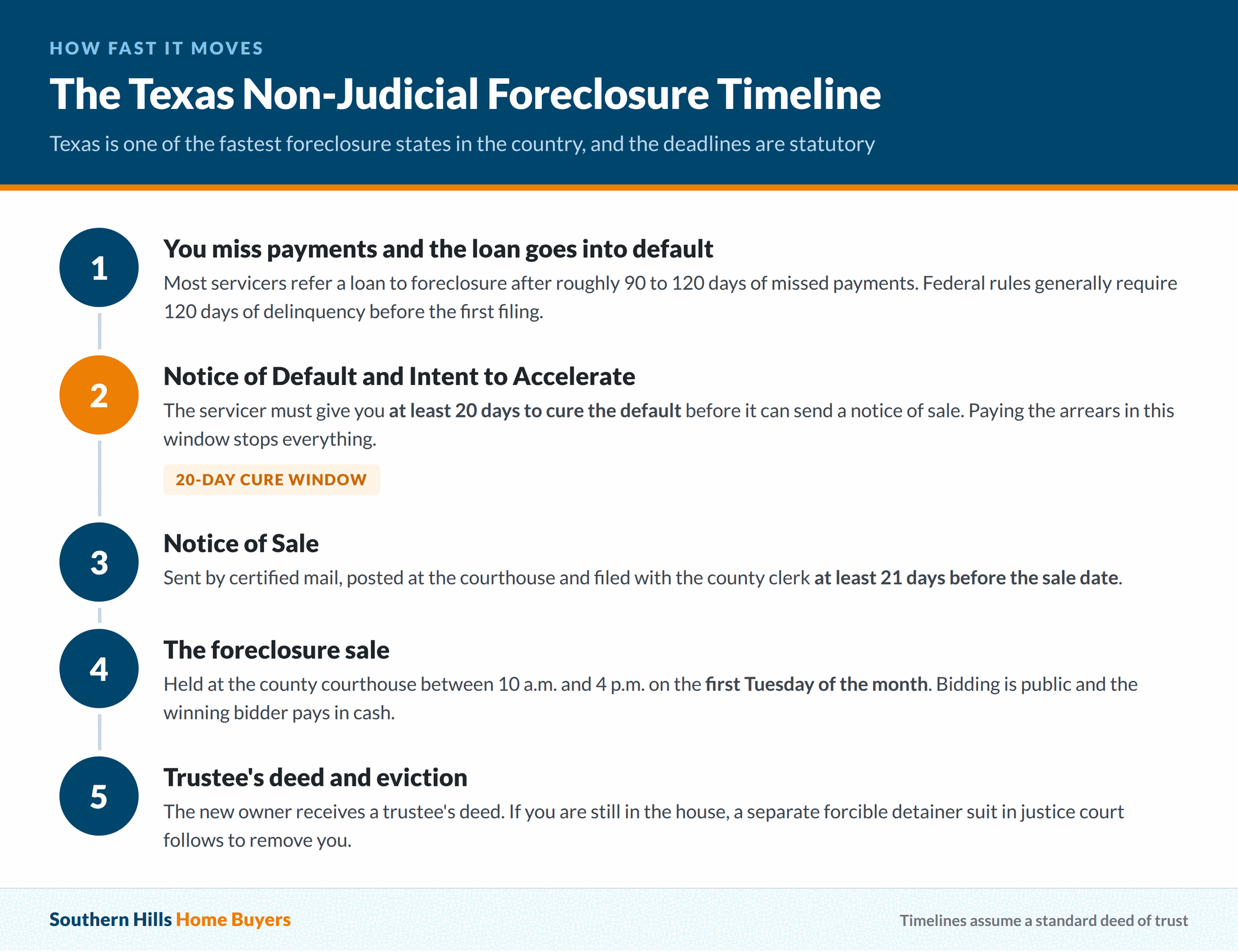
A non-judicial foreclosure can run from missed payments to a completed sale in as little as 3 to 6 months, and that route accounts for most foreclosures in Texas.
Homeowners get caught off guard because the steps sound orderly until you’re living inside them. Once the notice of default period expires, the lender files a notice of sale at least 21 days before the foreclosure auction. The property then sells at a public auction held on the first Tuesday of the month. Every Texas county runs its trustee sales that same Tuesday. Your home can change hands on the Tarrant County courthouse steps, or outside the Dallas County civil courthouse, on an ordinary Tuesday morning while you’re still drinking coffee. I’ve watched one of those sales finish in under ten minutes.
At the sale, the property goes to the highest bidder, and the lender usually opens with a bid based on the amount owed plus foreclosure costs. When nobody outbids the lender, the lender takes title. If a third-party investor wins instead, you’re facing a new owner who has every legal right to pursue possession.
The lender may use a court order known as a writ of possession to evict the occupying party from the property. Nothing about it is instant. It does start the clock on whatever time you have left in the home.
How Can You Prevent Foreclosure in Texas?
Miss the window to act before the notice of sale and most of your best options vanish for good.
Stopping a foreclosure is far easier than getting your house back after one completes. Talking to your servicer early, before you fall far behind, opens the widest set of paths. Most lenders would rather modify a loan or set up a repayment plan than haul a home to auction. That isn’t generosity. It’s arithmetic, because foreclosure costs lenders money too.
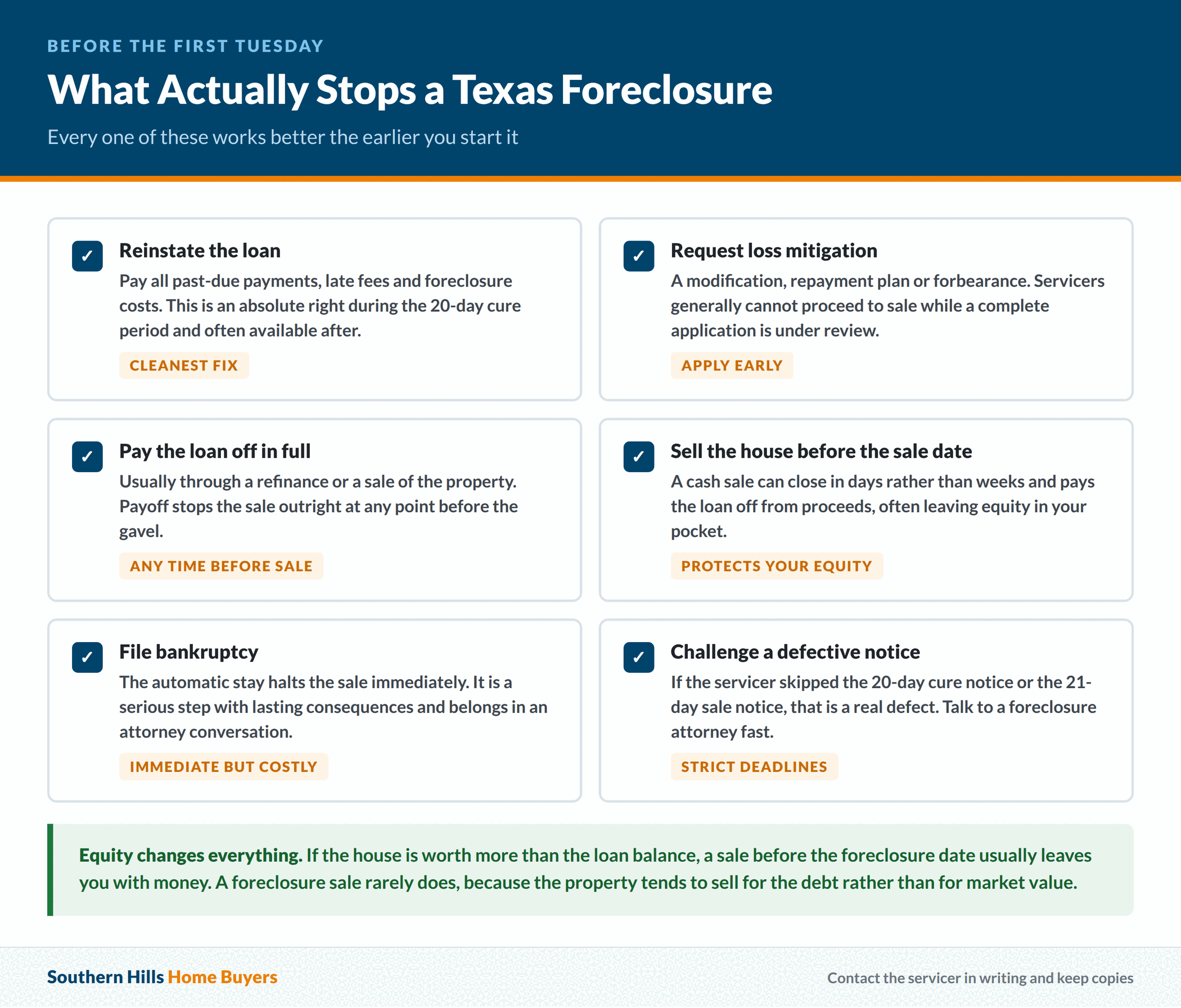
To prevent foreclosure, ask the lender about payment plans, temporary forbearances, or loan modifications. Forbearance pauses or reduces your payments for a set stretch. A repayment plan spreads what you owe across future months. Modifications change your loan terms permanently. None of it is guaranteed, and you’ll have to document the hardship with tax returns, bank statements, and a hardship letter. Servicers are required to consider your application if you submit it with enough lead time.
Selling the property outright before the auction is another real path, and it protects your credit far better than a completed foreclosure. As of March 2026, the Texas statewide median sale price sits at $341,800. Equity means a sale can pay off the defaulted loan, cover closing costs, and still put money back in your pocket. Homeowners sitting on a house in Frisco, Rockwall, or a well-kept neighborhood in Fort Worth often have more room there than they expect. Values in those markets have held up better than most sellers assume. Teams like Southern Hills Home Buyers work directly with homeowners in default and can move fast enough to beat the auction date, with no repairs and no agent commissions.
What Is Loss Mitigation and How Does It Help Texas Homeowners?
For a long time I lumped loss mitigation in with everything else servicers offer, and assumed homeowners already knew the term. Most don’t. That gap costs people their homes.
Loss mitigation is the formal name for the set of options a servicer must weigh before finalizing a foreclosure. It covers loan modifications, forbearance agreements, repayment plans, short sales, and deeds in lieu of foreclosure. A federal rule prevents servicers from foreclosing on a property if a borrower presents a loan modification application more than 37 days before the property is scheduled to be sold. A complete application filed on time legally pauses the foreclosure while the servicer reviews it. Incomplete applications get no such protection, so every page of supporting documentation matters.
A deed in lieu of foreclosure is the loss mitigation tool most homeowners overlook. It transfers the property straight to the lender, and a deed-in-lieu agreement usually includes a deficiency waiver, though that waiver is contractual rather than something Texas law requires. It won’t save your homeownership. What it can do is stop a deficiency judgment from chasing you once the dust settles. For homeowners who have accepted that they need to move on, a deed in lieu is often cleaner than riding the whole thing to the auction.
Short sales work differently. You sell the home for less than the balance owed, with the lender’s approval, and that tends to land better on a credit report than a completed foreclosure. Lenders rarely sue for a deficiency, given the time and expense involved, but having it addressed in writing during a short sale gives you real certainty. Whatever path you take, ask your servicer for everything in writing.
Can Bankruptcy Stop Foreclosure in Texas?
A homeowner in Garland called me two days before their foreclosure auction. They had already met with a bankruptcy attorney that same morning. By the afternoon, a Chapter 13 petition was filed.
Filing creates an automatic stay that generally stops foreclosures, repossessions, and most collection actions immediately. The stay takes effect the moment the petition hits the court. A sale scheduled for Tuesday morning gets halted the same day you file, even if that day is a Saturday. Bankruptcy is no permanent fix. As a tool for buying time and restructuring what you owe, though, it can be exactly what a homeowner needs.
Chapter 13 is a reorganization. It lets homeowners repay missed mortgage payments over three to five years while staying current on the new ones. The plan has to be court-approved, and you have to keep making payments going forward. Miss a payment inside a Chapter 13 plan and the lender can ask the court to lift the stay and proceed with the foreclosure anyway.
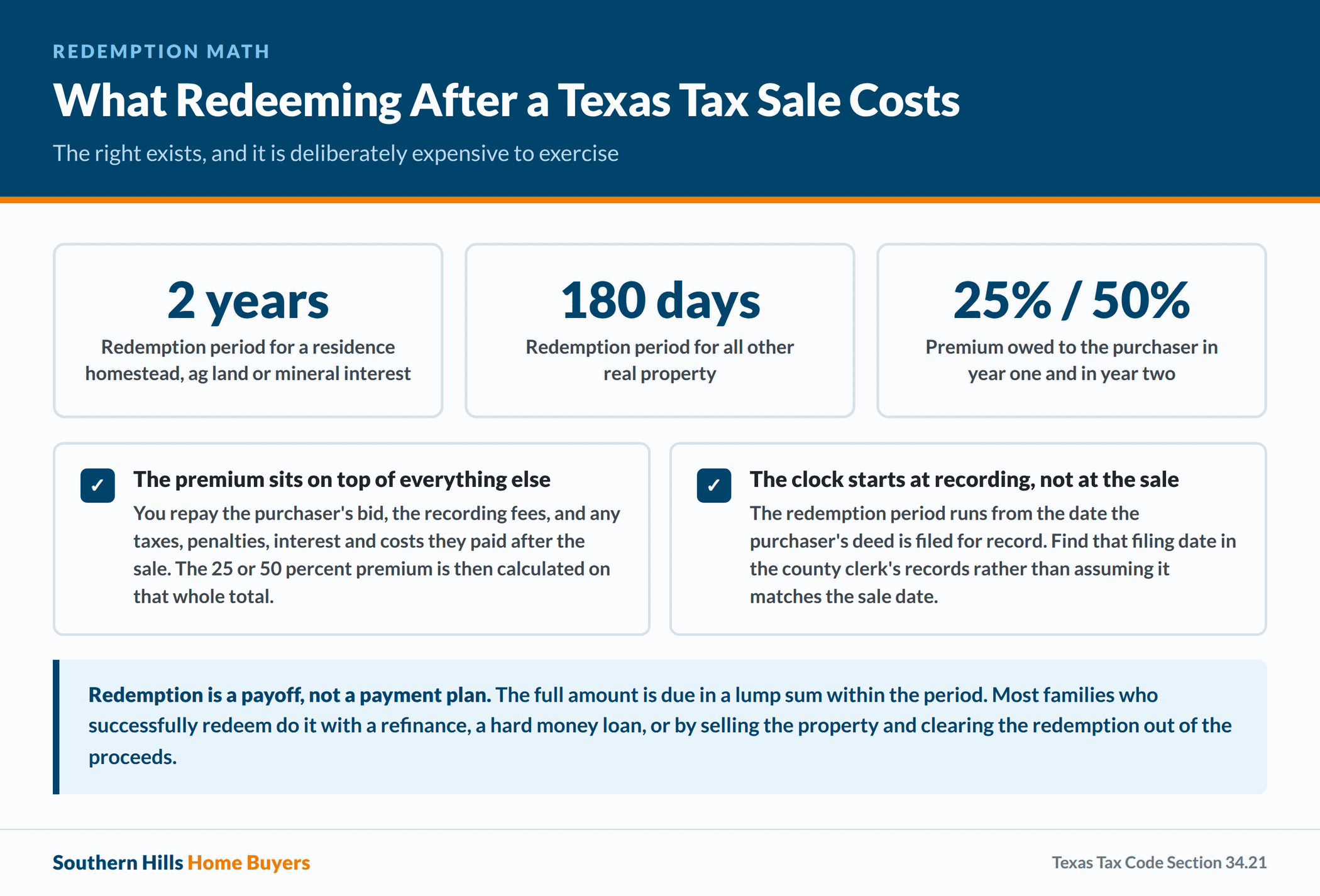
Liquidation under Chapter 7 may delay a foreclosure, but usually it will not let you keep the house if you are behind on payments. You get the stay without a structured path to catch up on arrears. Talk with a licensed Texas bankruptcy attorney about which chapter fits your income and your goals before you file anything. Filing the wrong chapter can burn your automatic stay for future cases.
Can You Refinance or Sell Your Home to Avoid Foreclosure in Texas?
Do you have real equity in the property right now?
Your answer decides which of these paths is realistic. If you are behind in payments, refinancing usually is not one of them. Lenders don’t extend new loans to borrowers already in default. Your credit has taken hits from the missed payments, your debt-to-income ratio looks rough on paper, and most conventional lenders won’t touch the file. Refinancing is a strong tool for homeowners who are struggling but still current. Once default sets in, that door tends to close.
Selling before the auction is a different animal. You can sell if the sale proceeds would pay off the mortgage and the cost of the sale. The current median days on market in Texas is 74 days. If your foreclosure sale is 45 days away and you’re listing through traditional channels, that timeline is uncomfortably tight before you even account for closing. A direct cash sale to a local buyer moves much faster, which spares you from watching the auction date creep closer while showings and counteroffers drag on. Southern Hills Home Buyers can make an offer without the listing process, the repairs, or the wait, and our page on how we buy houses walks through exactly how that goes.
A short sale requires lender approval and takes time to negotiate, but it’s worth exploring if you owe more than the property is worth. Your servicer’s loss mitigation department is the right place to start that conversation.
Can You Stay in Your Home During Foreclosure in Texas?
Homeowners keep the right to live in the property all the way through the foreclosure sale date, and often past it.
After the foreclosure sale completes, the new owner cannot walk in and change the locks. They have to pursue a formal eviction through the courts, which leaves you a window before anyone can legally remove you. That process takes weeks, sometimes longer depending on court schedules. You are still physically in the home during it.
Some investors who buy at auction will approach the former owner about a cash-for-keys arrangement, offering a modest payment to vacate promptly and leave the place clean. Nobody can force you into that. If moving out is inevitable anyway, getting paid for a tidy handover is worth considering.
The lender may use a writ of possession to remove the occupying party from the property. That writ comes through the justice of the peace court in most Texas counties. A constable delivers it, and you’ll have a short window to vacate once you are served. Ignoring a writ of possession is not a strategy. It speeds up the removal and wrecks any negotiating position you had with the new owner.
One thing worth knowing: staying through the whole process while you explore your options is perfectly legal. Use that time actively, not passively.
Can You Get Your House Back After Foreclosure in Texas?
Texas gives foreclosed homeowners almost no ground to stand on once the sale is complete. The belief that a completed foreclosure can be reversed dies fast when you read what Texas law actually provides.
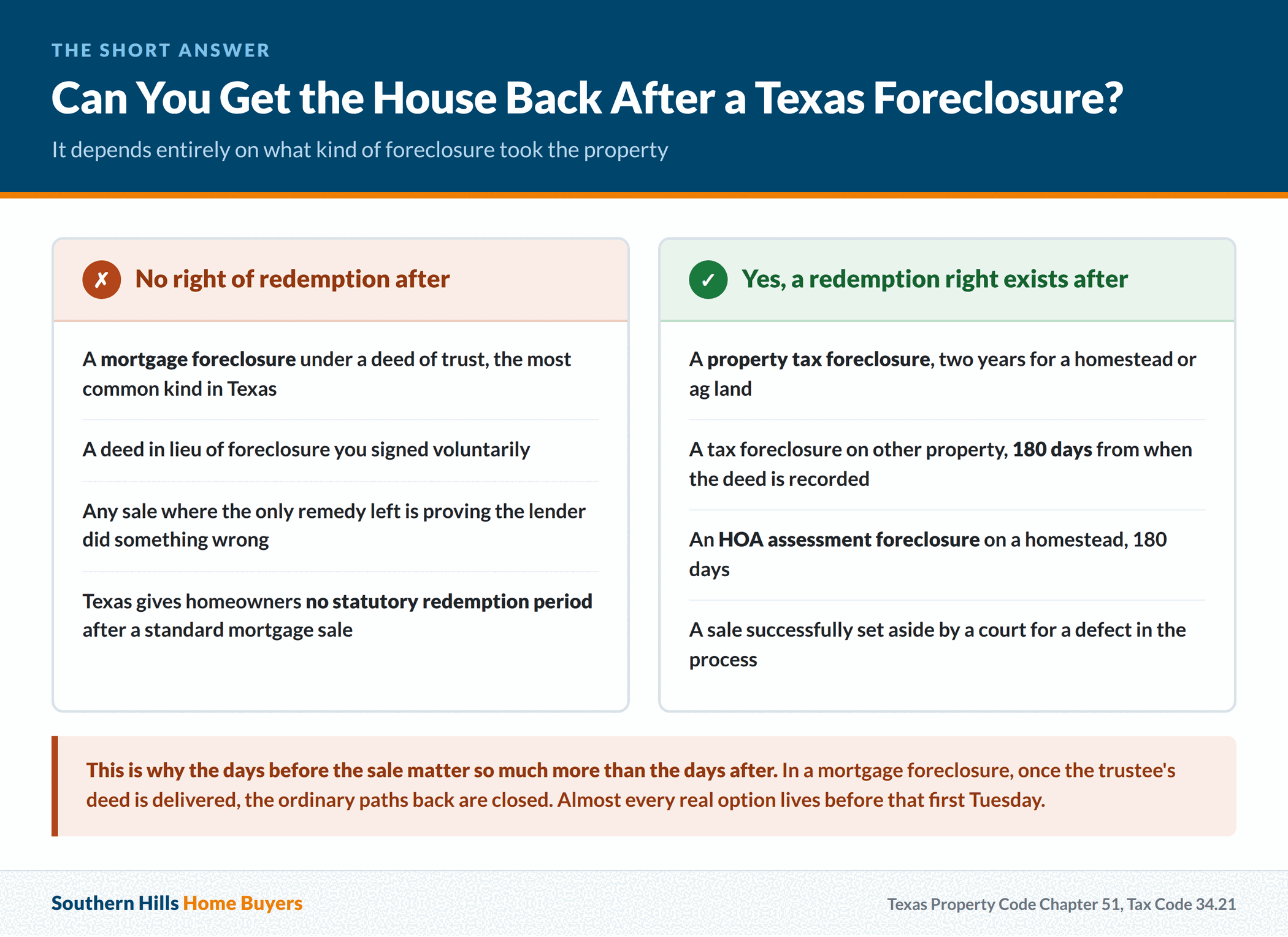
Unlike some states, Texas does not provide a right of redemption after a non-judicial foreclosure sale. Once that sale is complete, the former homeowner has no further right to reclaim the property. No grace period. No six-month window to scrape together the money and get the deed back. When the trustee’s deed transfers to the new owner at the courthouse, the prior owner’s legal claim to the property is gone.
Two narrower exceptions exist, and neither one covers a standard mortgage foreclosure. Tax foreclosures in Texas do carry a redemption period of several months to 2 years, depending on the property type. Your county tax office or a Texas property tax attorney can walk you through the specific window and the costs. HOA foreclosures carry their own statutory redemption rights as well. The owner of property in a residential subdivision may redeem the property from any purchaser at a sale foreclosing a property owners’ association’s assessment lien, under Texas Property Code Section 209.011. The deadline is the 180th day after the date the association mails written notice of the sale. That 180-day window belongs to HOA lien foreclosures, not mortgage foreclosures.
Outside those two exceptions, getting the house back means buying it from whoever won it at the auction. If the lender took title, you would be negotiating with the bank’s REO department, and that is a slow process in my experience. If an investor bought it, you would have to track them down and make your case. Neither path is simple. Neither one is cheap.
A homeowner I worked with in Waxahachie was caring for a parent who had just moved into assisted living when the foreclosure on her own home completed on a Wednesday. Losing the house and sorting through thirty years of belongings at the same time was crushing. What pulled her forward was focusing on what came next: rebuilding credit, finding stable housing, and accepting that a completed Texas mortgage foreclosure left no legal path back to that specific property. Knowing it clearly, as hard as that was, let her stop looking backward and start planning, which took a few weeks rather than days. Southern Hills Home Buyers connected her with local resources and helped her think through the next steps, even though there was no transaction to close.
If you’re in the pre-foreclosure stage instead of past it, that’s where every ounce of energy belongs. The Texas Law Help foreclosure fact sheet is a solid free starting point for understanding your rights under current Texas law.
Frequently Asked Questions
How Long Does a Foreclosure Last in Texas?
From missed payments to a foreclosure sale can take as little as 3 to 6 months in a non-judicial foreclosure. The real timeline depends on when the lender chooses to act, which month the first-Tuesday sale falls on, and whether you pursue any delay strategies like loss mitigation or bankruptcy. Judicial foreclosures, far less common in Texas, run longer because court scheduling stretches the process.
How Far Behind on a Mortgage Before Foreclosure in Texas?
Under federal law, the servicer usually can’t officially begin a foreclosure until you’re more than 120 days past due on payments, subject to a few exceptions. Smaller or private lenders may operate under different rules, so confirm the specific terms in your loan documents. Sitting 120 days behind doesn’t make foreclosure automatic. It means the lender now has the legal right to start the process.
How Long Can You Stay in Your House After Foreclosure in Texas?
After the foreclosure sale completes, you can stay in the property until the new owner obtains and executes a writ of possession through the courts. That eviction process takes weeks in most Texas counties. Nobody removes you on the day of the auction. Use those weeks to make concrete plans instead of waiting to see what happens. The constable delivers the writ once it is issued, and at that point vacating promptly is your best move.
Wherever you sit in this process, knowing where you actually stand is the first step. Maybe you just missed a first payment. Maybe there’s a notice of sale taped to your door. We’ve worked with homeowners all over Texas at every stage of this, and most of the time there are more options on the table than people realize before a sale happens. If you want to talk through your situation and see what’s possible, reach out to Southern Hills Home Buyers. No pressure, no obligation, just a straight conversation.
Facing Foreclosure in the Dallas-Fort Worth Metroplex
Timing is the whole game here, and the Metroplex numbers make that concrete. As of July 2026 the median listing price across the Dallas-Fort Worth-Arlington metro was about $439,000, according to Federal Reserve Economic Data. Homes sat a median of roughly 54 days on market. Add a financed closing on top and a traditional listing runs close to three months. If your sale date is five weeks out, the arithmetic does not work, and the equity you built goes to the courthouse steps instead of to you.
We buy houses facing foreclosure across the Metroplex. If the property sits in the city, we are the cash home buyers in Dallas who work these timelines every month. We also buy in Fort Worth, Grand Prairie, Irving, Plano, Denton and Arlington.
Tell Us Where You Are in the Process and We Will Tell You Straight
Whether the sale already happened or the date is still weeks out changes the entire conversation, and the paperwork does not always make clear which situation you are in. Southern Hills Home Buyers has worked with homeowners across the Dallas-Fort Worth Metroplex at every stage of this. That means behind on payments, notice of sale posted, tax sale already recorded, and everything in between. We will tell you honestly what we think your options are, including the ones that do not involve selling to us. You can also read other frequent questions here.
If selling turns out to be the right answer, we can move fast enough to matter. Reach out to Southern Hills Home Buyers or fill out the form below and we will get back to you with a straight answer, usually the same day.
Get Cash For Your Texas House Today
We buy houses in Texas without the hassle and red tape. Get your no-obligation cash offer for your home and just be done. Selling in as-is condition has never been easier.