

Go dig out that stack of papers in the junk drawer. Somewhere in the pile sits a deed, probably a survey from the year you bought, and receipts for the roof work you had done three summers back. Most sellers I meet believe they have every base covered. Then the title company calls during closing week asking for permit documentation nobody ever mentioned, and the whole schedule slides.
Bad paperwork doesn’t only slow a sale down. It can kill one outright.
The Document Reality Most Texas Sellers Miss
Documentation sinks more Texas sellers than bad pricing ever does. Price the house right, tidy the yard on a quiet Carrollton street, and the rest supposedly sorts itself out. What leaves sellers flat-footed is the paperwork layer sitting under every transaction, the part that settles whether you can legally transfer what you’re trying to sell.
As of June 2026, the median home price in Texas sat at $347,911. That’s real money on the table, and your paperwork guards every dollar of it. No title company closes without a clear chain of ownership. No lender funds without a clean appraisal file. A buyer’s attorney in Frisco or Irving will flag missing documents long before anyone reaches the closing table, and that flag costs you time you never budgeted for.
The gap I keep running into is sellers treating documents as an afterthought. They pour weeks into staging, photography, and MLS strategy, then scramble for a death certificate or a divorce decree two days before closing. Scrambling costs time. Time costs money while your mortgage keeps ticking every single day, and nobody refunds those payments later.
Statewide, days on market in 2025 rose to 67 days, up about a week from 2024. In a market that slow, one documentation delay pushes your buyer toward another property altogether. Getting organized before you list isn’t busywork. You’re protecting the offer you spent months building, on a house you may have owned for twenty years. Ten minutes with a folder now beats ten days of chasing later.
How Does the Texas Home Selling Process Work Step by Step?
A seller in McKinney listed her house and accepted an offer inside three weeks. Then it fell apart. She couldn’t produce a probate order showing she had legal authority to sell, because the property still sat in her late mother’s name. Starting over cost her four months.
Her story isn’t rare. A Texas sale runs roughly in this order. You prepare the property and gather documents, then list it or connect with a buyer directly. Next comes negotiating and signing a purchase contract, opening title, and clearing any liens or clouds on the title. After that, the buyer’s inspection and, if the buyer is financed, an appraisal. A title company handles the transfer at closing. Every single stage has a document attached.
What trips sellers up is that these stages overlap. The title company starts searching public records the moment you open escrow. If your deed carries an error, or an old contractor lien was never released, that shows up during the title search rather than at closing. Problems found early are cheaper and faster to fix, and they rarely cost you the buyer.
Go the FSBO route without a real estate broker or agent and the whole document burden lands on you. No broker coordinates the paperwork trail. You make sure every form is current, signed, and delivered on schedule. Plenty of sellers manage it. It’s still a lot to track.
What Documents Do You Need to Sell a House in Texas?
Every Texas home sale runs on roughly the same document stack. Most sellers badly underestimate how long pulling it together actually takes.
At minimum you’ll need the deed, a current survey, the seller’s disclosure notice, and the purchase contract. Add a title commitment from a title company, any HOA documents if the property sits in a managed community, and proof of mortgage payoff. Then your most recent property tax records, plus a valid government-issued ID for every person on title. That’s the core set. Depending on how the property came to you, probate orders, power of attorney, or trust documents may join that list.
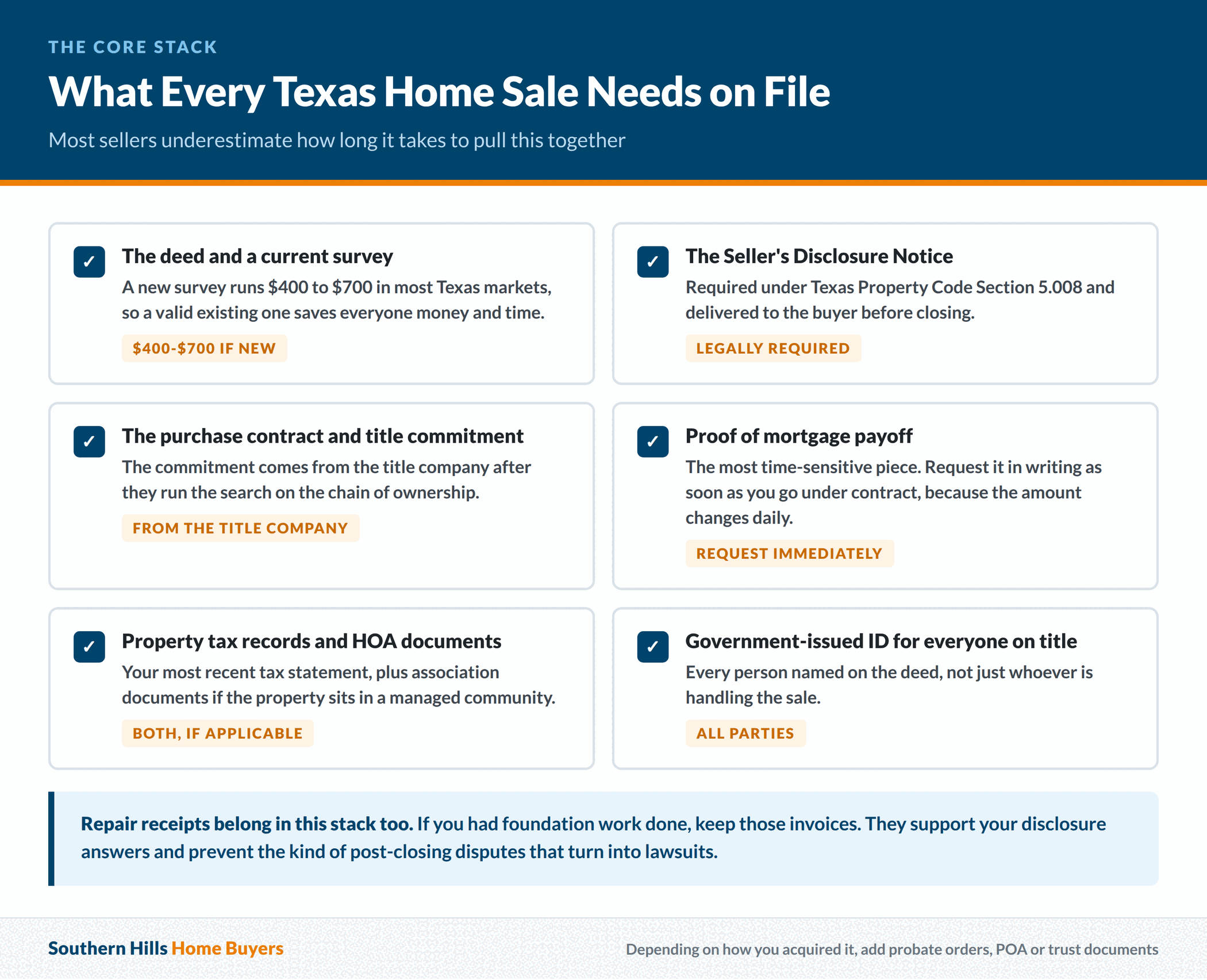
Texas seller disclosure requirements come from Texas Property Code Section 5.008. It requires sellers of residential property to hand the buyer a written Seller’s Disclosure Notice before closing. The TREC version covers structural condition, environmental hazards, flooding history, and material facts about the property. One form, a lot of ground.
Repair receipts belong in this stack too. Had foundation work done on a house in Arlington or Garland? Keep those invoices. They back up your disclosure answers and head off the post-closing disputes that turn into lawsuits. One folder, assembled before your first showing, saves more stress than any amount of staging, and it costs you an afternoon. Buyers who can’t verify a repair tend to walk away from it.
What Is Proof of Ownership When Selling a Texas Home?
A family reached out to us a couple of years back about a property outside Waxahachie. Older ranch-style place, detached garage packed with rusted farm equipment nobody had touched since their father passed. All four siblings were ready to move on. We walked the property on a Tuesday morning, and the first thing we asked to see was proof the estate had been administered and the heirs held authority to sell. They didn’t have it yet.
Ownership proof in Texas almost always means your deed, specifically the warranty deed or special warranty deed recorded with the county clerk when you bought the place. That recorded document establishes your right to sell. If the home came to you through inheritance, a muniment of title or a court-issued order from the probate process stands in for a traditional deed transfer.
Have you ever tried to track down a deed from twenty years ago? County clerk offices keep recorded copies, and most Texas counties let you pull them online now. If yours vanished in a move, that portal is your first stop and it’s usually free. Don’t wait until you’re under contract to find a gap in the chain of ownership, because by then the clock belongs to somebody else.
Things get complicated fast when a co-owner has passed away, when a divorce decree changed title but nobody updated the deed, or when a property moved between family members without proper recording. Every one of those adds time before you can close. What you thought was weeks out can stretch into months, and nobody is obligated to wait.
What Title and Deed Papers Do Texas Home Sellers Need?
Sorting out ownership usually exposes the next layer. The deed itself has to be clean, properly executed, and free of competing claims. Your title company runs a title search, pulling every recorded document tied to the property back through the chain of ownership, sometimes decades deep. They’re hunting liens, judgments, easements, and any gap that could cloud the title before the lender ever sees it.
In Texas the seller usually pays for owner’s title insurance. That policy, issued by the title company once the search clears, tells your buyer the property is legitimately yours to sell. If an old contractor lien or a tax debt surfaces during the search, you clear it before closing. Waiting until after is how sellers end up in court.
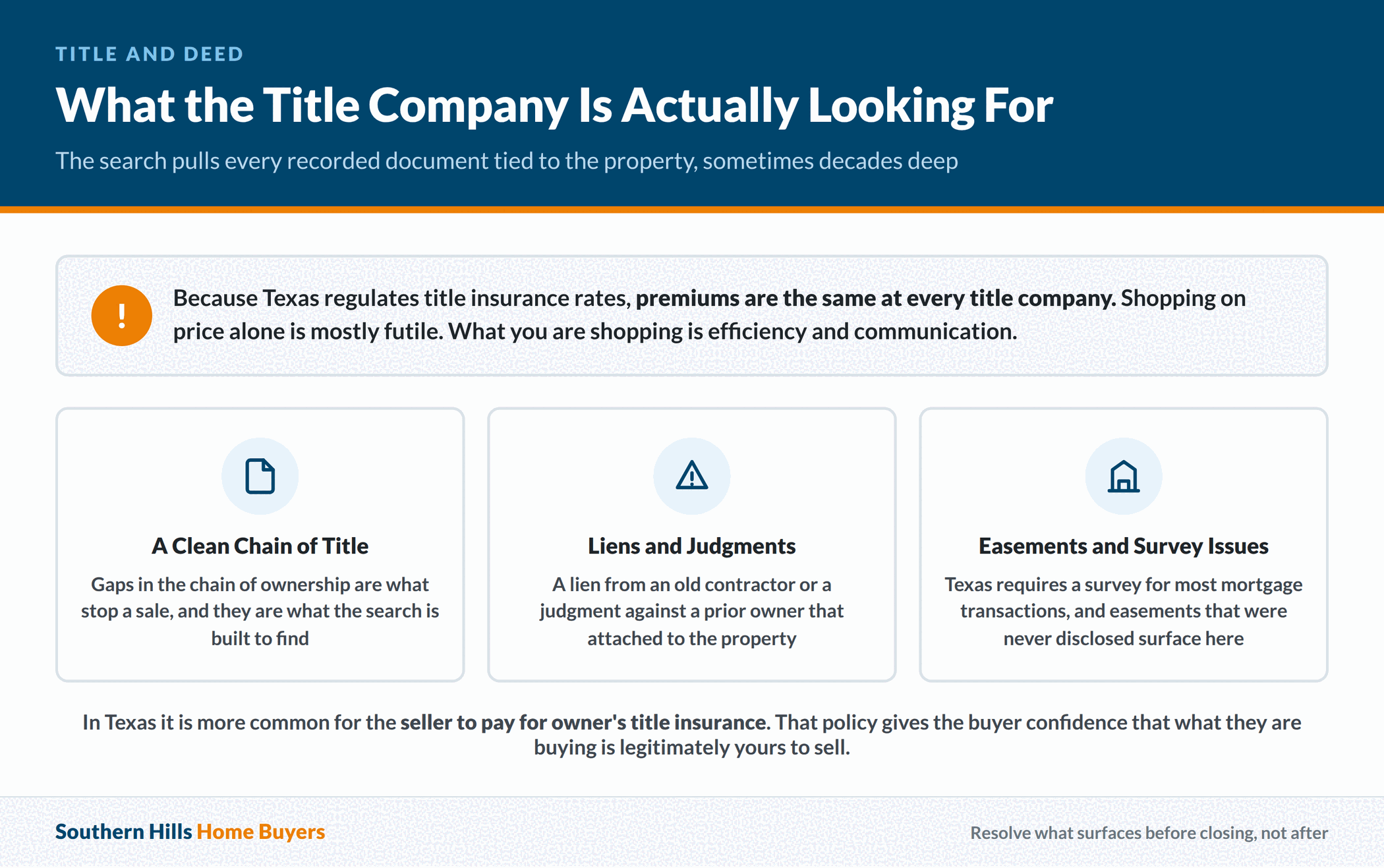
Most mortgage transactions in Texas require a survey. If you still have the survey from when you bought the property, and it’s current enough, the lender may accept it. A new one runs between $400 and $700 across most Texas markets. Handing over a valid existing survey saves everybody money and time.
Because Texas regulates title insurance rates, premiums come out the same at every title company. Shopping on price alone is mostly futile. What you’re really shopping is efficiency and communication. A slow title company on a fast closing does as much damage as a missing document, and I’ve watched that wreck a closing week.
Who Must Provide a Seller’s Disclosure Notice in Texas?
The standard TREC form covers about 20 categories: structural issues, roof age, flooding history, environmental hazards, and more.
Sellers of previously occupied single-family residences must provide this disclosure form, used together with a contract for the sale of real property. Section 5.008 of the Texas Property Code creates an obligation that reaches the vast majority of residential transactions. Narrow exemptions exist for foreclosure sales, court-ordered transfers, and certain family transfers, think estate sales gone to probate. Those exemptions won’t cover most sellers reading this page.
As of January 2025, the disclosure form carries a new mold remediation disclosure requirement. Sellers should be using TREC Form 55-1, effective May 28, 2026, which you can download straight from the Texas Real Estate Commission’s website. Handing over an older disclosure isn’t a technicality. It’s a gap that can reopen a buyer’s right to terminate the contract.
Delivery has to happen on or before execution of the purchase contract, or within a reasonable time after execution if unforeseen circumstances get in the way. Late delivery does more than extend the termination window. It signals disorganization at the worst possible moment, and in my experience that alone can shake a buyer’s confidence in the whole transaction. Deliver it early and that problem never starts.
Keep repair records to support your answers. Foundation work, roof replacements, plumbing repairs, anything you’ve touched, document it. Buyers and their inspectors in Fort Worth and Denton are thorough. A disclosure that matches the inspection report builds trust fast, and trust is worth more than any repair credit.
What Should Texas Home Sellers Know About Contract and Offer Documents?
So what does a purchase contract actually commit you to, and what comes back to hurt you when it’s wrong?
Your sales contract is the legally binding agreement between you and the buyer. Most Texas transactions use contracts promulgated by the Texas Real Estate Commission. Working with a licensed real estate broker or agent, you’ll start from the TREC-approved form. FSBO sellers often use those same forms and then skip addenda they need. The third-party financing addendum belongs in the file when the buyer has a bank loan. An HOA addendum shows up when the property sits in a mandatory property owners association. A backup contract notice comes into play when a secondary offer is involved.
Every addendum shifts your obligations and your buyer’s rights. A missing financing addendum leaves the answer unclear when the buyer’s lender declines the loan. Read each document carefully before you sign it. A skim isn’t a read, and signatures are hard to take back.
The earnest money agreement rides along in this package. That deposit sits in an escrow account held by the title company, and the contract spells out what triggers its release or return. Get the earnest money terms in writing. Check them against what you actually agreed to out loud, before anybody signs a thing.
What Financial Documents Are Required to Close a Texas Home Sale?
Sit down for a second. Plenty of sellers aren’t ready for how many financial records they have to produce before that check lands in their account.
Your mortgage payoff statement is the most time-sensitive piece of the stack. Request it in writing from your lender the day you go under contract, because payoff amounts shift daily as interest accrues on the balance. Today’s figure won’t match the figure at closing three weeks out, not even close. Your title company needs an updated statement, sometimes only days before closing, before it can finalize the settlement statement.
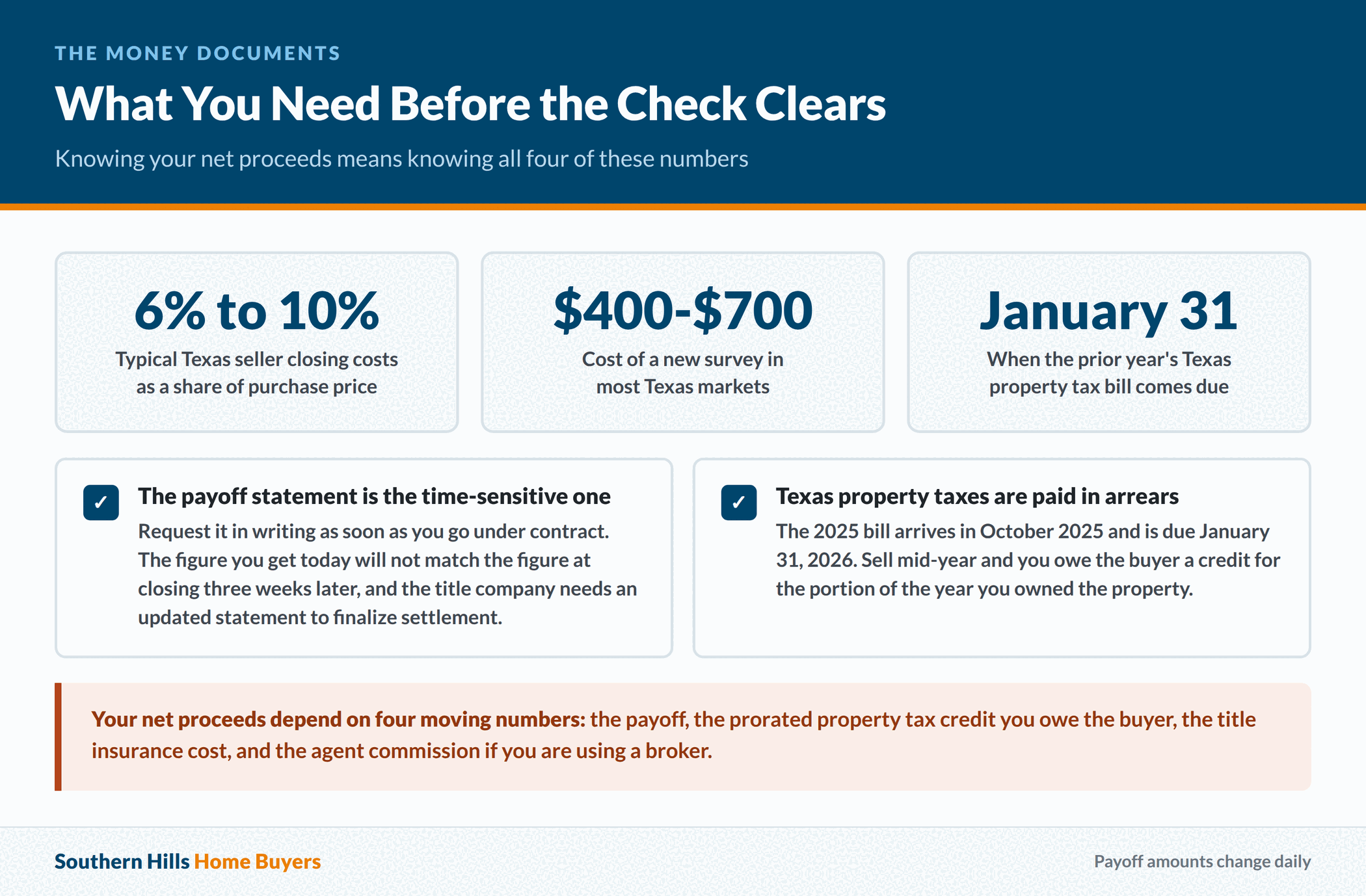
Texas seller closing costs typically run 6 to 10 percent of the purchase price. On a sale near the state median, that adds up quickly. Knowing your net proceeds ahead of closing requires knowing your payoff, the prorated property tax credit you owe the buyer, the title insurance cost, and the agent commission if you’re using a broker.
Property taxes in Texas get paid in arrears. The 2025 tax bill arrives in October 2025 and comes due January 31, 2026. Sell mid-year and you owe the buyer a credit for the months you owned the property, and even a few weeks adds up. Your most recent tax statement lets the title company calculate that proration accurately. Guessing at it slows the file down.
The settlement statement, called a Closing Disclosure, is the document that lines all of this up. Review it carefully before signing. Errors happen on settlement statements, and catching one the day before closing is stressful but fixable. Catching one after closing turns into a much longer conversation.
Which Tax Records and Hoa Documents Matter for a Texas Sale?
Most sellers never budget for the HOA resale certificate fee, and that fee goes straight to the association rather than the buyer or any agent. For sellers in managed communities around Lewisville and Rockwall, it’s usually the first real surprise of the whole process.
Sell inside an HOA community and you typically pay for the resale certificate yourself. That’s the official document disclosing the HOA’s financial condition, rules, and any violations, and it runs $100 to $300. Texas requires that certificate to reach the buyer within a specific window, and buyers can terminate the contract after reviewing it. Know what your HOA’s financials say before a buyer finds out.
The Texas Real Estate Commission also publishes a Subdivision Information form, Form 37-5, for properties subject to mandatory membership in a Property Owners’ Association. If your home sits in a mandatory HOA, that form belongs in the required paperwork.
Property tax records serve two purposes in a Texas sale. They confirm the assessed value the buyer’s lender uses during appraisal review, and they document your tax ID number, which the title company needs to process the proration. Pull your most recent statement and keep it in the document folder from day one.
How Do Texas Sellers Prepare Documents for a Cash Buyer Vs. a Financed Buyer?
One objection comes up constantly: “If I sell to a cash buyer, there’s barely any paperwork.” Reasonable guess. Not true.
Core documents stay the same no matter how your buyer pays for the house. You still need a deed, a disclosure notice, a survey, a settlement statement, and your payoff documentation. What drops away in a cash sale is the lender-driven paperwork. No bank-ordered appraisal, no loan underwriting file, no lender’s title policy, and no waiting on approval timelines that can eat weeks by themselves.
Cash buyers pay less in closing costs because most lender-related fees never appear. Skip the lender-required appraisal, the underwriting fee, the lender’s title policy, and mortgage insurance. For you as the seller, a cash offer usually brings fewer contingencies and a faster path to the closing table. That’s most of the delay gone.
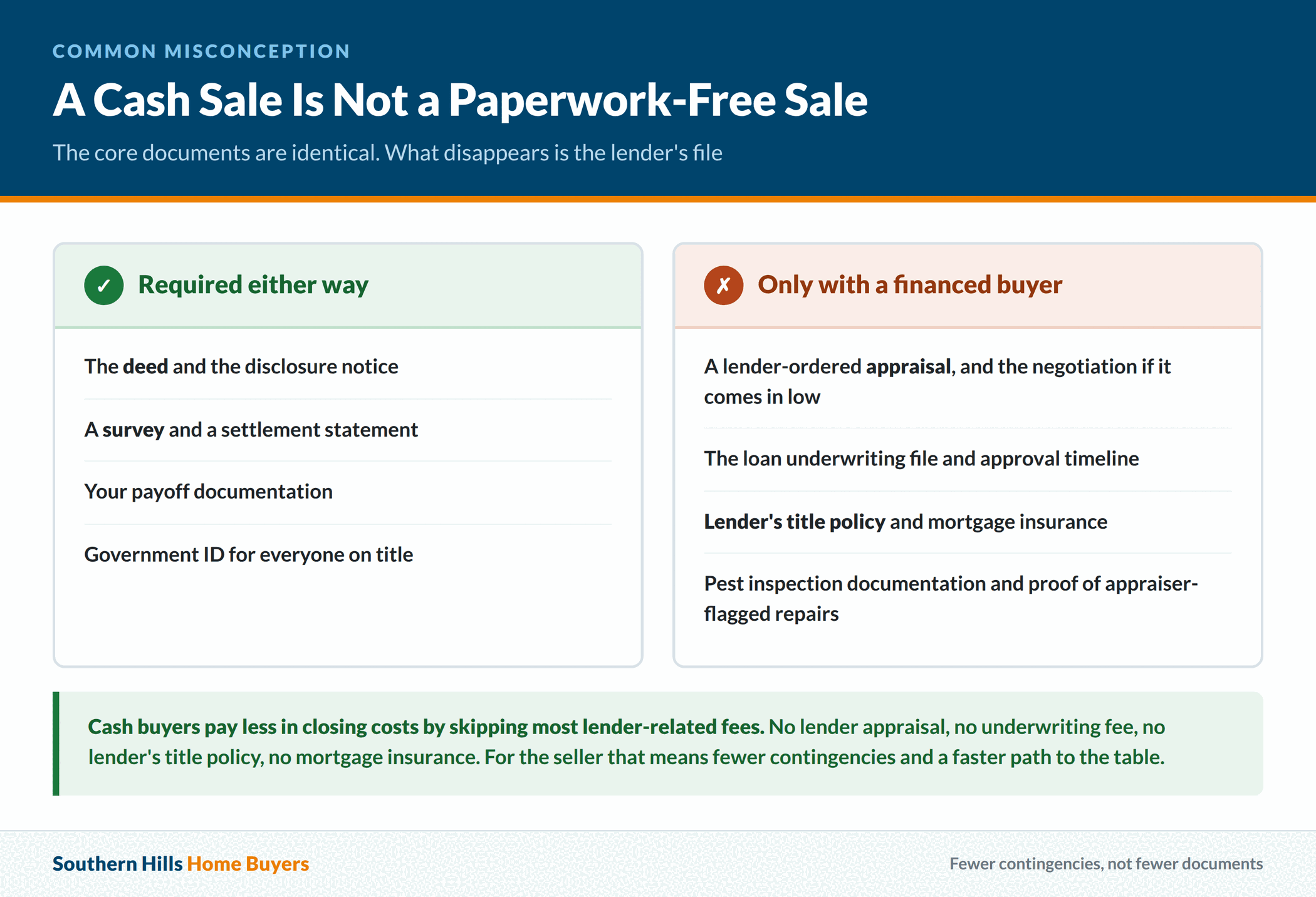
With a financed buyer, the lender drives most of the document demands. The buyer’s bank orders an appraisal, which needs property access. If the home doesn’t appraise at contract price, you’re suddenly in a negotiation you never planned for. The lender may also require a current survey, pest inspection documentation, and proof that repair items flagged by the appraiser got completed before funding.
That’s one reason sellers in Grand Prairie and Mesquite prefer working with a buyer like Southern Hills Home Buyers, who buy with cash and never bring a lender’s checklist along. The document stack is shorter and the timeline is tighter. Nobody sits around waiting on an underwriter to sign off. It’s also far less likely to fall apart over a financing condition nobody saw coming.
What Happens If You Sell a Texas Home Without the Right Paperwork?
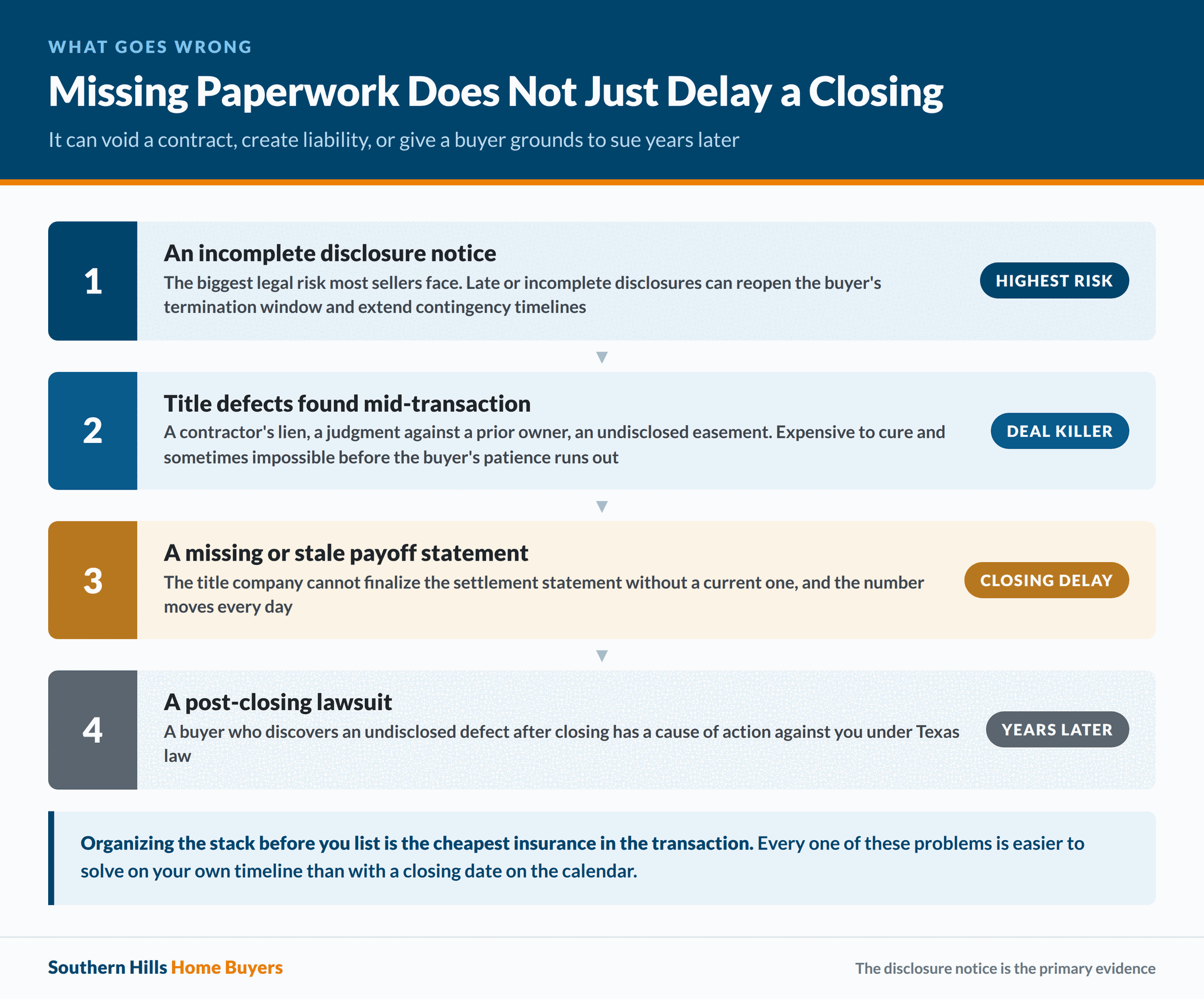
Missing or incorrect documents do more than delay a closing. They can void a contract, expose you to legal liability, or hand a buyer grounds to sue you years after the transaction.
An incomplete seller’s disclosure is the biggest legal risk most sellers carry. Late or thin disclosures reopen the buyer’s termination window and stretch contingency timelines. A buyer who finds an undisclosed defect after closing has a cause of action against you under Texas law, and the disclosure notice you signed becomes the primary evidence in that dispute.
Title defects found mid-transaction cost real money to cure, and sometimes they can’t be resolved before a buyer’s patience runs out. Think of a lien from a contractor who worked the property years ago, a judgment against a prior owner that attached to the land, or an easement nobody ever disclosed. Every one of those surfaces during title searches on Texas properties every week.
Second real case. A couple in Mansfield had their home under contract twice, two agents and two listings, six months apart. Both fell through, and nobody could tell them why. The second round brought no offers at all, just silence while carrying costs piled up. When they came to us, the problem turned out to be a clouded title from an old home equity loan plus a disclosure nobody updated after a water heater flood. Once we found the actual issue, they finally had a path forward. Southern Hills Home Buyers meant they didn’t have to fix everything first, because we handled the transaction knowing exactly what we were buying.
Getting the paperwork right from the start isn’t caution for its own sake. It’s the line between a closing and a collapse.
Frequently Asked Questions
How Do I Sell My House Without a Realtor in Texas?
Selling without an agent in Texas, known as FSBO, hands you every responsibility a broker normally covers. Pricing, marketing, negotiating, coordinating documents, all of it. You can use TREC-promulgated contracts directly, and many FSBO sellers reach the MLS through a flat-fee listing service. Document obligations don’t shrink just because no agent is involved. The seller’s disclosure, a valid deed transfer, and a title company are still required before you can close.
What Are the Three Most Important Documents in Any Texas Property Sale?
The deed actually transfers ownership, so it has to be executed and recorded correctly with the county clerk. Your Seller’s Disclosure Notice carries the most legal exposure when it’s wrong or missing. A purchase contract defines every right and obligation between you and the buyer. Get those three right and the rest of the transaction stays manageable, even a messy one.
What Should I Avoid Doing Before Selling My House in Texas?
Skip the major renovation right before listing unless you know your local market, because plenty of buyers in Plano and Frisco would rather negotiate a credit than inherit your taste in tile. Don’t leave disclosure questions blank without a genuine reason, because blanks read as hiding something. Order your mortgage payoff statement early, since lenders take several business days to produce it. And never sign anything you haven’t read, even when the agent or buyer’s representative calls it standard.
Is a Handwritten Bill of Sale Legal in Texas?
A handwritten bill of sale can be legally valid in Texas for personal property. Real estate is different, because the deed has to meet specific statutory requirements before the county clerk will record it. That means writing, a proper identification of the parties and the property, consideration, and notarization. A handwritten document hitting all of those can be enforceable. Most real estate attorneys and title companies still require a properly prepared deed so they can insure and record the transaction cleanly.
Want to talk through where you stand and which documents your situation actually calls for? Southern Hills Home Buyers is a reasonable place to start. No obligation and no pressure, just a straight conversation about your property and your options. We’ve bought houses in all kinds of condition, with all kinds of paperwork complications, and we’re glad to help you work out the next step.
Getting Your Paperwork Together in the Dallas-Fort Worth Metroplex
Every county in the Metroplex keeps property records online, which turns the first half of this stack into a same-day job instead of a week-long one. Dallas, Tarrant, Collin and Denton counties all publish searchable deed and tax records. That matters more than it sounds. As of July 2026 the median listing price across the Dallas-Fort Worth-Arlington metro ran about $439,000, with a median of roughly 54 days on market, according to Federal Reserve Economic Data. A document problem found under contract costs you that whole clock again.
We close on houses across the Metroplex and work the paperwork side with you instead of handing over a checklist. Inside the city limits, we’re the cash home buyers in Dallas who untangle missing deeds and title gaps on a regular basis. We buy in Fort Worth, Irving, Garland, Rockwall and Waxahachie too.
Missing a Document? That Is Usually Fixable
A lost deed, a title still sitting in a parent’s name, an old lien nobody knew about, a survey from 1994: these are normal problems with normal solutions. We’ll tell you which ones need fixing before a sale and which ones the title company handles at closing. Southern Hills Home Buyers has closed on properties across the Dallas-Fort Worth Metroplex with every version of this. No pressure and no obligation. You can also read other frequent questions here.
Ready to start? Reach out to Southern Hills Home Buyers or fill out the form below, and we’ll come back to you with a straight answer, usually the same day.