


You missed a payment. Maybe two. Now the phone rings from numbers you don’t recognize, and a stack of mail sits on the table that you haven’t opened. Take a breath if that’s where you are. The stretch of time between a missed payment and an actual foreclosure sale is the most valuable asset you have right now, and most Texas homeowners burn it by waiting.
What the Hardship Letter Process Actually Looks Like
Plenty of people picture the hardship letter as a last-ditch Hail Mary, something you fax over once every other option is gone. That’s backwards. Your letter is the opening move. It’s the document that starts a formal conversation with your servicer and opens the door to loss mitigation. Without it, your servicer owes you nothing but a foreclosure notice.
What breaks down is the assumption that servicers sit waiting to help. They aren’t waiting. They’re running a process, and the hardship letter is what drops you into it. A servicer holding nothing in writing has no reason to pause collection activity, and the Texas foreclosure timeline moves faster than most borrowers expect. Most loans from a bank have to sit 120 days delinquent before foreclosure activity can start. That four-month clock, though, starts at your very first missed payment, not at the moment you finally call. By the time panic sets in, part of your runway is already gone.
Most loss-mitigation applications require you to describe the change in financial circumstances that is preventing you from paying your mortgage. That hardship can be unemployment, temporary or permanent disability, uninsured medical expenses, divorce, death, or other circumstances generally beyond your control that reduce your income or increase your expenses. The letter gives that story a formal home, so the loss mitigation department has something concrete to weigh instead of a phone call.
A couple of years ago I worked with a seller in Mansfield who was splitting assets after a separation and just needed the situation resolved cleanly. The house had a second-story bonus room that had been the home office, still full of filing cabinets. She hadn’t written a hardship letter, because nobody had told her that was step one. By the time we connected on a Wednesday afternoon, she had less than three weeks before a scheduled sale date. Filing that letter alone that week bought her room to look at every option, including a direct sale that let her walk away without carrying the debt into the next chapter of her life.
What Is Foreclosure and How Does It Work in Texas?
One homeowner in Denton bought at the peak of the market and then lost her job six months later. She figured she had a year to sort things out. She had far less.
Texas has a distinctive foreclosure process because it’s a “deed of trust” state. When you took out the mortgage loan, you signed a conditional interest in the property over to a trustee, not just to the lender. Default on the loan and that trustee can sell the home on the lender’s behalf without a long court battle. Non-judicial foreclosure is the most common type in Texas. It lets lenders foreclose outside the court system, as long as your loan documents carry a “power of sale” clause. Most foreclosures in Texas follow that path, since it’s faster and cheaper for lenders.
Scheduled for the first Tuesday of the following month, regardless of holidays, that auction date is fixed. Once the notice of sale goes up, your window to negotiate is measured in weeks, not months. Judicial foreclosure does exist in Texas for certain home equity loans and reverse mortgages, and those cases carry extra protections, but most standard mortgage loans travel the non-judicial path. Not sure which type applies to your loan? Your loan documents or a housing attorney can tell you, and the deed of trust is the place to look first.
What Happens When You Miss a Mortgage Payment in Texas?
Getting this part wrong costs homeowners their homes. Borrowers assume a missed payment buys a grace period, a gentle reminder, maybe a late fee, and then more time. The fees are real. The comfort is false.
Your credit score takes a hit the moment a payment gets reported late to the bureaus. That’s typically 30 days after the due date. Interest keeps accruing on the unpaid principal, and late fees pile onto your balance. The account slides into delinquency status, and the servicer’s collections department starts calling. If the homeowner stays delinquent, usually 30 to 90 days past due, the lender sends a Notice of Default. In Texas that’s often a demand letter giving the homeowner a short window to cure the default by paying the overdue amount plus fees. Those fees add up faster than most people expect. It’s typically issued 30 to 60 days after the missed payment, depending on the lender.
The 120-day preforeclosure period gives most homeowners plenty of time to start the loss mitigation process with their loan servicer. That phrase, plenty of time, is misleading. Four months goes fast when you’re handling a job loss, a medical crisis, or a divorce. Start gathering documents on day one. Pay stubs, bank statements, income tax returns, a written budget and a hardship letter deserve your attention the moment you know the money is going to be short.
What Is the Difference Between a Mortgage Lender and a Servicer?
A seller in Lewisville kept calling his original bank to ask about a repayment plan. The bank kept transferring him around. Three weeks went by before somebody told him his loan had been sold to a different servicer. He’d been calling the wrong company the whole time.
After your lender hands you a mortgage, it may sell that mortgage to another investor. That happens constantly in the American mortgage market. Your lender, the institution that originated the loan, is often not the company you send payments to. Your servicer is the outfit that handles the account, collects payments and runs the loss mitigation process when you fall behind. Sometimes they’re the same company. Sometimes they’re not.
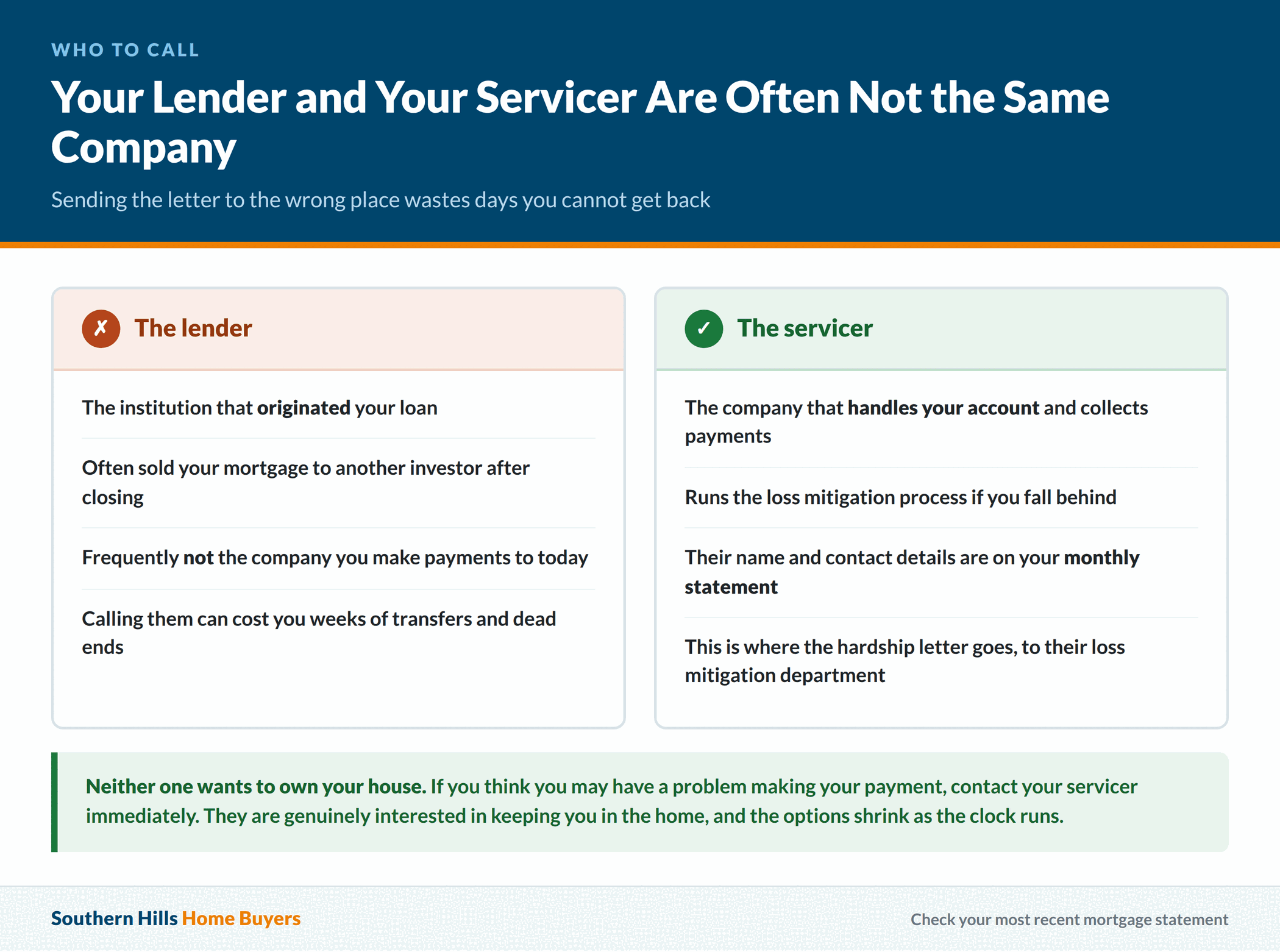
Look at your monthly mortgage statement for the servicer’s name and contact information. That’s the servicer you call, not the bank you signed with three years back. A hardship letter goes to the servicer’s loss mitigation department, and sending it to the wrong place burns days or weeks you can’t get back. Pull the most recent statement, find the servicer’s name, and verify the mailing address and fax number before anything leaves your hands. If you think you may have a problem making your mortgage payment, contact your lender or servicer right away. Neither one wants to own your property. They’d rather keep you in it, and that’s not sentiment, it’s arithmetic on their end.
How to Communicate with Your Lender or Servicer Before It Is Too Late
Redfin’s March 2026 data puts the Texas median sale price at $341,800, down 1.8% year over year. That leaves plenty of Texas homeowners who bought in 2021 and 2022 sitting on thinner equity than they expected. That math changes the conversation with your servicer. Know your approximate home value before you call.
Document every conversation with your servicer. Write down the date, the time, the representative’s name, and exactly what got said. Follow each call with a written confirmation by email or mail, and keep copies. Servicers handle enormous call volumes, and what one representative tells you out loud may not match what lands in your file. The paper trail is what protects you if a dispute shows up later.
Ask specifically for the loss mitigation department. General customer service can’t approve a repayment plan, a forbearance, or a loan modification. Loss mitigation specialists are trained to work through workout options, but they need your hardship letter and your financial documentation before the formal review process can begin. It may take a few weeks or longer to hear back from the servicer’s specialist about the decision on your workout plan, so the sooner you submit, the better your timeline looks.
When Does the Foreclosure Process Begin in Texas?
The 120-day federal threshold is the floor for most bank-issued loans. Cross it and the servicer can formally start the foreclosure process, and from there the clock inside Texas law takes over.
If the default isn’t cured inside that period, the foreclosure process accelerates. Once the cure period expires, the lender files a Notice of Sale with the county clerk and mails a copy to the homeowner. That notice must be posted at the county courthouse, published in a local newspaper, and mailed to the homeowner. The mailing has to happen at least 21 days before the auction date. So from the moment the Notice of Sale goes out, you have at minimum a few weeks before the home hits the auction block. That sale falls on the first Tuesday of the month, always a Tuesday, without exception.
This isn’t much runway. Homeowners who wait for the Notice of Sale to land before making calls are already deep in crisis territory. Loss mitigation, the process where your hardship letter actually carries weight, works best when it starts during the preforeclosure window, before any notices get filed. Your lender only has to send two notices ahead of a foreclosure sale, and once both have arrived your options have narrowed hard. This is also the point to call a HUD-approved housing counselor, earlier than most borrowers think, and to read up on the moves that head off a foreclosure in Dallas. For free foreclosure prevention counseling, call the HOPE Hotline at 888-995-HOPE (4673).
What Happens During Acceleration Procedures on a Texas Mortgage?
A single missed payment in Arlington can set off a chain of events most homeowners never see coming. Acceleration is a contractual trigger with real consequences.
Acceleration means the servicer declares the entire remaining balance of your mortgage loan due immediately, not just the missed payments but every dollar left on the loan. That happens after the cure period on the notice of default runs out. Once a loan is accelerated, catching up on past-due payments no longer stops the foreclosure, because you’d have to pay off the full balance. Reinstating the loan by covering what’s past due has to happen before acceleration kicks in.
Your loan agreement spells out when and how acceleration can be triggered. Lenders generally have to give you notice before they accelerate, and Texas law gives borrowers a chance to cure the default first under most standard deed of trust agreements. Got an acceleration notice? Talk to a Texas real estate attorney immediately. A lawyer who handles foreclosure defense can read your specific loan documents and tell you what rights you’ve still got. The Texas State Law Library is a solid starting point for finding legal resources statewide.
What Are the Stages of Foreclosure in Texas?
Sit down across from me at your kitchen table and I’ll walk you through exactly how this plays out, step by step, because knowing the map makes the territory less frightening.
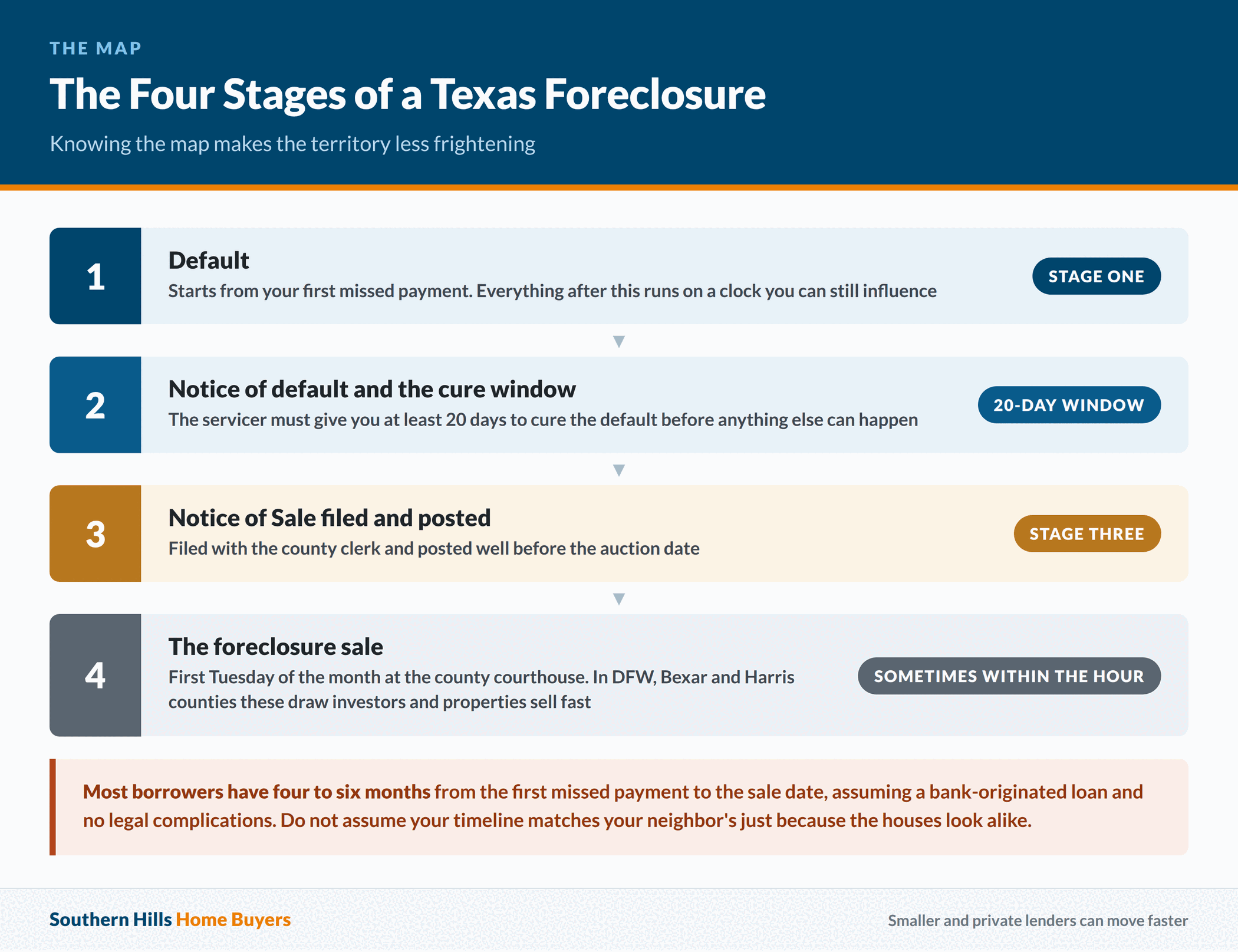
Stage one is default, which begins with your first missed payment. Stage two is the notice of default and the 20-day cure window, the stretch where stopping a foreclosure once it starts is still straightforward. If that window closes without a resolution, stage three arrives. The lender files and posts the Notice of Sale with the county clerk, well ahead of the auction date. Stage four is the foreclosure sale itself, held on the first Tuesday of the month at the county courthouse. Across Dallas County, Tarrant County and the rest of the Metroplex, these foreclosure auctions draw investors, and properties sell fast, sometimes inside the first hour.
The Texas non-judicial foreclosure process moves quickly from that first formal notice to the sale itself. Add the preforeclosure period and most homeowners get somewhere between four and six months from the first missed payment to the sale date, assuming a bank-originated loan and no legal complications. Smaller or private lenders can move faster under Texas state law, so don’t assume your timeline matches your neighbor’s just because the houses look alike.
Eviction proceedings can follow the sale. A foreclosure sale in Texas transfers the property title to the buyer, and the former homeowner has no automatic right to stay. Your local county clerk’s office can confirm current procedures and timelines for your county.
What Is Loss Mitigation and What Workout Options Are Available?
Servicers don’t have to offer every loss mitigation option to every borrower. What’s available depends on your loan type, your investor, your servicer’s guidelines, and whether the hardship is temporary or permanent.
Repayment plans spread your past-due payments across several months, stacked on top of the regular payment. Forbearance lets you pause or reduce payments for a set stretch, with the understanding that you’ll repay what got deferred later. A loan modification changes the actual terms of your mortgage, maybe lowering the interest rate, maybe extending the loan term, maybe both. For FHA-insured loans, FHA has established a loss mitigation option called the Payment Supplement. It pairs a standalone Partial Claim, which brings the mortgage current, with a new Monthly Principal Reduction payment. That reduction temporarily lowers the borrower’s monthly payment for three years, after which the borrower resumes the full principal and interest amount. Some homeowners also ask whether they can pause mortgage payments while selling, and that’s a separate question.
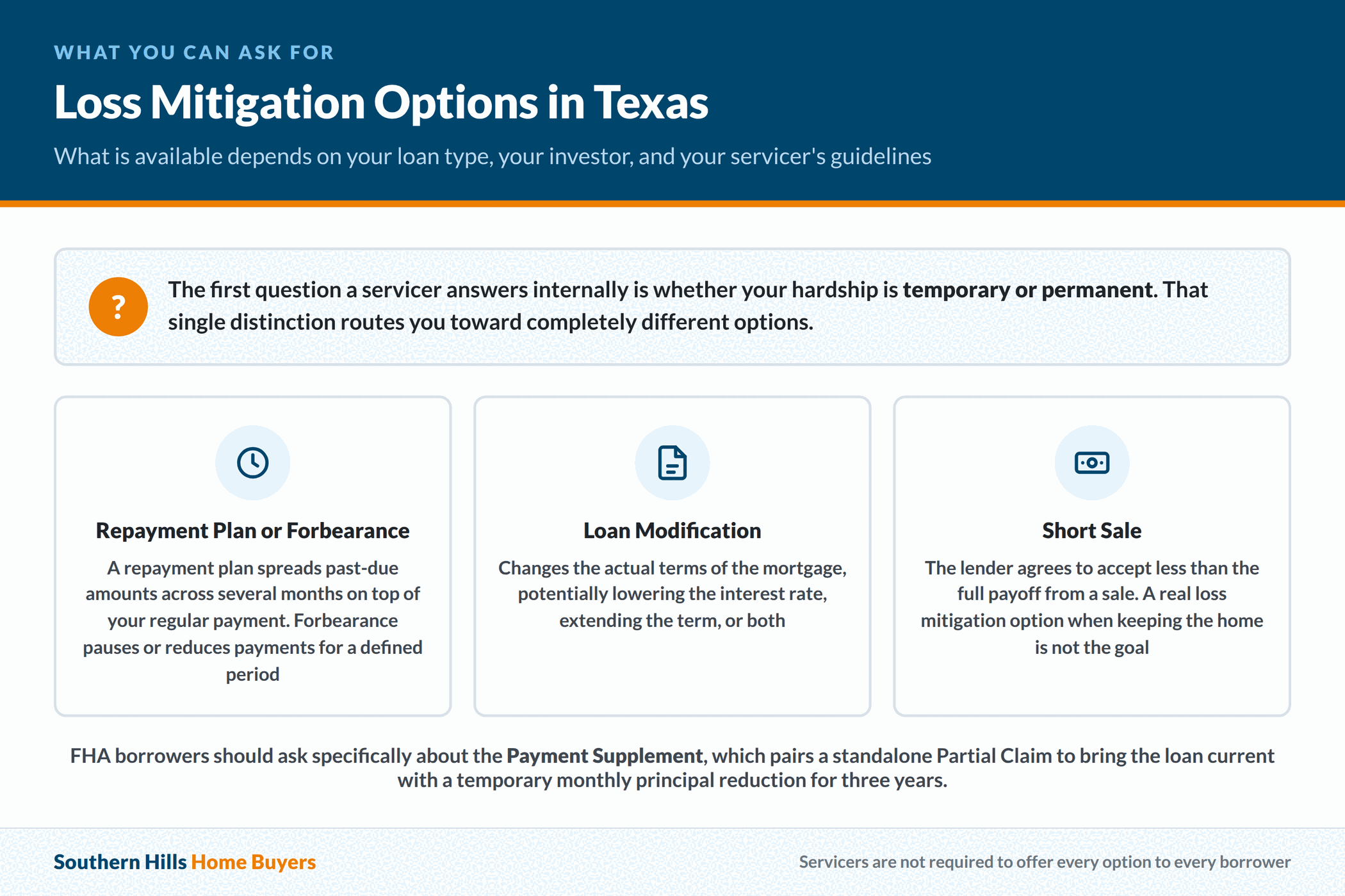
For conventional loans backed by Fannie Mae or Freddie Mac, similar modification options exist. The Consumer Financial Protection Bureau publishes resources that explain what your servicer has to offer and review during the loss mitigation process. A short sale, where the lender agrees to take less than the full loan payoff from a sale, is another loss mitigation option when keeping the home isn’t financially realistic. So is a deed in lieu of foreclosure, where you hand the property over to the lender voluntarily.
How to Prioritize Your Debt When Facing Financial Hardship in Texas?
Which bill gets paid first when you can’t pay them all?
Your mortgage outranks almost everything else. Credit cards can send collection letters, and utilities have shutoff processes that take time, but your mortgage lender can take the property. That’s a categorically different kind of debt, and your budgeting has to reflect it. Pay the mortgage first if you can pay anything at all. After that, cover the utilities you need for basic living, then any car payment tied to your ability to earn income.
Pull together the full financial picture before you contact your servicer. Monthly income from every source, including pay stubs or proof of business income. Monthly expenses broken down honestly, all outstanding debts, and bank statements for the past two or three months, since servicers check those against each other. The Texas Department of Housing and Community Affairs keeps a list of certified free credit counselors who can help you build a budget and prepare your loss mitigation application at no charge.
A certified nonprofit credit counselor can help you build a budget at no charge. Never hand an agency a large up-front fee or donation, and don’t join an organization that charges a membership fee. Any “foreclosure rescue” outfit asking for money before it has done anything is waving a red flag worth heeding.
How to Write a Hardship Letter to Your Mortgage Servicer in Texas
Your hardship letter is not the place to beg. It’s a business document.
Servicers read hundreds of these. What earns a letter real attention is specificity, honesty, and a clear line between what happened in your life and why the mortgage payment isn’t happening right now. Emotional language doesn’t move the needle. Facts and documentation do.
Open with a concise statement of who you are as the borrower: your name, your loan number, and the property address. “I lost my position in March 2025 following a company-wide reduction in force” is more useful than “things have been really difficult.” Name the event and the date. Explain how it cut your income or raised your expenses.
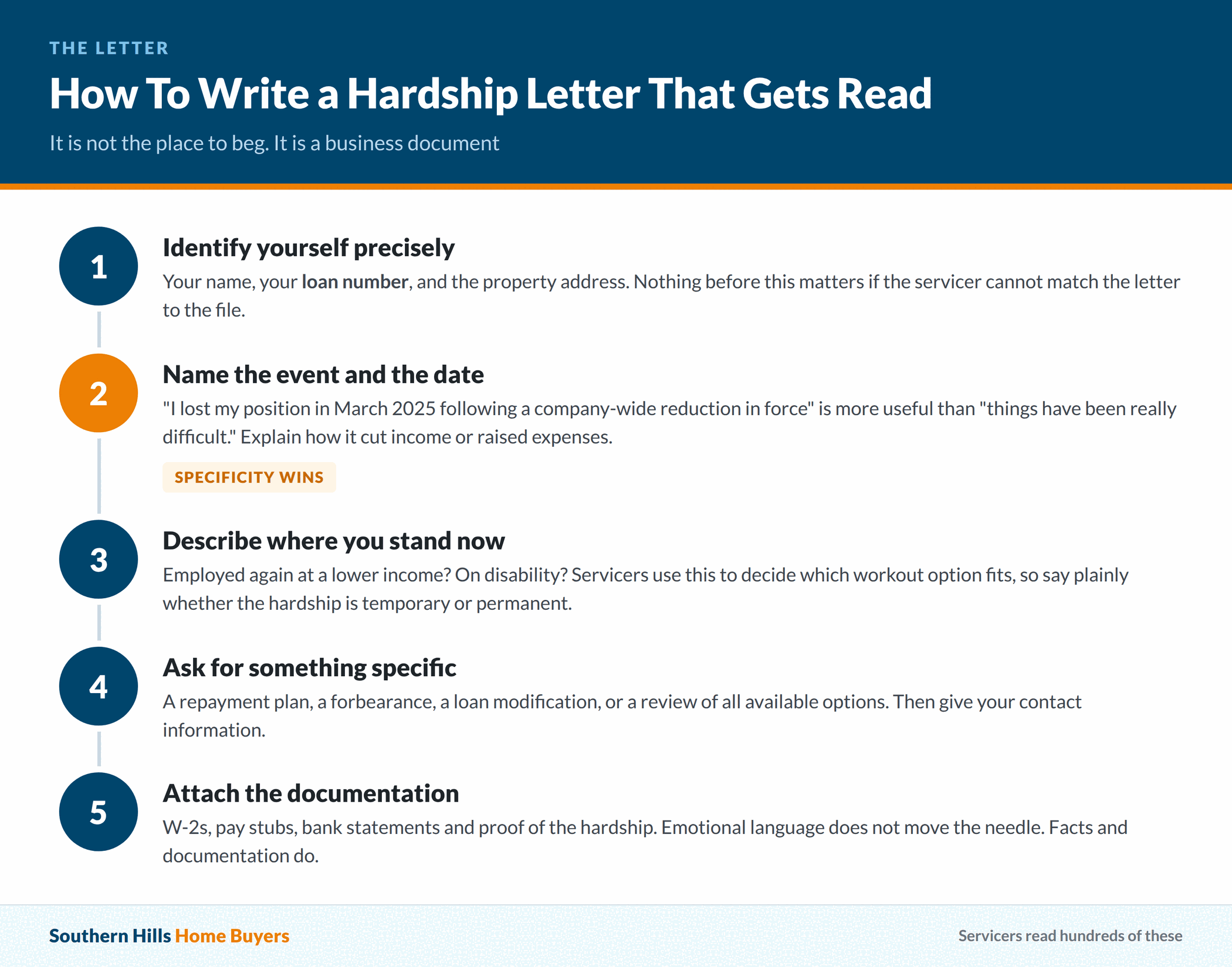
Then state where your finances stand today. Are you employed again at a lower income? Are you on disability? Is this a temporary gap or a permanent change? Servicers use those answers to decide which workout option, if any, fits. If the hardship is temporary, say so and explain why you believe that. If it’s permanent, say that too, and ask for options that match your new income reality.
Close the letter with a clear statement of what you’re asking for: a repayment plan, a forbearance, a loan modification, or a review of all available options. Give them your contact information, and say you’re willing to provide any additional documentation they need.
Documentation to attach starts with W-2 forms from the previous year, a completed budget, and the hardship letter explaining your situation. Add your most recent pay stubs or paychecks, two to three months of bank statements, and your most recent federal income tax returns. Include a list of all monthly expenses and outstanding debts, plus supporting documents for the hardship itself, like a termination letter, a medical statement, or a divorce decree.
Keep the letter to one page if you can, though two pages is the outside limit. Servicers don’t need your biography. They need a clear picture of what happened, where you stand, and what you’re asking for.
If the math in your household doesn’t support keeping the property even with a modification, that’s worth facing honestly instead of delaying. Teams like Southern Hills Home Buyers work directly with Texas homeowners who are weighing every option. That includes a direct sale that closes fast and clears the mortgage debt without waiting on a traditional listing to pan out.
What Happens If You Abandon Your Property During Foreclosure in Texas?
Some homeowners say, “I’ll just leave. The bank can have it.” That logic misses several things that will follow you long after you drive away.
Abandoning the property doesn’t end your legal relationship with the mortgage debt. Until the foreclosure sale closes and the title transfers, you’re still the owner of record. Property taxes keep accruing in your name, the homeowner’s insurance obligation stays with you, and damage or vandalism can land liability on you. Vacant homes in Texas neighborhoods like Oak Cliff in Dallas, or in older parts of Mesquite, don’t sit quietly. They attract problems fast.
After the foreclosure sale, the lender may still come after you for a deficiency judgment if the sale price doesn’t cover the full loan balance. Texas law does allow deficiency judgments in certain circumstances, and that leftover balance can follow you into the next chapter of life. It can affect your ability to get another home loan or handle other financial obligations. Your Texas real estate attorney or a housing counselor can explain how deficiency rules apply to your loan type, because the rules differ for home equity loans and standard mortgage loans.
I watched this pattern repeat during a stretch of years when the market shifted. A number of sellers in Haltom City, just north of Fort Worth, walked away from properties they thought were underwater. One homeowner left a garage full of tools and equipment behind, figuring the bank would handle everything. The liability and the deficiency both caught up with him. Disappearing doesn’t make the debt disappear. Staying engaged, even when the situation feels hopeless, keeps more options open.
A direct sale to a local buyer, closed before the foreclosure sale date, can wipe out the deficiency risk entirely. The mortgage debt gets paid off at closing. Southern Hills Home Buyers has worked through these situations with Texas homeowners who needed a fast, clean resolution with no loose ends. You can see how a direct sale works and then talk with the team about what the timeline would look like on your property.
Homes that sold in Texas were taking an average of 72 days on market as of November 2025, so a traditional listing carries real timing risk against a foreclosure deadline. That holds whether the house sits in McKinney or out past Waxahachie. This isn’t an argument against listings in general. It’s arithmetic applied to a specific deadline.
Frequently Asked Questions
What Should You Write in a Mortgage Hardship Letter?
Your hardship letter should carry your loan number, the property address, and a clear description of the event that caused the hardship. State where your finances stand today, and make a specific request for the kind of assistance you want. Attach supporting documents: recent pay stubs, bank statements, income tax returns, and any paperwork tied directly to the hardship, such as a termination letter or a medical bill. Keep the tone factual and the letter brief, one to two pages.
How Do You Qualify for Mortgage Hardship Assistance?
Most loss-mitigation applications ask you to describe the change in financial circumstances preventing you from paying your mortgage. Recognized hardships include unemployment, temporary or permanent disability, uninsured medical expenses for a family member, divorce, death, or other circumstances generally beyond your control that reduce your income or increase your expenses. Your servicer will also review your income, your expenses, your bank statements, and the current value of the property to decide which workout options you qualify for. There’s no universal income cutoff. Qualification depends on your loan type and investor guidelines.
What Emergency Mortgage Payment Assistance Programs Are Available in Texas?
The Texas Department of Housing and Community Affairs is the primary state agency for housing assistance, and its foreclosure prevention resources include a directory of certified free credit counselors. TDHCA’s Texas Homebuyer Program also offers mortgage assistance through approved providers statewide. For immediate guidance, the HOPE Hotline at 888-995-HOPE (4673) connects you with HUD-approved counselors who can help you weigh your options at no cost.
What Does a Good Hardship Letter Look Like?
A strong hardship letter opens with your loan details and a one-sentence statement of the hardship. It then explains the specific event in plain language, describes your current financial situation honestly, and closes with a direct request for a specific type of assistance. No long apologies. No dramatic language. A servicer reading your letter needs to understand quickly what happened, where you are now, and what you’re asking for. That clarity, backed by solid documentation, does more for your application than any amount of emotional appeal.
If you’ve read this far and you’re still unsure whether fighting for a modification makes sense, or whether a direct sale before the foreclosure date is smarter, that’s a real conversation worth having. You don’t have to work it out alone. Southern Hills Home Buyers talks with Texas homeowners in exactly these situations, no pressure and no obligation, just a straight conversation about what your options actually are. Reach out to the team whenever you’re ready.
Facing Hardship in the Dallas-Fort Worth Metroplex
When the letter doesn’t land the option you need, the equity in the home is usually the next resource. As of July 2026 the median listing price across the Dallas-Fort Worth-Arlington metro ran about $439,000, with a median of roughly 54 days on market, according to Federal Reserve Economic Data. Set that against a four to six month window from first missed payment to sale date. A traditional listing plus a financed closing eats nearly all of it, which is why homeowners with a posted sale date usually need something faster.
We buy houses from homeowners in hardship across the Metroplex, on their timeline rather than the county’s. If the property sits inside the city, we’re the cash home buyers in Dallas who work these situations every month. We also buy in Fort Worth, Garland, Mesquite, Grand Prairie and Irving.
Send the Letter. Then Find Out What the House Is Worth Today
Writing the hardship letter and knowing your fallback aren’t competing strategies. They’re the same strategy. Knowing what the property would bring in a fast sale tells you how much room you actually have while the servicer takes its time. We can look at it and give you a straight number, and we’ll tell you honestly if we think you should keep working the loss mitigation route instead. No pressure and no obligation. You can also read other frequent questions here.
Ready to get started? Reach out to Southern Hills Home Buyers or fill out the form below, and we’ll come back to you with a straight answer, usually the same day.
Get Cash For Your Texas House Today
We buy houses in Texas without the hassle and red tape. Get your no-obligation cash offer for your home and just be done. Selling in as-is condition has never been easier.