

You sign the listing agreement on a Tuesday afternoon and you feel good about it. The broker seemed sharp. The commission rate looked fair, and you honestly believed the house would sell inside a month. Then three months go by. Showings are sparse, communication goes quiet, and that “For Sale” sign in the yard starts to look like a monument to stalled plans. Now you’re wondering whether you’re trapped, or whether there is a legitimate way out.
Homeowners across the state ask me that constantly, and the honest answer has more layers than it first appears.
Can You Actually Get Out of a Listing Agreement?
A signed listing agreement is a legal contract between you and a real estate broker in the State of Texas. Sellers can generally revoke the agreement. Doing that without the broker’s cooperation, though, can expose you to financial consequences written into the contract itself. That part rarely comes up at the signing table.
Several years ago I worked with three siblings who had inherited their late mother’s home in Mesquite, just east of Dallas. They had listed it with an agent. Three months in, the listing had gone nowhere and the mortgage kept stacking up. The house had a detached garage stuffed floor to ceiling with tools and old furniture from three decades of living there. They came to me on a Thursday, frustrated and anxious, needing a real solution fast. We stepped in and closed with cash, and nobody had to fight a legal battle over the listing agreement. One conversation with the agent settled things once the siblings understood the leverage they actually held. Expired listings shift that leverage a long way.
Texas home prices in June 2026 sat at a median of roughly $347,900, down slightly from the prior year. Sellers working in a softening market are under real pressure. Waiting out a bad listing relationship is not just inconvenient anymore. It costs money. In a declining market, every extra month on the shelf costs more than the month before it.
What Is a Listing Agreement in Texas?
Statewide median days on market hit 69 days as of June 2026, up three days year over year. Sixty-nine days is a long stretch to sit locked into a contract with a broker who is not producing results. So understanding what a listing agreement actually is matters from day one, before you sign anything at all.
Every home sale in Texas starts with a listing agreement. It is the contract between you, the seller, and your broker that authorizes them to market and sell your property. It spells out what the broker will do, what you will pay, how long you are committed, and what happens if none of it works out.
The form most brokers hand you is the TXR Residential Real Estate Listing Agreement, often called the Exclusive Right to Sell. Texas Realtors publishes it as a standard form. The terms inside it are not standard. Every blank on that form is negotiable, and brokers rarely volunteer that. What gets written into those blanks determines the relationship you will have with the brokerage.
When you sign, you are granting the listing broker exclusive authority to market your property for a defined period. That exclusivity makes the contract binding, and it is also what makes walking away complicated. Your agreement covers the commission rate, the listing term, advertising rights, and what happens if you sell the property yourself or through another brokerage. Agents call that last one a procuring cause dispute. All of it is in writing, and all of it carries weight under Texas real estate law.
The Texas Real Estate Commission (TREC) licenses and regulates brokers and sales agents working in the state. A broker who violates their obligations under the agreement, or under TREC’s ethical standards, opens a door most sellers never knew was there. More on that in a minute.
Key Components of a Valid Texas Listing Agreement
Sellers rarely read the full listing agreement before signing, the same way they skip the documents needed to sell a house in Texas until closing week. That habit costs some of them later, when they try to exit and find out how thorough the contract really is.
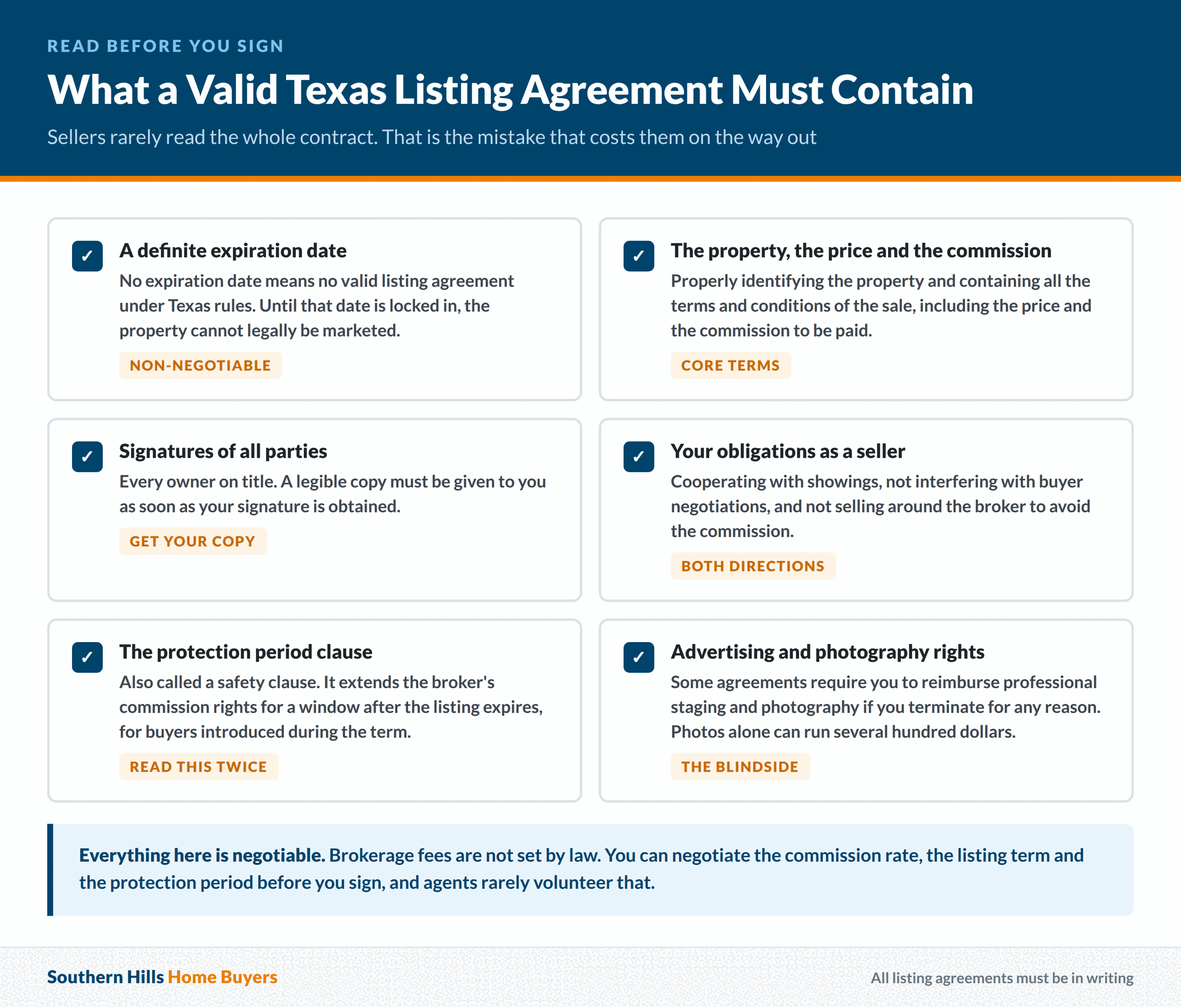
All listing agreements have to be in writing, properly identifying the property and containing every term and condition under which the property is to be sold. That includes the price, the commission to be paid, the signatures of all parties, and a definite expiration date. No expiration date means no valid listing agreement under Texas rules, which means the property cannot legally be marketed until that date is locked in.
Your listing agreement has a start date and an end date. That is the window you are committed to. During that period the broker holds the exclusive right to market and sell your property. Terms at traditional brokerages commonly run from 90 days to 12 months, with six months being typical, and sometimes non-negotiable at the larger firms.
Beyond the term, the contract spells out your obligations as a seller. You cooperate with showings. You do not interfere with buyer negotiations, and you do not sell the property around the broker to dodge a commission. There is usually a protection period clause too, sometimes called a safety clause. It extends the broker’s commission rights for a set window after the listing expires, if a buyer introduced during the listing period ends up buying the property.
Pay close attention to anything about advertising and photography rights. Some agreements say that if the broker provides professional staging and photography, and the seller then terminates the listing for any reason, the seller reimburses the broker for those expenses. Professional photos alone can run several hundred dollars. Sellers who skipped that paragraph get blindsided by it.
Types of Listing Agreements Texas Sellers Should Know About
A seller in Grand Prairie called me once after signing a net listing agreement with an out-of-area broker. She had not realized the broker was motivated to keep whatever came in above her minimum price, rather than to maximize what she walked away with. Picking the right listing agreement shapes the whole relationship with your agent, and the wrong one quietly costs you.
In Texas residential real estate, the most common arrangement is the exclusive right to sell. Your broker earns the agreed commission no matter who finds the buyer, even if you find the buyer yourself. It is the contract between you and your broker that authorizes them to market and sell your property. Most agents push this form because it protects their commission, and that protection runs in both directions.
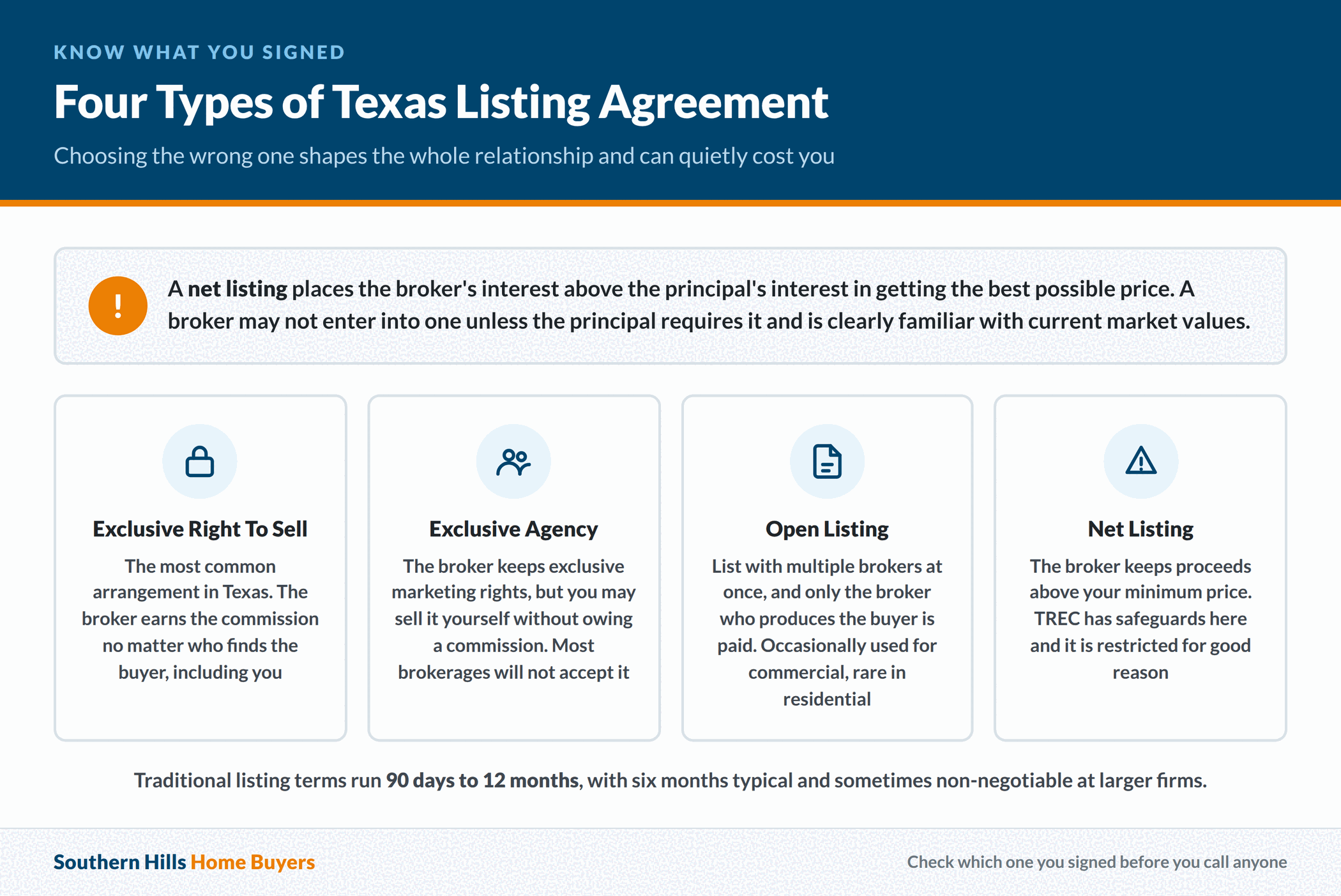
An exclusive agency listing is less common. Your broker still holds exclusive marketing rights, but you keep the right to sell the property yourself without owing a commission. Most traditional brokerages will not accept that arrangement, which is why you rarely see one.
Open listings let you list with several brokers at once, and only the broker who produces a buyer earns the commission. Sellers use open listings on commercial property now and then. In residential, they are rare.
A net listing places the broker’s interest above the principal’s interest in obtaining the best possible price. A broker may not enter into a net listing agreement unless the principal requires it and the principal is clearly familiar with current market values of real property. TREC has safeguards here for good reason.
Your contract type determines how much leverage you carry into a termination conversation, and what fees, if any, you will face on the way out.
What Rights Do Sellers Have When Signing a Listing Agreement?
Sellers in the State of Texas are parties to a legal contract. They are not employees of a brokerage. That distinction matters more than most listing conversations admit.
Brokerage fees are not set by law, and they are negotiable. You can negotiate the commission rate, the listing term, the protection period, and plenty of other provisions before you sign, in Plano or anywhere else in Texas. Agents rarely volunteer that, and it is no oversight. Shorter terms and lower commissions do not serve a broker’s finances.
You have the right to a copy of the listing agreement the moment you sign it. A legible copy of every written listing agreement or other written authorization must be given to the owner of the property by a licensee. That has to happen as soon as the signature of the owner is obtained. So you should not have to ask twice or chase anyone down. An agent who leaves without handing you a copy has already created a problem.
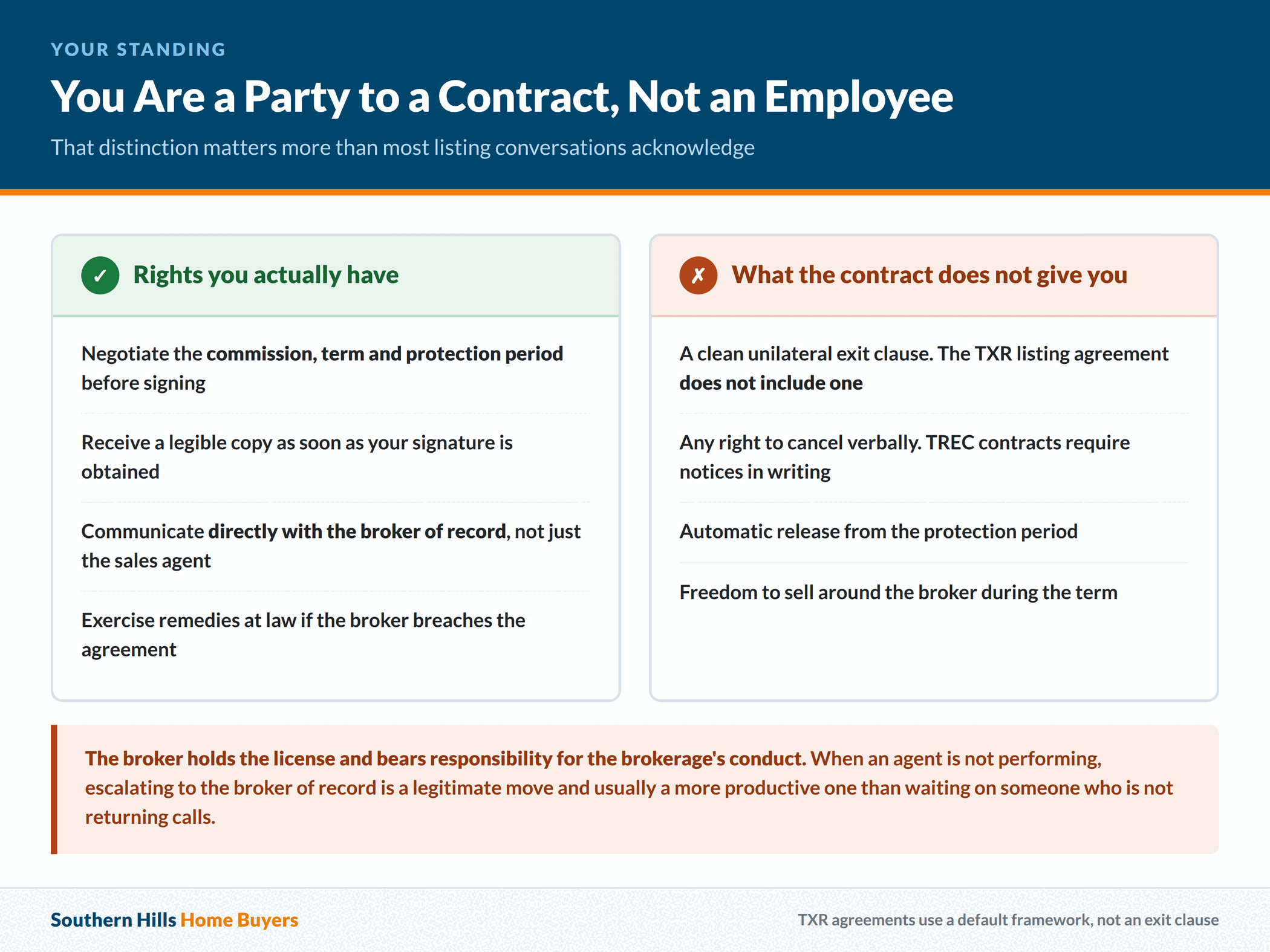
Can you get out of a listing agreement if things are not working? The TXR listing agreement does not include a clean exit clause for sellers. The agreement runs on a default framework instead. Under Paragraph 16, if either side breaches the agreement, the other side has remedies.
You also have the right to communicate directly with the broker of record, not just the individual sales agent who listed your home. When an agent is not performing, escalating to the broker is legitimate and usually more productive. The broker holds the license. That same broker bears responsibility for the brokerage’s conduct under Texas real estate law, so you are not stuck waiting on somebody who will not return your calls.
Legal Grounds for Terminating a Listing Agreement in Texas
Some sellers hear “legal grounds” and assume they need something dramatic, like fraud or complete abandonment. That is not quite right. The bar sits lower than most people expect.
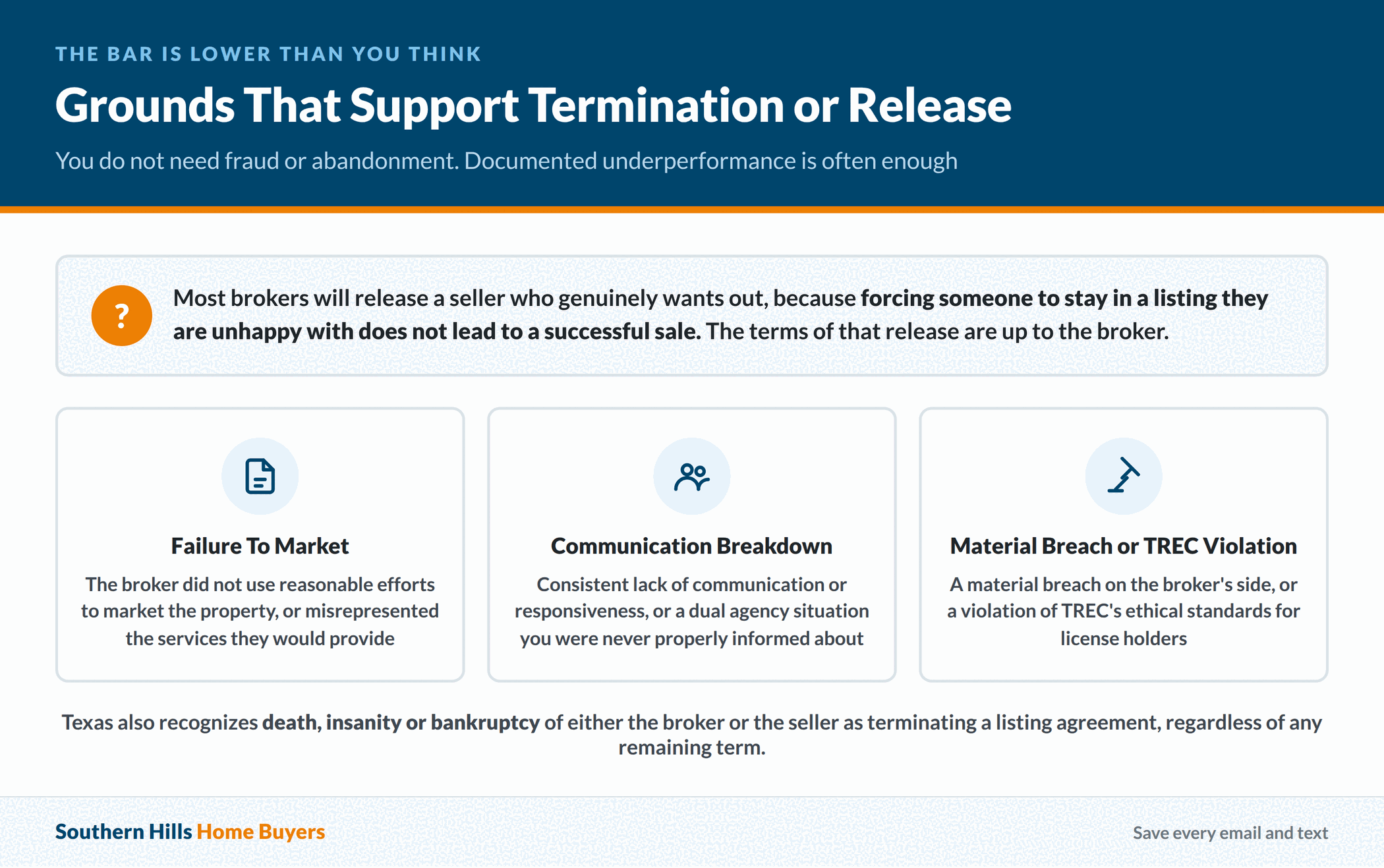
If the seller stops cooperating, the broker can terminate and may still be owed a commission. If the broker breaches, the seller can exercise remedies at law. In practice most brokers will release a seller who genuinely wants out, because forcing somebody to stay in a listing agreement they resent does not produce a sale. The terms of that release, though, are up to the broker, and some will ask for reimbursement of marketing expenses already spent.
Grounds that may support termination or release start with the broker’s failure to use reasonable efforts to market the property. Consistent lack of communication or a pattern of unreturned calls counts. So does misrepresentation of the services the broker said they would provide, or a dual agency situation where you were not properly informed. A material breach of the contract on the broker’s side belongs on the list. TREC’s ethical standards for license holders matter here too, and a sales agent who violates them hands you leverage in a termination conversation.
Death, insanity, or bankruptcy of either the broker or the seller can also legally terminate a listing agreement in Texas. Courts and TREC treat those circumstances as dissolving the contractual relationship, whatever listing term is left on the paper.
Mutual agreement is by far the cleanest path. Ask the agent to mutually terminate the agreement. If they want to know why, be honest about your reasons. If they refuse, go to the agent’s broker and review the request with the broker directly. Most situations resolve at that level, without lawyers.
How to End a Listing Agreement the Right Way in Texas
So what is the actual process once you have decided you want out?
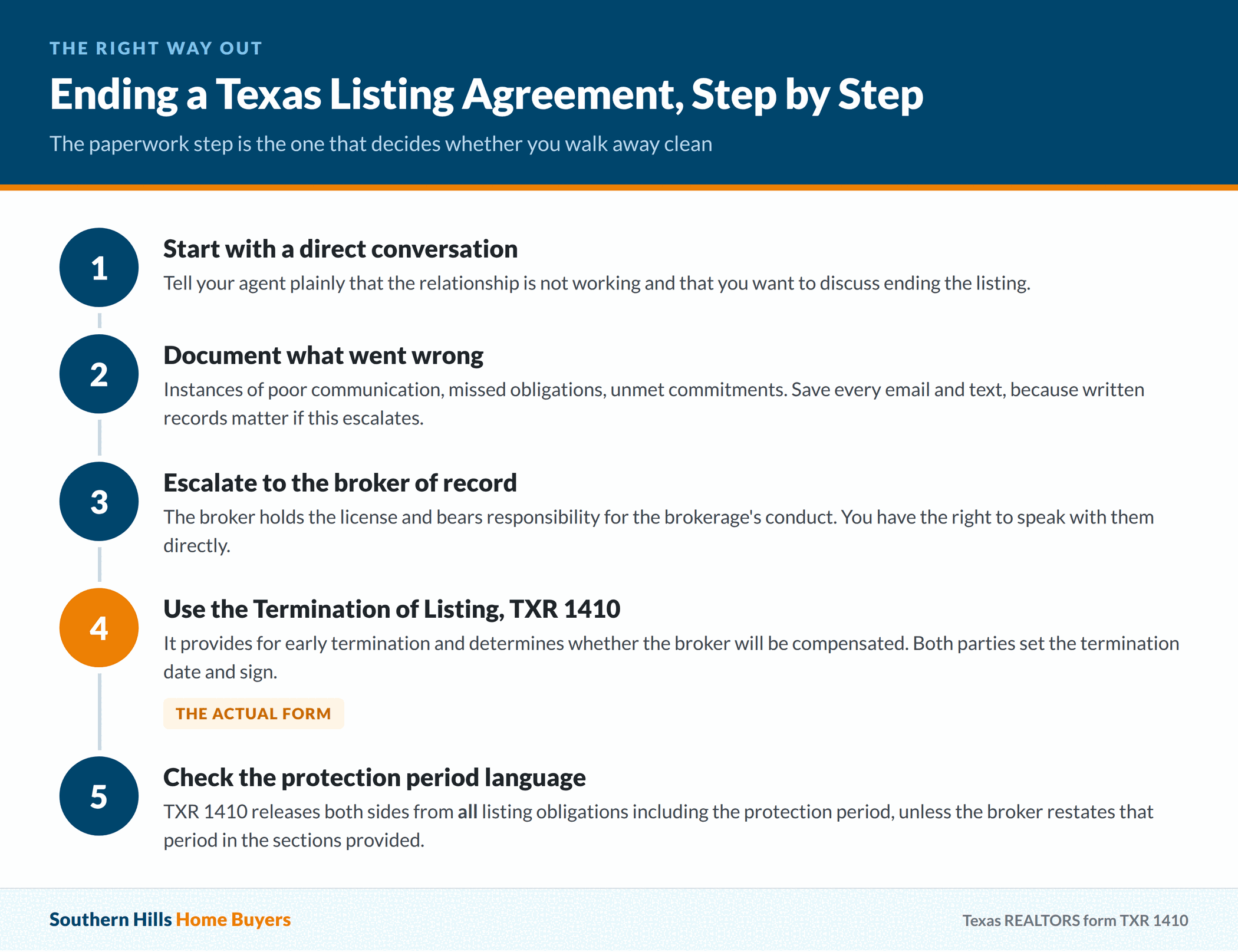
Start with a direct conversation. Tell your agent plainly that the relationship is not working and that you want to discuss ending the listing. Come prepared. Document the poor communication, the unmet commitments, the promises that went nowhere. Written records matter if this escalates, so save every email and text.
If you determine that you want to terminate the listing agreement, you can use the Termination of Listing form, known as TXR 1410. That form provides for early termination of a listing. It also determines whether the broker will receive compensation for the early termination.
Brokers and their seller clients can agree to end any Texas Realtors listing agreement using the TXR 1410 form. Sellers and brokers can set the termination date and agree to broker fees when the property is sold or leased. Both parties sign it, and the termination becomes official.
The form also releases the seller and broker from all listing obligations including the protection period. Brokers should be mindful to restate the terms of that period in the sections provided in the Termination of Listing if they want the protection period to continue. If your broker signs TXR 1410 without reinstating that language, the protection disappears entirely, and I have watched sellers walk away clean because of it. You can then list with another agent, or sell directly, without owing your former broker anything.
Designed for residential, commercial, and farm and ranch properties, the TXR 1410 works for all of them. It covers the full range of real estate transaction types.
If you are unsure how your own contract reads, or whether you have grounds to terminate without penalty, talk to a Texas real estate attorney before you send anything in writing. That is the smart move. The Texas State Bar’s lawyer referral service can point you toward somebody with the right background.
What Is a Notice of Seller’s Termination of Contract?
Confusing a Notice of Seller’s Termination of Contract with a Termination of Listing form creates real problems. They are two different documents doing two different jobs.
The Notice of Seller’s Termination of Contract comes into play after a purchase contract is already in place between a seller and a buyer. It is not for ending your relationship with your broker. It is for pulling out of an agreed sale. Mixing the two up can leave you legally exposed in a transaction where you assumed you were protected.
TREC contracts require that all notices from one party to another must be in writing. A verbal statement that you are canceling something, whether that is the listing or a purchase contract, generally is not enough on its own. Whatever you communicate, put it in writing. Send it through a channel that creates a record, like email or certified mail, and not a phone call.
The TREC website at trec.texas.gov keeps the current library of promulgated forms, including the contracts and notices sellers need. Checking there for current form versions is worth the five minutes, because form numbers and requirements do change. Texas law, for example, requires a seller to give a buyer a copy of any mold remediation certificate issued during the five years preceding the sale of the property. Those disclosure obligations do not vanish because you are trying to exit a contract.
A real estate attorney can help you determine exactly which form applies to your situation, draft the written notice, and review any release you are asked to sign before you put pen to paper.
What Happens If You Cancel a Listing Agreement Without Legal Cause?
Sit across from enough sellers and a pattern shows up. People cancel agreements on impulse, without thinking through what is waiting on the other side of that decision.
Sellers can revoke the listing agreement, but there may be damages to the broker for which the seller can be held liable. That liability does not depend on the broker having done anything wrong. A seller in Garland who pulls a listing on Monday because she would rather try a different brokerage can still owe the commission that broker would have earned. Photography, signage, and ad spend add up fast, and those out-of-pocket marketing costs come with the claim.
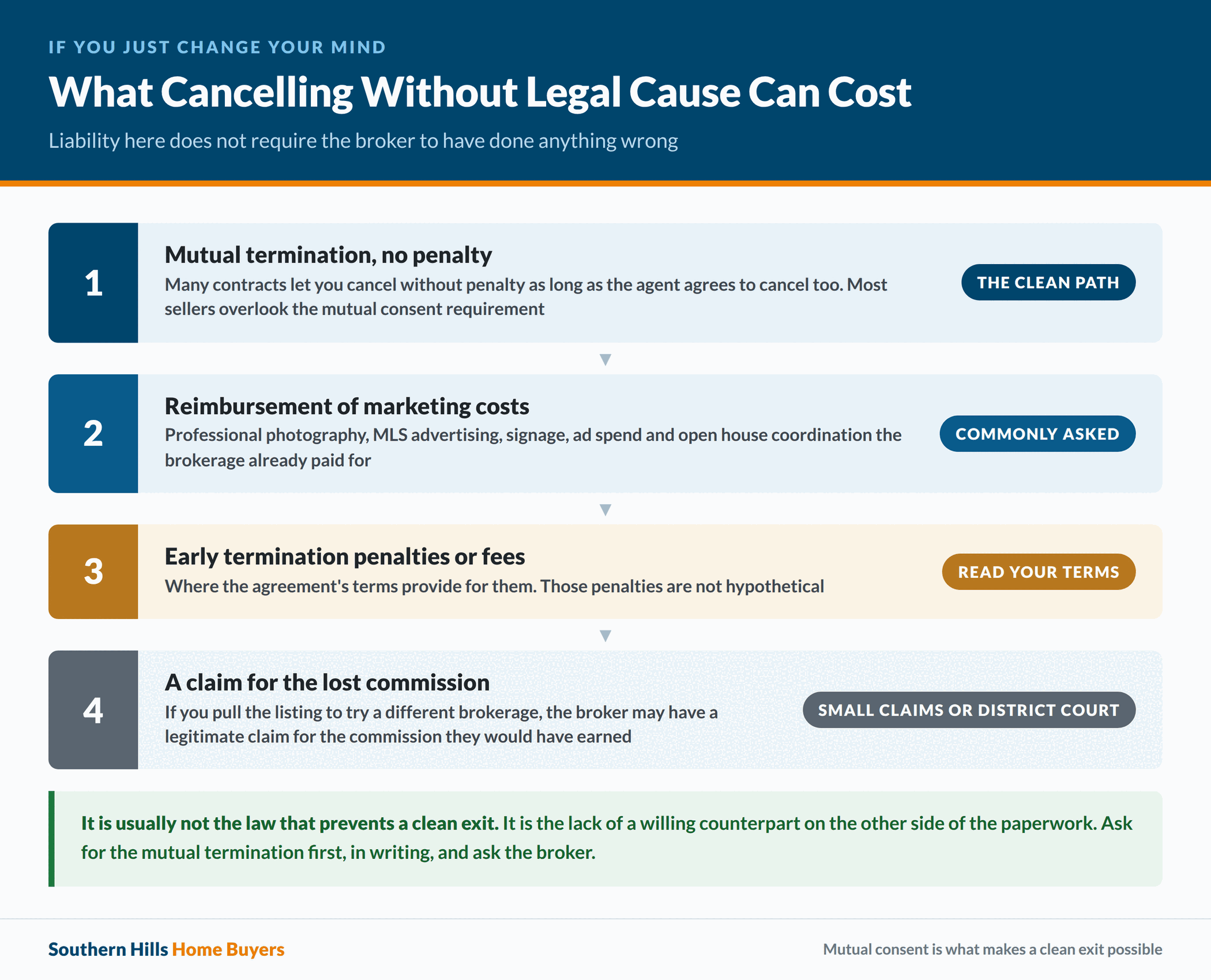
Depending on the agreement’s terms, early termination may bring penalties or fees. Those penalties are not hypothetical. Brokers who spent money on professional photography, MLS advertising, and open house coordination hold a financial stake in the listing, and they can seek reimbursement.
Many contracts let you, the seller, cancel the listing without penalty as long as the agent agrees to cancel it too. Most sellers miss the mutual consent requirement sitting in that sentence. It usually is not the law that blocks a clean exit. It is the lack of a willing counterpart across the table.
If you cancel unilaterally and the broker will not agree, you may face a claim in small claims court or district court, depending on the amount at issue. Money is not the only cost. An unresolved dispute with a brokerage can complicate your next listing, especially if the same MLS serves your area and relationships carry weight.
The smarter path always ends with both parties signing a release. Even when that costs something, a clean exit is worth more than a dispute that drags on for months.
How to Find a Top Real Estate Agent in Texas
One seller spent six months with an agent who had strong residential credentials and no feel for her neighborhood. After a clean release she listed with someone who had closed several transactions in the same subdivision inside the past year. The house went under contract in under three weeks.
Finding the right agent in Texas starts with looking past the license and the headshot. The number of homes for sale was up statewide by 23.1% in 2025, which gave buyers more choices than they had seen in years. An agent who cannot price and position a home in that kind of inventory is going to cost you time.
Ask prospective agents for their transaction history in your ZIP code, not their total volume. An agent who sells 40 homes a year in Frisco may have almost no feel for a slower market in Waxahachie, or for the quirks of an older neighborhood in East Austin. Local knowledge, pricing instinct, and honest communication beat production awards every time.
Verify the agent’s license on TREC’s public lookup database, and confirm they are affiliated with an active, licensed real estate brokerage. An agent working without proper supervision, or whose license sits in inactive status, cannot legally represent you. TREC’s website at trec.texas.gov makes that lookup fast and free.
Shorter listing terms protect you. A 30-day agreement that renews gives both sides a natural exit point, with nobody invoking the default clause or negotiating a termination. A 12-month agreement leaves you relying on the broker’s willingness to sign a TXR 1410 when things are not working.
Before you re-list with another agent, think about whether a direct sale fits your situation better. If you want speed, certainty, or a clean exit without the risk of another long listing term, Southern Hills Home Buyers works with Texas homeowners across the region who need exactly that. No listing agreement, no agent commission, and no photography sessions you will owe money for if things go sideways.
One more thing worth knowing before you decide. An agent working as a dual agent, representing both buyer and seller in the same transaction, has competing loyalties by definition. Texas law requires written consent for dual agency, and written consent does not make the arrangement risk-free for the seller.
How to Find a Top Real Estate Agent in Texas: the Seller’s Side of the Story
Before the Frequently Asked Questions section, one pattern I keep seeing deserves naming directly. A man called on a Wednesday afternoon about a property he had inherited in Rockwall, east of Dallas. The house had been in his family for more than thirty years. The garage alone held enough to fill a small storage unit twice over: tools, furniture, a riding mower, boxes of documents, and things none of the siblings could identify. His brothers and sisters lived in different cities and wanted a clean exit. No showings, no strangers walking through the kitchen, no months of uncertainty. We made a cash offer, gave them time to sort through what they wanted to keep, and closed without anybody negotiating a listing termination or worrying about a protection period. Sometimes the better answer is not a better agent. Sometimes it is a completely different kind of sale.
If you are in a similar spot, Southern Hills Home Buyers is the kind of buyer who understands that inherited properties come with complications a standard listing does not solve well.
Frequently Asked Questions
Can a Broker Terminate a Listing Agreement?
Yes, a broker can terminate the listing agreement, though doing so may expose the broker to damages owed to the seller. Brokers can renounce the listing agreement, but they may be held for damages to the seller. In most cases a mutual termination using the TXR 1410 form is the cleanest path for both parties, since it releases everyone from their obligations and settles the question of any fees.
How Do You Terminate a Listing Agreement in Texas?
Brokers and their seller clients can agree to end any Texas Realtors listing agreement by using the Termination of Listing form, known as TXR 1410. Sellers and brokers can set the termination date and agree to the broker fees when the property is sold or leased. Both parties need to sign the form for it to take effect. If your broker will not cooperate, speak with the broker of record directly, and consider a Texas real estate attorney if the situation still does not resolve.
Can I Cancel My Listing Agreement and List with Another Realtor?
You can, but you need a signed termination of your existing listing first. Signing a new listing agreement while an active one is still in force creates a legal mess, and it can end with two brokers claiming a commission on the same sale. Get a signed TXR 1410 from your current broker before you sign anything new. If the protection period from the old listing is still running, a buyer introduced during that period could trigger a commission obligation to the prior broker even after you have moved on.
Can I Get Out of a Real Estate Listing Agreement?
A listing agreement can be terminated by either side, so you are not trapped. The practical question is whether you can exit without a financial penalty. Mutual agreement is the cleanest route, and many brokers will release a seller who comes to them honestly and explains why the relationship is not working. If a broker refuses and you believe they have breached their obligations, a Texas real estate attorney can help you weigh your options under the contract’s default provisions.
If you are stuck in a listing that is not working, you do not have to sort through it alone. The same goes if you have already canceled and you are trying to figure out what comes next. Southern Hills Home Buyers has worked with sellers all across Texas who needed a straightforward path forward. Sometimes that meant a fast cash offer. Sometimes it meant an honest conversation about the options on the table. Reach out at southernhillshomebuyers.com when you are ready to talk. No pressure, no obligation.
What This Looks Like in the Dallas-Fort Worth Metroplex
Before you re-list, be honest about why the first listing did not work. As of July 2026 the median listing price across the Dallas-Fort Worth-Arlington metro was about $439,000, with a median of roughly 54 days on market, according to Federal Reserve Economic Data. If your house sat 90 days with no offers in a market where the median moves in 54, the problem is usually price or condition rather than effort. A new agent alone will not fix that.
We buy houses across the Metroplex, including plenty that came off a listing nobody could move. Inside the city limits, we are the cash home buyers in Dallas local sellers call when the listing route stalls. We also buy in Fort Worth, Plano, Irving, Carrollton, McKinney and Lewisville.
If the Listing Failed Because of the House, Let Us Take a Look
Sometimes a listing fails because the agent underperformed, and a better agent solves it. Sometimes it fails because the house needs a roof, or the title has a problem, or the honest market value sits below what anybody wanted to hear. Southern Hills Home Buyers has bought plenty of houses across the Dallas-Fort Worth Metroplex that came off a stalled listing. We will tell you which situation we think you are in, including the times when the answer is that you should re-list with somebody good. You can also read other frequent questions here.
No pressure and no obligation. Reach out to Southern Hills Home Buyers or fill out the form below, and we will get back to you with a straight answer, usually the same day.