
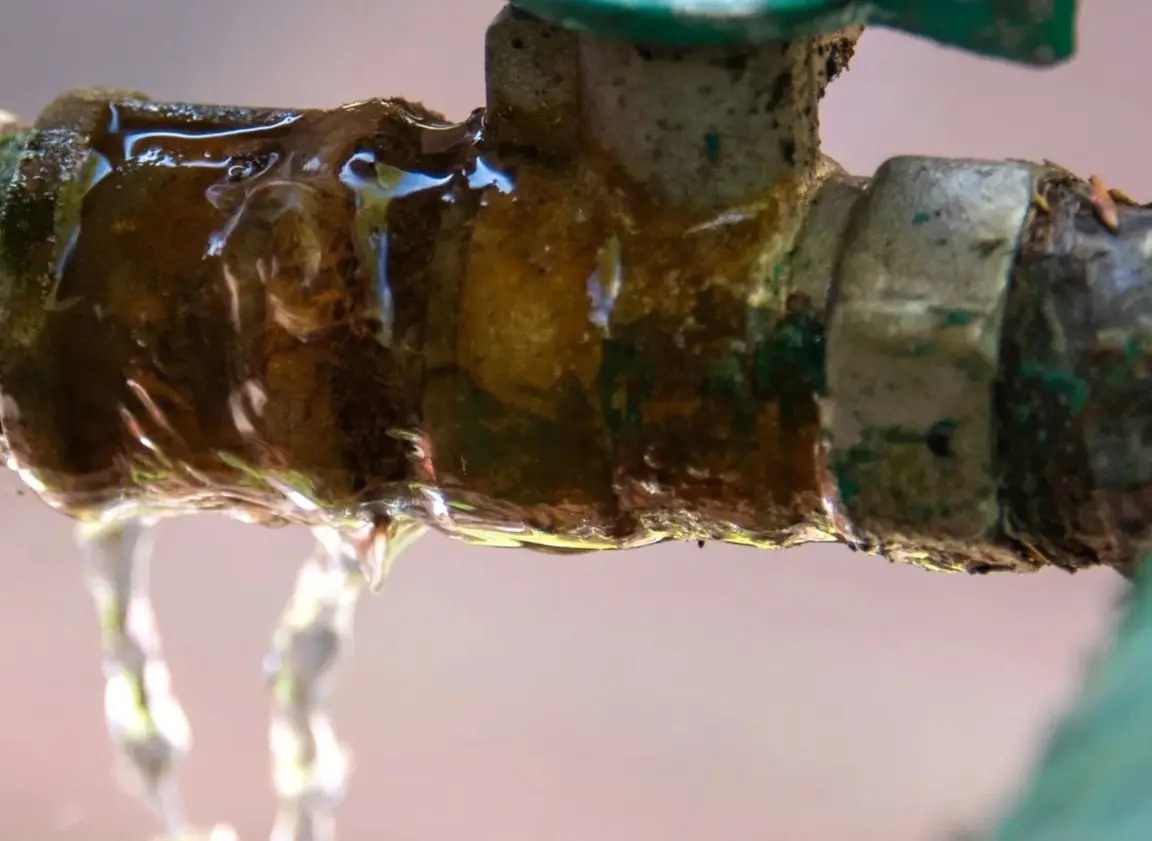
You close on a house in Mesquite on a Friday. By Sunday afternoon you’re pulling up a corner of carpet to lay down a rug, and the subfloor underneath is soft, dark, and smells like a wet dog. That smell doesn’t come from a weekend. It comes from months, maybe years, of water sitting where nobody could see it. And the seller checked “No” on every water damage question in the disclosure.
That moment is disorienting and expensive. You still have options.
Texas law treats nondisclosure seriously. Homebuyers in your spot have more recourse than most agents will mention at the kitchen table. What follows is what actually happened to you, why it matters legally, and which moves are worth making next.
What Are the Most Common Causes of Hidden Water Damage in Texas Homes?
Roof leaks don’t announce themselves. Water that gets in through a cracked ridge cap or worn flashing on an older house in Arlington can travel fifteen feet inside a wall before it stains a ceiling. By the time an inspector walks through, it’s invisible. The drywall looks fine. The paint looks fresh.
Plumbing failures are the other big culprit. Slab leaks under a concrete foundation are nearly impossible to spot without specialized equipment. They turn up constantly across Dallas County, where the clay soil shifts with every wet and dry cycle. A slow drip below a slab can erode concrete from underneath for two or three years before the foundation moves at all. Sellers who’ve had remediation done know this. Some disclose it properly. Others repaint and move on.
Texas homes take on water damage from severe storms, roof leaks, plumbing failures and flash flooding. Humidity and sudden swings in weather push moisture through walls, insulation and flooring within hours. That combination, hard weather on top of aging plumbing, is why Tarrant County and Dallas County see so many of these disputes after a sale closes. I budget for a moisture inspection before I commit to anything.
Drainage deserves a mention too. Grading that sends rainwater toward a foundation instead of away from it drives a large share of moisture claims. You see it in neighborhoods like Oak Cliff in Dallas and the older parts of Garland, where lots were never graded to modern standards. An inspector won’t always catch what a heavy rain does if he shows up on a dry October morning.
I’ve helped families sell homes where the garage held boxes stacked floor to ceiling against every wall. The water damage behind those boxes stayed invisible until moving day. It isn’t always deliberate concealment. It creates the same problem for whoever buys the place.
What Counts as Water Damage a Seller Must Disclose in Texas?
If you sold me this house, I’d want to know everything you knew. Past floods, current leaks, old repairs, whether the place has ever been wet at all. The Texas standard runs broader than most sellers realize while they fill out that disclosure form.
Sellers are legally required to disclose the condition of their property under Texas Property Code § 5.008. The Seller’s Disclosure Notice covers any previous water damage, plus whether the repair work was done professionally.
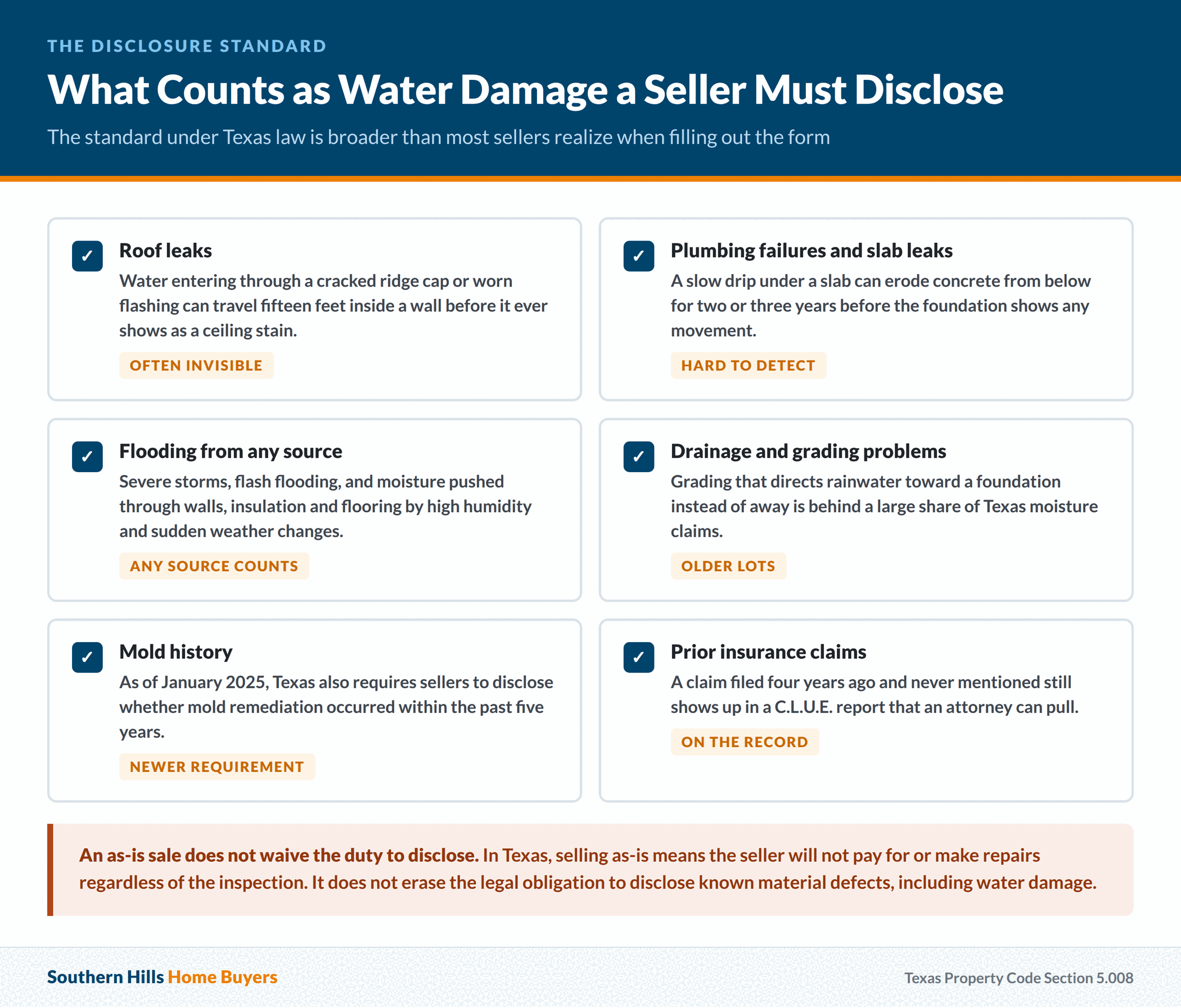
Plenty of Texas sellers think an “as-is” sale wipes out the duty to disclose, and our guide to what Texas home sellers are required to disclose by law lists the whole set. Selling “as-is” in Texas means the seller won’t pay for repairs, no matter what the inspection turns up. The clause doesn’t waive the legal duty to disclose known material defects, and water damage is one of them.
Roof leaks, plumbing failures, flooding from any source, drainage trouble, mold remediation history and prior insurance claims all sit inside the obligation. As of January 2025, Texas sellers must also say whether mold remediation happened on the property within the past five years. That newer rule targets the fresh-paint-over-mold scenario inspectors still miss.
Most buyers underrate how much the insurance claim history matters. A seller who filed a claim four years ago and then sold without disclosing it leaves a trail, because that claim sits in a C.L.U.E. report any attorney can pull.
When Did the Water Damage Start and Why Does the Timeline Matter?
When the water damage started matters enormously to your legal claim. A seller who flooded two years before closing and said nothing stands in a very different position than one whose roof leaked for the first time the week of the sale. Courts and attorneys look at the same three things: when the damage began, when the seller likely knew, and whether repair records, insurance claims or contractor invoices would have surfaced the problem.
Under Texas Civil Practice and Remedies Code Chapter 16, fraud claims generally have a four-year statute of limitations from when the fraud was discovered or reasonably should have been discovered. DTPA claims generally carry a two-year statute of limitations from when the consumer discovered the deceptive act. Which one applies in your case is a question for an attorney. The short answer holds either way: the sooner you document what you’ve found and consult legal counsel, the stronger your position.
Last year I bought a house in Mesquite from a family that had spent three years trying to rent it out after their dad passed. We cleared the place out on a Saturday and found a long waterline on the back wall, low to the ground. The tenants had mentioned flooding. Nobody in the family had ever looked into it. None of them knew it was there. A seller who pays a contractor to paint over mold before listing is another matter entirely.
Your timing also shapes your leverage long before litigation enters the picture. Water damage repair costs in Dallas run from around $1,900 to $9,300 depending on severity, according to restoration cost data from 2025. Get a professional home inspection the moment you suspect a problem. Then you can put a real number on the loss before you call the seller or an attorney, which means you arrive with facts instead of guesses.
How Can You Tell If a Seller Deliberately Hid Water Damage Before the Sale?
Fresh paint inside a closet is suspicious. Not always. When it’s fresh paint on the lower three feet of a closet wall, in a house that hasn’t otherwise been touched since 2008, that’s worth slowing down for.
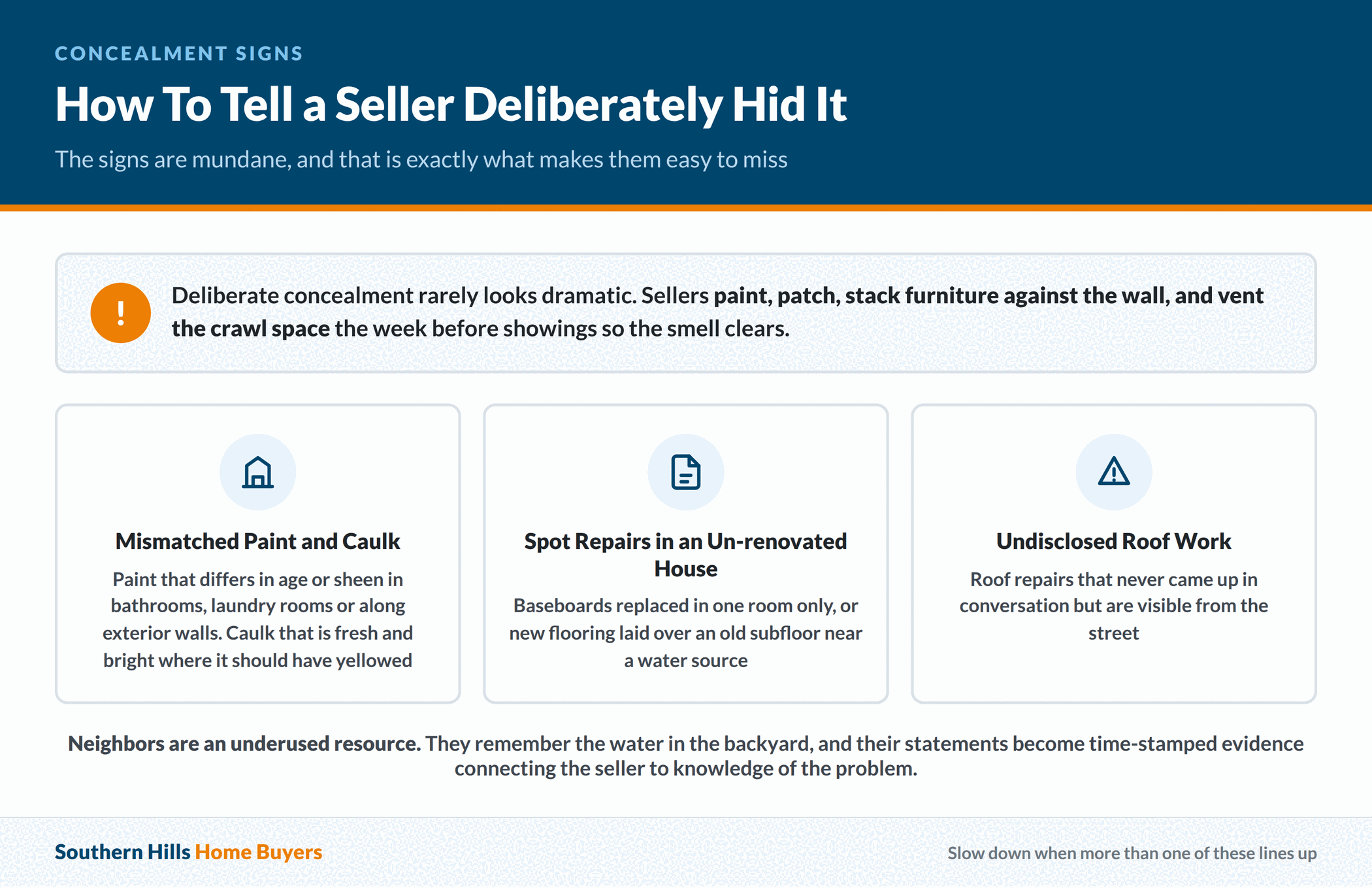
A seller who fails to disclose water damage rarely does anything dramatic. They paint, they patch, they push furniture against the wall, and they vent the crawl space the week before showings so the smell clears. The signs are mundane, deliberate rather than accidental, and that is exactly what makes them easy to miss.
Once you start to suspect intentional concealment, a handful of details deserve your attention:
Paint that doesn’t match in age or sheen, especially in bathrooms, laundry rooms or along exterior walls. Baseboards replaced in one room of a house nobody has otherwise renovated. New flooring laid over an old subfloor near a water source, which I’ve watched hide years of slow leaks. Caulk that’s bright and fresh in spots where it should have yellowed with age. Roof repairs that never made the disclosure but are visible from the street.
To establish that the seller knew about problems, gather time-stamped evidence: neighbor testimony about water pooling on the lot, the property’s insurance claim history through a C.L.U.E. report, and an inspection by a forensic contractor who can detect masked repairs like fresh paint over mold or patched foundation cracks.
Neighbors are an underused resource. They remember the water standing in the backyard after the last big storm. They saw the remediation truck in the driveway. Ten minutes over the fence can surface more than three hours of a home inspection.
What Evidence Do You Need to Prove a Seller Knew About Water Damage?
A good home inspector report won’t build your case by itself. An inspection tells you what exists in the house. It says nothing about when the problem started or what the seller knew.
You build a solid nondisclosure case in layers. Start with the disclosure form itself. Pull the copy the seller signed and read every water-related question against the damage you’ve turned up physically, because the answers on paper rarely match what a sharp inspector finds in person. Any gap between what got checked and what actually exists in the house is the foundation of your claim.
After that, records carry the weight. A C.L.U.E. report reveals insurance claim history, and neighbor statements about earlier water pooling work as time-stamped evidence tying the seller to knowledge of the problem. Contractor invoices and permits dated before the sale prove remediation happened, which proves the seller knew there was something to remediate. Permit records are public in Texas and searchable through most county appraisal district websites, so I pull them before I even schedule an inspection.
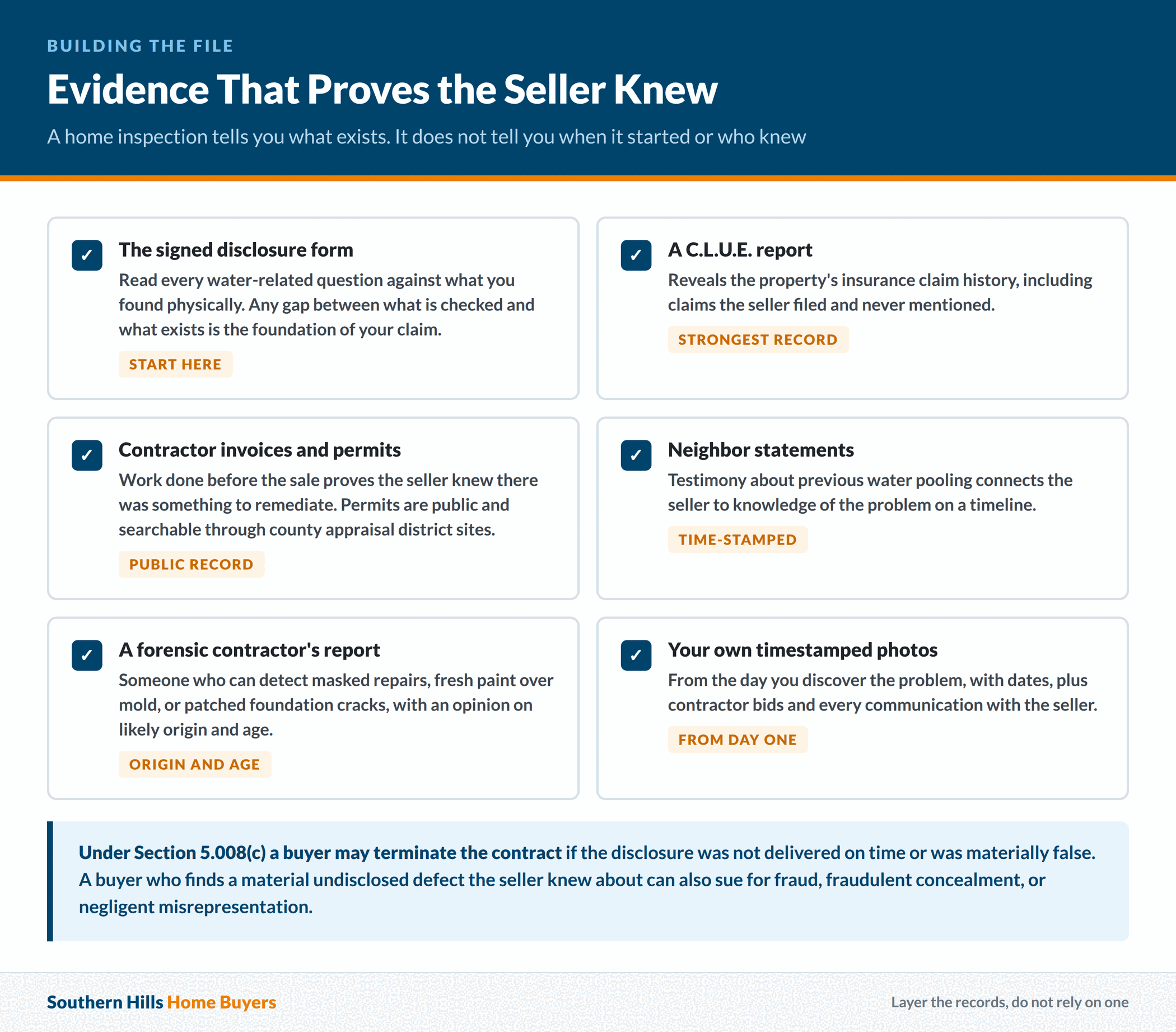
Under Section 5.008(c), a buyer may terminate the contract if the disclosure was not delivered on time or was materially false. A buyer who discovers a material undisclosed defect the seller knew about can also sue for fraud, fraudulent concealment or negligent misrepresentation. Damages may reach actual repair costs, consequential damages and, in some cases, attorney’s fees.
Timestamped photographs of the damage from your own phone, paired with a written report from a licensed home inspector or forensic contractor, round out the file you’ll need.
How Does Undisclosed Water Damage Affect Property Value in Texas?
Water damage that reaches the structural layer of a home, subfloors, load-bearing walls, roof decking, is not a cosmetic problem. Mold remediation runs from $500 to over $6,000 depending on how far the growth has spread, according to 2025 restoration data out of Houston. Redfin’s March 2026 data puts the Texas median sale price at $341,800, down 1.8% year over year, and buyers here already ask for concessions. A home with a known water damage history sells for less and takes longer to move. Sometimes it doesn’t sell at all without a real price reduction. I’ve watched that pattern play out in neighborhoods that were otherwise strong.
The value hit runs in two directions. There’s the repair bill sitting in front of you, and then there’s the stigma discount that trails the property into its next sale. Even after remediation, a house with a disclosed flood or water damage history draws lower offers, because informed buyers price in the odds of a repeat.
Around 77% of real estate lawsuits trace back to disclosure issues. A seller who hides water damage isn’t only creating legal exposure for himself. He’s moving a real financial burden onto a buyer who bought in good faith. Put a figure on that burden through a licensed appraiser’s opinion of value, before and after the disclosed defect. That is one of the most persuasive moves available to you in a legal claim.
What Are Your Legal Rights When a Texas Seller Fails to Disclose Water Damage?
A buyer moved into a craftsman bungalow in Waxahachie last spring. Two months after closing, a plumber found an active slab leak that had run long enough to undermine a section of the foundation. The seller had filed an insurance claim eighteen months earlier on the same issue and never disclosed it. That’s the kind of omission that turns a routine closing into a legal fight.
The buyer had far more options than she knew.
A seller’s failure to provide the required disclosures lets you pursue monetary damages under either the Texas Deceptive Trade Practices Act or the Statutory Fraud Act. Even without leaning on a statute, you may be able to add a common law claim for misrepresentation or fraud.
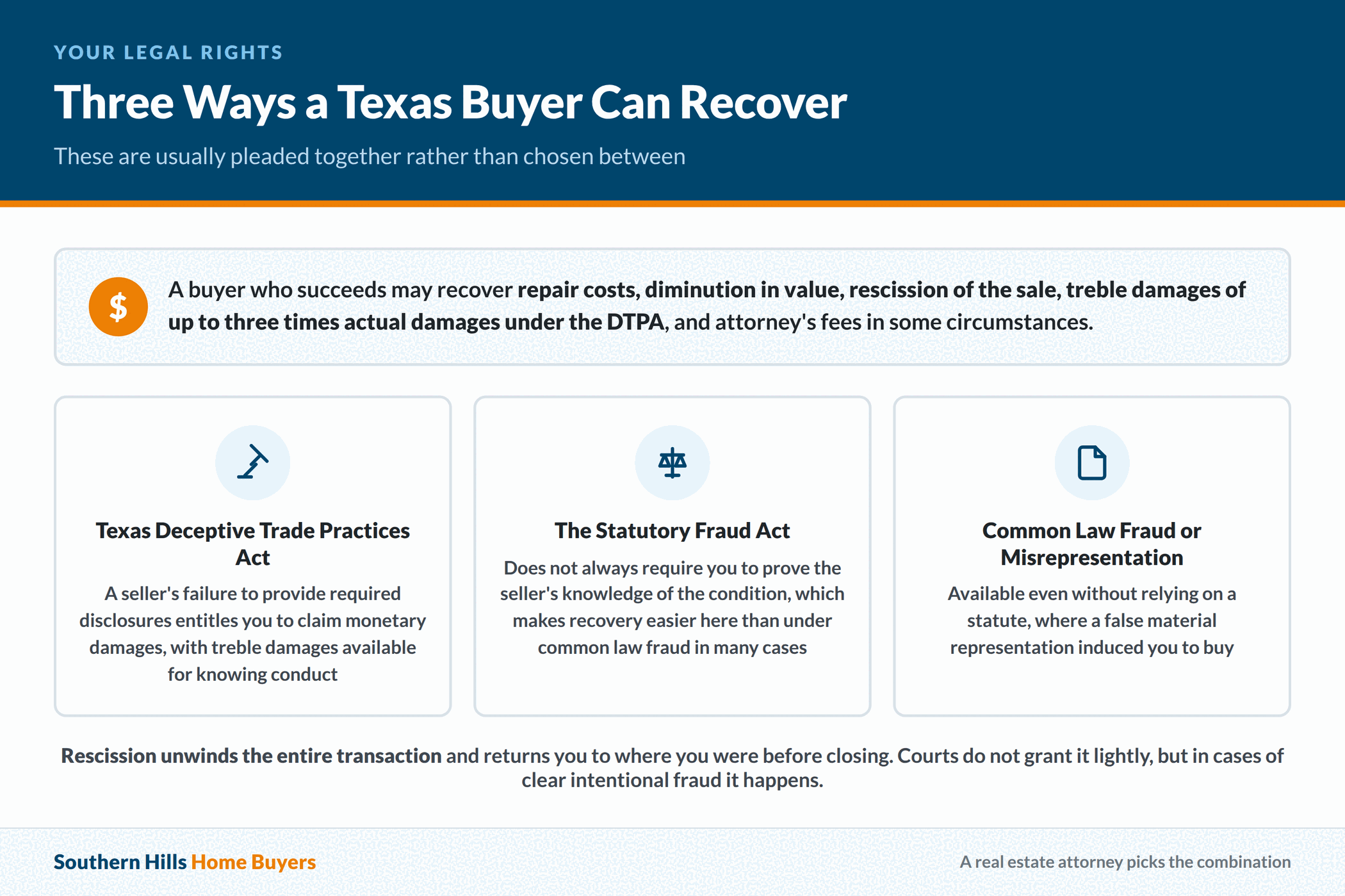
Depending on the legal theory and the facts, a buyer who wins a nondisclosure lawsuit may recover the cost of repair, diminution in value and rescission of the sale. Treble damages of up to three times actual damages are available under the DTPA, and attorney’s fees in some circumstances. Rescission unwinds the whole transaction and puts you back where you stood before closing. Courts don’t hand it out lightly. In cases of clear intentional fraud, it does happen.
The Statutory Fraud Act doesn’t always require you to prove the seller’s knowledge of a condition, which makes recovery easier under that statute than under common law fraud in many cases. That matters. Proving what somebody knew is always harder than proving what they said against what actually existed.
Reach out to Southern Hills Home Buyers if you’ve inherited a property with water damage and can’t decide whether to chase the prior seller or sell as-is and move forward. They work with Texas homeowners in exactly these tangled situations.
How Do You File a Lawsuit Against a Seller for Undisclosed Water Damage in Texas?
Some sellers push back and argue the buyer should have caught it during inspection. Texas law gives that defense very little room in most cases. A buyer’s right to a home inspection doesn’t relieve the seller of the obligation to disclose what he already knows, and Texas courts have said so consistently. That is why the seller’s responsibility for repairs after closing keeps landing in front of judges.
The practical path to litigation starts before you hire an attorney. A formal DTPA Demand Letter has to go out by certified mail at least 60 days before you file suit, which gives the seller an opportunity to settle. That step is mandatory under the DTPA, and skipping it can sink your case before it opens. Many disputes resolve here. Once a seller reads a formal demand letter on attorney letterhead citing specific statute violations, the math on settling tends to shift.
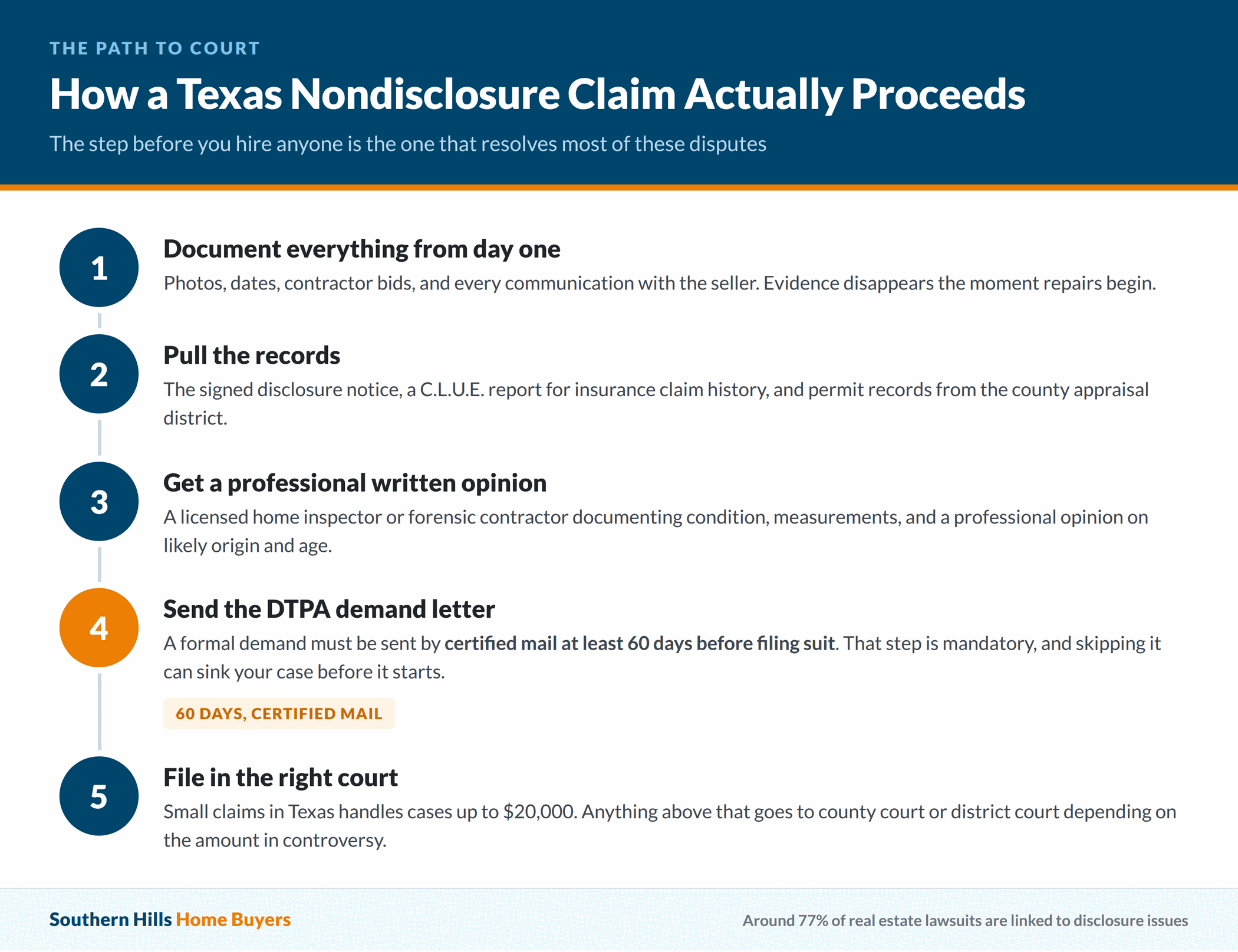
If the demand produces nothing, your attorney will file in civil court. Small claims in Texas handles cases up to $20,000, sending anything larger to a county court or a district court depending on the amount in controversy.
Damages may cover the cost to repair undisclosed defects, reduction in property value, rescission of the transaction and, where the fraud was intentional, exemplary damages. Attorney’s fees and costs are sometimes recoverable too.
Document everything from the day you discover the problem: photos, dates, contractor bids, every message with the seller. If you’d rather sell the property than fight that battle, Southern Hills Home Buyers buys homes as-is in Texas. They can tell you what the home is worth in its current condition, useful context for an attorney calculating your actual damages.
Who Can Help You Recover Damages After a Seller’s Failure to Disclose in Texas?
No one professional handles all of this. You need a team, and calling them in the right order saves time and money.
The most important call goes to a real estate attorney. Texas has real estate litigation firms in every major market, from Fort Worth to McKinney, and many offer free initial consultations. They’ll tell you quickly whether your facts support a DTPA claim, a fraud claim, or both. The Texas State Bar’s lawyer referral service is a reliable starting point if you don’t have a personal referral.
Your licensed home inspector or forensic contractor comes second. Somebody has to document the physical condition of the damage in writing, with photos, measurements and a professional opinion on likely origin and age. That report becomes part of your evidence file.
The insurance company deserves a call too, even if you doubt they’ll pay. Homeowners insurance may cover water damage from sudden or accidental events like burst pipes or appliance failures, though most policies exclude gradual damage. You can also check the property’s official flood zone for free at the FEMA Flood Map Service Center. Knowing where your coverage stops tells you how much of the repair bill falls back on the seller.
A couple I worked with in Rockwall were caring for the wife’s mother, who had just moved into assisted living after a fall. They had inherited the mother’s house and wanted it sold quickly to help cover the facility costs. A buyer backed out after discovering mold behind the kitchen cabinets, probably from a dishwasher that had been leaking slowly for years, and the family had no idea where to turn. They weren’t trying to hide anything. They simply hadn’t known it was there. We bought the house on a Wednesday, gave them a fair cash offer built on the actual condition, and they closed without having to manage repairs, attorneys or a second failed sale.
Maybe you’re on the other side of that equation, the buyer who found what the seller left behind. Southern Hills Home Buyers can also help you think through your options on the property itself, separate from whatever legal path you pursue.
Frequently Asked Questions
Do Sellers Have to Disclose Water Damage in Texas?
Under Texas Property Code § 5.008, sellers are legally required to disclose the condition of their property using a Seller’s Disclosure Notice, including any previous water damage and whether that damage was repaired professionally. Flooding from a burst pipe, roof leak, storm runoff or sewage backup has to be disclosed even when the damage looks minor. Skipping that disclosure doesn’t make the obligation disappear. It creates liability after closing.
What Are the Updated Requirements for Seller Water Disclosure in Texas?
Texas tightened its disclosure requirements in January 2025. Sellers now have to say whether mold remediation happened on the property within the past five years. The standard TREC Seller’s Disclosure Notice form reflects that update. Sellers also have to disclose flood zone status, prior flooding events, whether flood insurance is or was required, any known drainage issues, and the full repair history tied to water intrusion.
What Can I Do If the Seller Didn’t Disclose Water Damage When I Bought My House?
Start by pulling the disclosure form the seller signed at closing. Compare it line by line against what you’ve found in the house. Then bring in a licensed contractor or forensic inspector to document the damage in writing. Your next call goes to a Texas real estate attorney, who can assess whether you have a DTPA claim, a fraud claim, or both. A formal DTPA Demand Letter sent via certified mail at least 60 days before filing is a required step before you can initiate a lawsuit, so don’t sit on it too long.
What Happens If a Home Seller Doesn’t Disclose Known Problems in Texas?
Fraudulent concealment cases can end in punitive damages. The Texas Deceptive Trade Practices Act lets buyers recover treble damages in some circumstances, and in egregious cases a court can unwind the transaction entirely through rescission. Past the legal consequences, a seller who failed to disclose also has to live with the practical fallout: the nondisclosure becomes part of the property record once litigation begins, which complicates any future sale.
If you’ve bought a Texas home and found water damage the seller never mentioned, you’re in a genuinely stressful situation, and it’s fine not to know your next step yet. Talk to a real estate attorney about the legal side. Get a contractor in to put a number on the damage. And if you’d rather sell the property than fight a long legal battle, we’re happy to take a look and give you a straightforward offer with no strings attached. Reach out to Southern Hills Home Buyers whenever you’re ready. No pressure, no obligation.
Undisclosed Water Damage in the Dallas-Fort Worth Metroplex
The value math is sharper here than the statewide numbers suggest. As of July 2026 the median listing price across the Dallas-Fort Worth-Arlington metro sat near $439,000, with a median of roughly 54 days on market, according to Federal Reserve Economic Data. A stigma discount that costs a few percent on the Texas median costs meaningfully more on a Metroplex house. That’s why putting a number on the loss with a licensed appraiser matters before you decide whether to fight or to sell.
We buy houses with a water damage history throughout the Metroplex, disclosed or newly discovered. If the property sits in the city, we are the cash home buyers in Dallas who look at these houses every week. We also buy in Fort Worth, Plano, Garland, Mesquite and Irving.
Want a Real Number on the House As It Sits Today?
Whether you’re weighing a claim against the seller or just deciding what comes next, knowing what the property is actually worth right now helps either way. That includes an attorney calculating your damages. Southern Hills Home Buyers has walked houses across the Dallas-Fort Worth Metroplex with slab leaks, roof damage, mold behind cabinets and every other version of this. We’ll tell you plainly what we see. No pressure and no obligation. You can also read other frequent questions here.
Ready to get started? Reach out to Southern Hills Home Buyers or fill out the form below, and we’ll get back to you with a straight answer, usually the same day.
Get Cash For Your Texas House Today
We buy houses in Texas without the hassle and red tape. Get your no-obligation cash offer for your home and just be done. Selling in as-is condition has never been easier.

Author: Brandon Beatty
Brandon Beatty’s passion is buying income producing properties and building businesses. He focuses on buying houses and small multi family buildings in Texas that have an opportunity to add value through proper management and renovations while helping property owners sell quickly and without the hassles of a traditional sale.
Brandon is the founder of Southern Hills Home Buyers and has been featured on real estate news sites, including Zillow, Redfin, Realtor.com, HomeLight, List With Clever, Offerpad, and OpenDoor.