
Most houses built before 1980 hold materials nobody gave a thought to at the time. The siding looked fine. Floor tiles looked fine. Attic insulation looked like every other attic on the street. Then a permit gets pulled, or a buyer’s inspector shows up, and asbestos turns into the only word anybody will say. The closing date tends to go quiet right along with it, and the homeowner is left holding a problem nobody warned about.
You can sell a house with asbestos in Texas. State law doesn’t require you to strip it clean first. What the law does require, and what lands on sellers who ignore that rule, is where this gets complicated in a hurry.
What Is Asbestos Siding and Why Was It Used in Home Construction?
A house built before the mid-1980s looks like every other house from the curb. Maybe the siding has been painted a dozen times over. Maybe the roof was replaced once already, and the utility room floor looks like ordinary tile. Nothing about that signals a hazardous substance. The part homeowners rarely expect is this: these materials were considered solid choices when they went in, sometimes even as premium upgrades worth paying extra for.
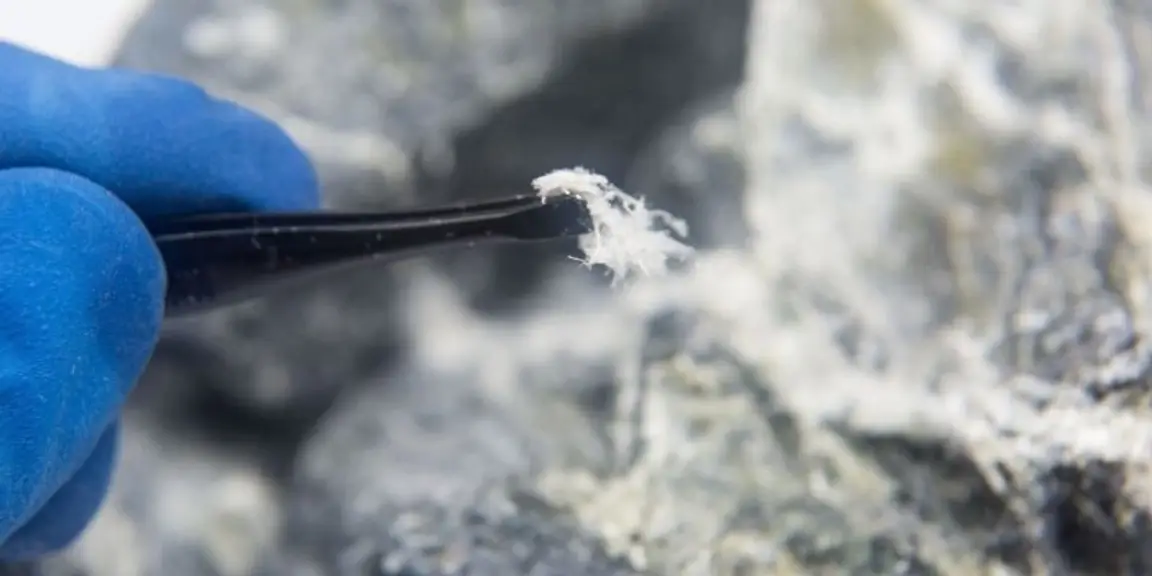
Mineral asbestos is a group of naturally occurring silicate minerals, prized for heat resistance, tensile strength, and low cost. Builders put it in roof shingles, floor covering, pipe insulation, cement board, and siding panels. Homes built between roughly 1930 and 1980 are the ones most likely to contain it. Asbestos fibers were cheap, fireproof, and durable in a way the synthetic materials of that era couldn’t match, and contractors knew it. Hard to argue with a product like that on a job site.
Not long ago I bought a property in Mesquite, on a street of brick-and-board homes from the late 1960s. A widow there had been quietly carrying two mortgages for almost a year after losing her husband. Asbestos siding on the back addition was one reason her retail listing kept falling apart at the inspection stage. Two deep freezers sat in the garage, both full of food she was afraid to throw out. That detail shows up in estate situations more often than you’d guess. We got her out from under both mortgages so she could put her attention on her family instead of the asbestos.
The Environmental Protection Agency enforced restrictions that effectively ended widespread use of asbestos in construction products, working through the Toxic Substances Control Act. A full ban on all new uses arrived later, through regulatory action still unfolding in recent years. Health implications from that long stretch of use are playing out in Texas homes right now. Buyers and sellers in older neighborhoods are still sorting through the fallout.
How Can You Tell If Your House Has Asbestos Siding?
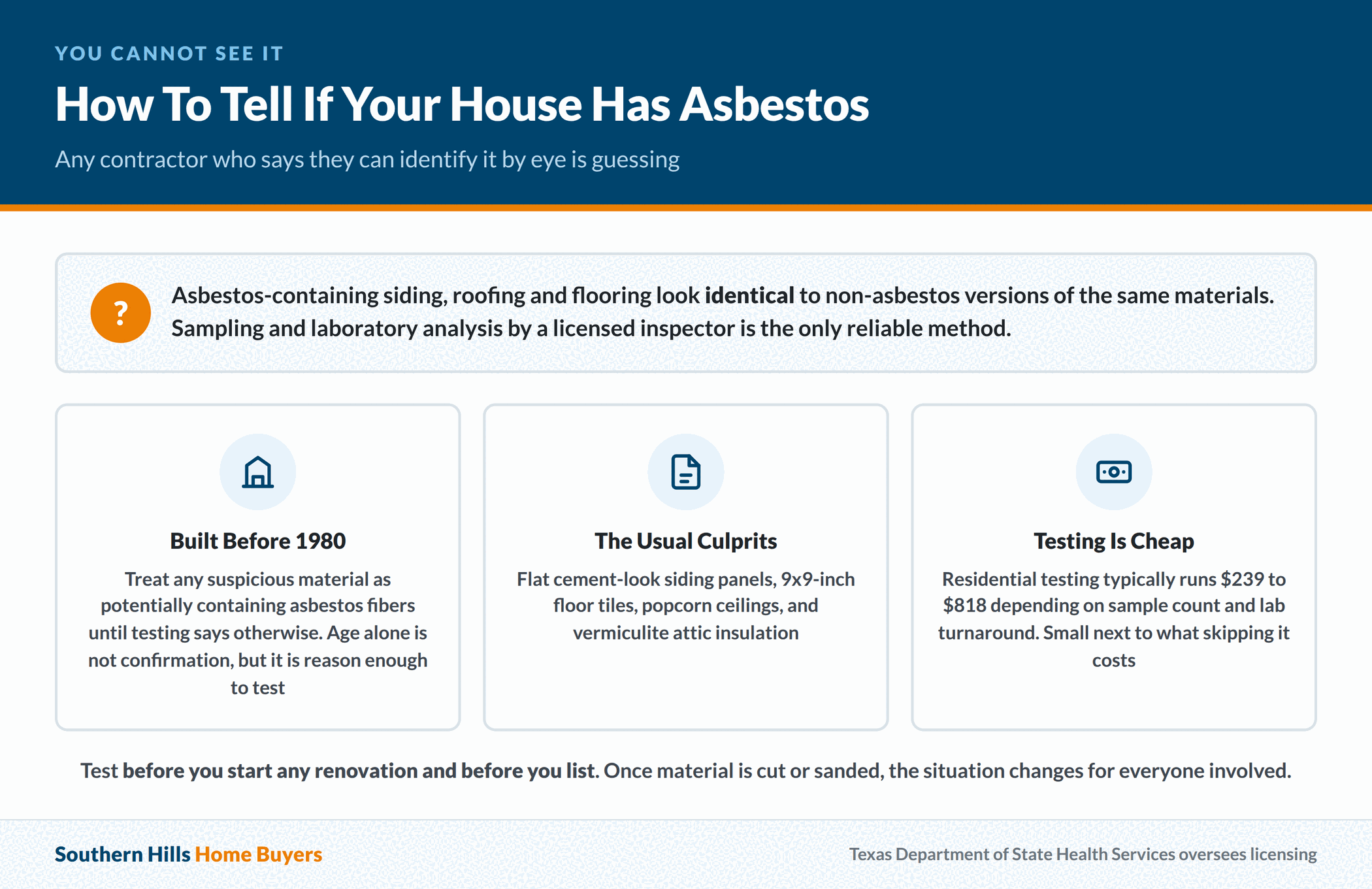
You cannot identify asbestos by looking at it. That’s the honest answer. Any contractor who tells you otherwise is guessing.
Asbestos-containing siding, roofing, and flooring look identical to non-asbestos versions of the same materials. Sampling and laboratory analysis by a licensed inspector is the only reliable method, and I’ve never once managed to tell by eye. In Texas, the Texas Department of State Health Services oversees asbestos licensing and can point you toward accredited professionals nearby.
Treat age as your first clue. If your home went up before 1980, assume any suspicious material contains asbestos fibers until testing says otherwise. Siding that looks like flat cement panels, floor tiles in 9×9-inch squares, popcorn ceilings, and vermiculite attic insulation are the usual culprits. Age by itself confirms nothing. It is reason enough to test before you start a renovation, and reason enough to test before you list the property.
Testing for asbestos in a residential property usually costs between $239 and $818, depending on how many samples you pull and how fast the laboratory turns them around. Small money, set against what skipping it costs. Buyers, their agents, and their lenders all pay attention to this. Texas properties are sitting about 69 days before going under contract, according to Redfin’s June 2026 data, so buyers have room to be picky. An undisclosed hazardous material hands them every reason to walk away.
Is Asbestos Siding Dangerous to You and Your Family?
Knowing it’s there and knowing when to worry are two separate problems. Sellers who run the two together make their first mistake early, and it usually costs them.
Undisturbed asbestos in good condition carries far less immediate risk than asbestos that’s been cut, sanded, or damaged. Intact material keeps the fibers bound inside it. Danger climbs when siding cracks, roofing crumbles, or floor tiles break during a renovation, because that’s the moment asbestos fibers go airborne. Once airborne, they can be inhaled deep into the lungs, where they lodge permanently.
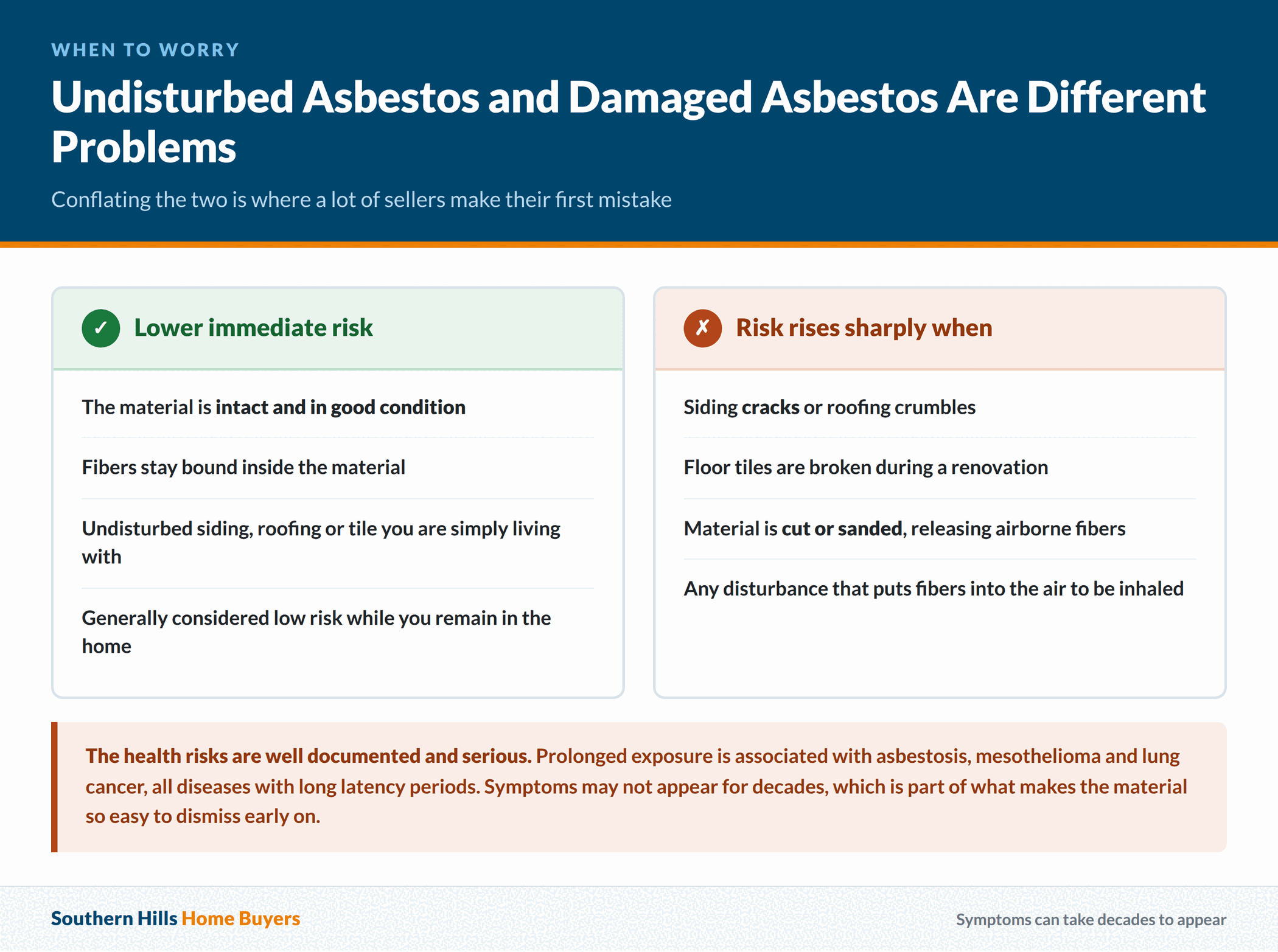
Health risks tied to asbestos exposure are well documented and serious. Prolonged exposure to asbestos fibers is associated with asbestosis, mesothelioma, and lung cancer, all human diseases with long latency periods. Symptoms may not surface for decades. That delay is part of what makes the material so hard to manage as a public health issue, and so easy to shrug off early on.
For a seller whose asbestos siding is undisturbed and in decent shape, the immediate safety risk to your family while you live there is generally considered low. Risk climbs during any work that damages the material. Demolition, power washing, and drilling all qualify. Any renovation on an older Texas home ought to start with a professional inspection, before a single nail comes out.
Can You Sell a House with Asbestos Siding in Texas?
So, does asbestos actually kill a sale?
Not automatically, and often not at all. In Texas it is legal to sell a house with asbestos, and illegal to conceal it. That distinction carries enormous weight. Texas built its disclosure framework around what you know and whether you share it honestly, not around whether the problem gets fixed before closing.
In June 2026 the Texas median home sale price sat at $347,911, according to Redfin. Buyers have options at that price, and they use them. A home with disclosed asbestos, properly tested and accurately represented, still sells. It often sells to investors, to cash buyers, or to buyers who understand what remediation runs and negotiate the price accordingly. A home where the asbestos got hidden is a different animal, and the legal reason why comes up further down.
Cash buyers and real estate investors tend to be the most pragmatic about asbestos. They’ve seen it plenty. They know what removal costs, and they price offers around the condition of the property. Companies like Southern Hills Home Buyers buy properties as-is across Texas, asbestos and all, which hands a seller an option that sidesteps the inspection-fallout cycle. You disclose honestly, they make an offer that reflects the property’s actual condition, and you close without the retail drama.
What Are the Property Disclosure Requirements for Home Sellers in Texas?
A seller in Plano called me after her sale collapsed on the ninth day of the option period. Her buyer’s inspector found asbestos-containing floor tile in the utility room. She’d lived there twenty-two years and genuinely had no idea. Her disclosure form said unknown, which is what she’d written for everything she hadn’t specifically verified. That one gap cost her the contract.
Texas seller disclosure requirements sit in Texas Property Code Section 5.008, which requires sellers of residential property to deliver a written Seller’s Disclosure Notice to the buyer before closing. The disclosure has to address structural components, built-in appliances, environmental hazards such as lead paint or asbestos, flood damage history, previous foundation repairs, and any encroachments or easements on the lot. Sellers answer based on what they actually know on the day they sign.
This form is not a warranty, and it is no substitute for a home inspection. It is a legal record. Concealing a known defect exposes a seller to liability after closing, even under an as-is contract. Selling as-is doesn’t buy you a pass on disclosure, which surprises plenty of sellers who assume the contract language protects them. It only means you aren’t agreeing to fix what you disclosed.
Do You Have to Disclose Asbestos Siding When Selling a House in Texas?
Texas Property Code Section 5.008 lists asbestos components explicitly as a defect category requiring disclosure, alongside everything else covered in our guide to what Texas home sellers are required to disclose by law.
The seller disclosure form in Texas asks sellers whether they know of asbestos or other hazardous materials in the home. If you know about asbestos in your house, you generally have to disclose it on that form. One word, known, carries all the legal weight here. Hiring an inspector before you list isn’t required of you. Testing you have already had done is another story entirely. Where an earlier inspection flagged something, or a contractor mentioned it during past renovation work, that knowledge is yours to disclose.
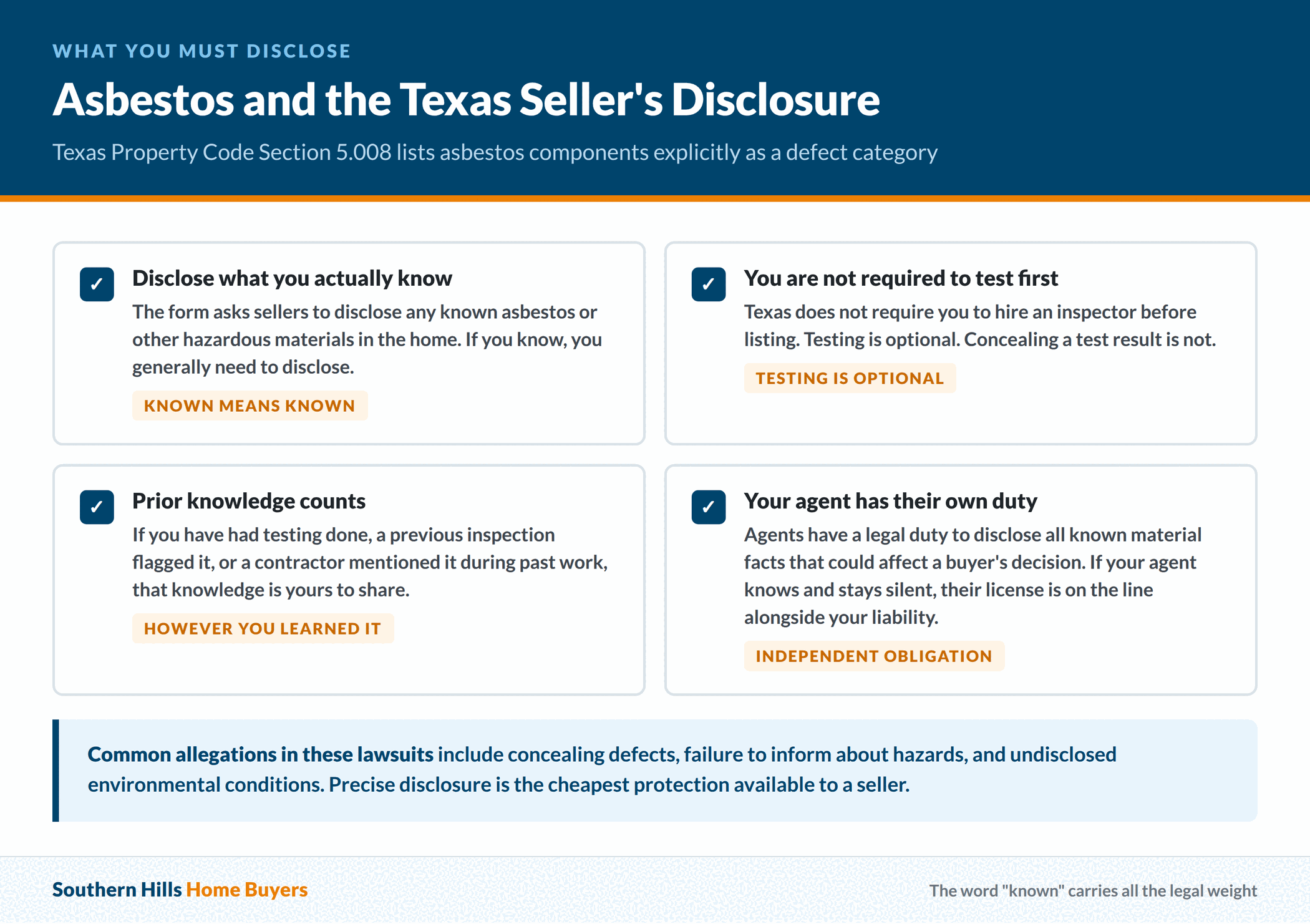
Something plenty of articles skip: your listing agent carries disclosure obligations too, independent of yours. Real estate agents have a legal duty to disclose known material facts about a property that could affect a buyer’s decision. Common allegations in lawsuits against agents include concealing defects, failing to inform about hazards, and undisclosed environmental conditions. If your agent knows about the asbestos and doesn’t disclose it, their license and their liability sit on the line alongside yours.
Federal disclosure law doesn’t require asbestos disclosure specifically, and state requirements vary. Most jurisdictions require disclosure only where the seller has actual knowledge of asbestos. Texas sits in the more rigorous camp, with one of the more detailed mandatory-disclosure frameworks anywhere in the South.
Do You Have to Remove Asbestos Siding Before Selling?
A homeowner in Garland got a quote for $18,000 to abate the asbestos siding on her 1970s ranch house. She thought that was the only road to a sale. It wasn’t.
Texas law doesn’t require asbestos removal, only that you stay forthcoming about what you know. Sellers in Texas have three realistic paths. One is to remediate before listing. Another is to sell as-is with full disclosure and let the buyer negotiate a price adjustment. The third is to sell directly to a cash buyer who handles the remediation themselves. Each path carries its own cost profile and its own timeline, so knowing your financial position going in shapes which one actually makes sense.
Retail buyers using conventional financing sometimes hit a wall here. Certain loan programs require remediation before they will fund the loan, which narrows your buyer pool the same way unpermitted work does. That is a real market constraint. It doesn’t mean you have to spend $25,000 before you can sell. It means the retail pool may not be where your buyer is. Investors, cash buyers, and direct buyers like Southern Hills Home Buyers aren’t subject to the same lender requirements, so those restrictions never touch a direct sale.
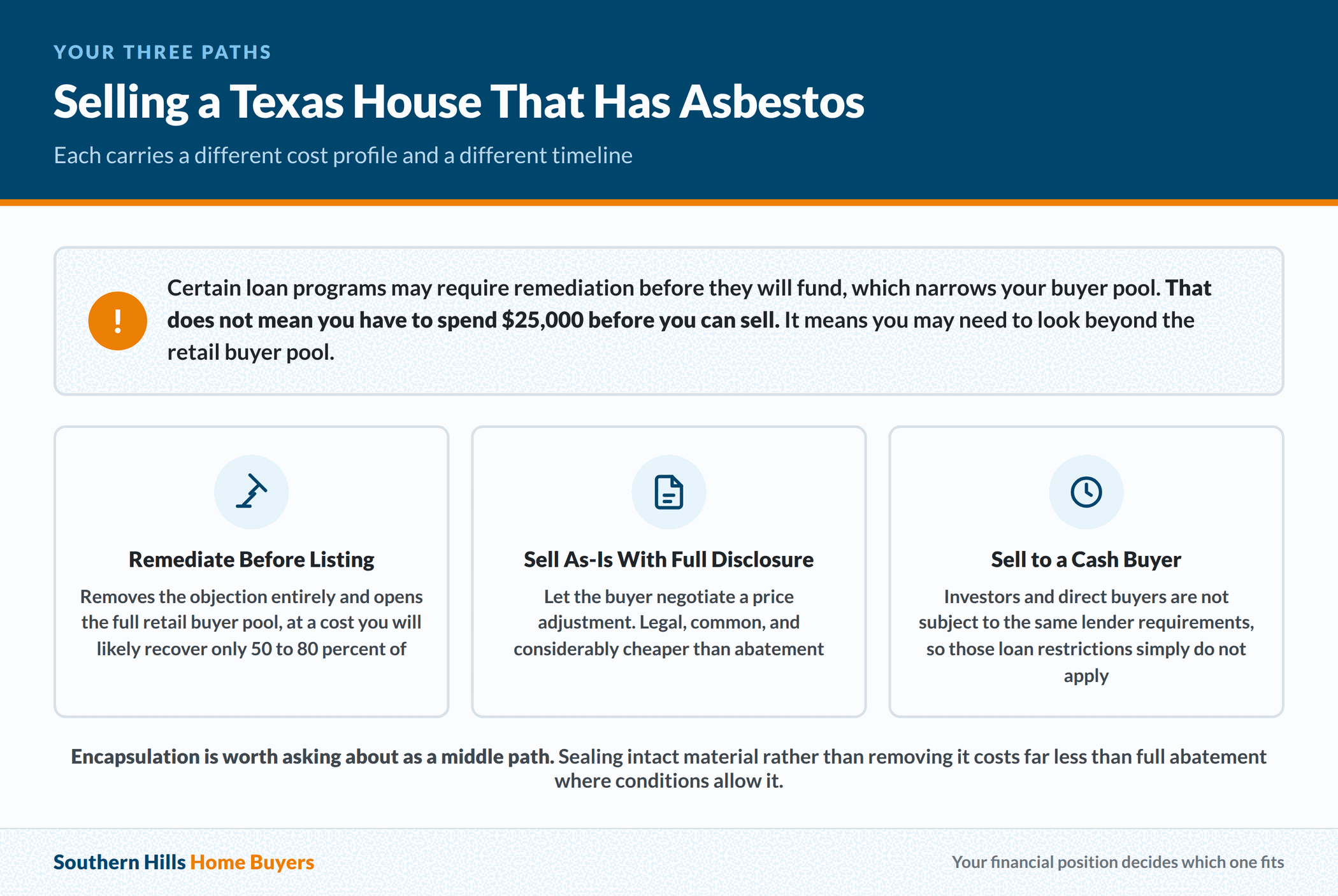
Encapsulation sits in the middle, and it is worth asking about. Sealing the siding instead of tearing it off costs less where local regulations allow it, though many jobs still require a full removal. A licensed Texas abatement contractor can tell you whether encapsulation is approved for your specific situation. Approval brings the cost down considerably.
How Much Does Asbestos Removal Cost in Texas?
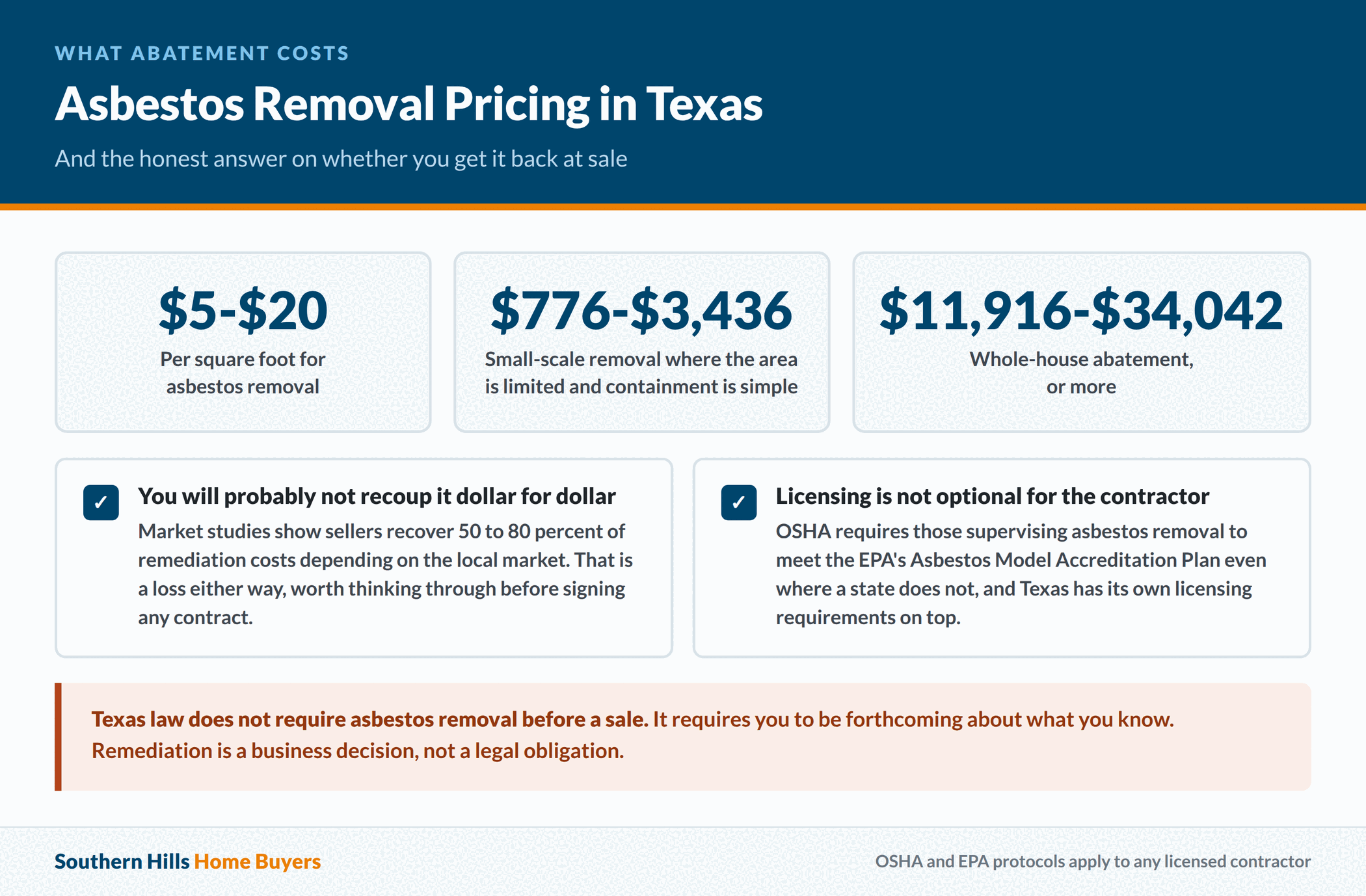
Sellers ask constantly whether they’ll recoup the cost of remediation in a higher sale price. The honest answer is probably not, at least not dollar for dollar.
You may not recover the full cost of remediation in the sale price. Market studies show sellers recover 50 to 80 percent of remediation costs, depending on the local market. Either way that is a loss. In a Texas market where sellers are already handing out price concessions to get to closing, stacking remediation on top creates a math problem worth working through before you sign any contracts.
Expect to pay about $5 to $20 per square foot for asbestos removal. Whole-house abatement, handled at scale, runs roughly $11,916 to $34,042 or more. Smaller localized projects cost less. Small-scale removal typically runs $776 to $3,436 when the affected area is limited and containment is straightforward.
Any licensed contractor you hire has to follow protocols set by OSHA and the Environmental Protection Agency. OSHA requires anyone supervising asbestos removal to meet the Asbestos Model Accreditation Plan from the EPA, even where a state doesn’t require it. Texas layers on its own licensing requirements through DSHS, so confirm your contractor is certified at the state and the federal level before you sign anything. Pull quotes from at least three contractors. Between the lowest and the highest bid on identical scope, the gap can run into thousands of dollars.
What Should You Do If You Find Asbestos After Buying a Home in Texas?
My early assumption was that buyers who found asbestos after closing always had a strong legal case. That’s too simple.
Your options depend heavily on what the seller knew, and when they knew it. Sellers are required to disclose genuine knowledge, not what they should have gone looking for. Ignorance stops working as a shield once a seller had reason to know about a defect. A seller who never tested and marked unknown stands in a different legal position than one who had an inspection report sitting in a drawer and answered none known on the disclosure form.
Do not attempt removal yourself. Texas licensing rules exempt single-family homes, so the state will not stop you, and that is exactly what makes this dangerous. Disturbing the material without containment puts fibers into the air your family breathes, and local disposal rules still govern whatever you tear out. Your first step is a licensed inspector who can test and document where the asbestos-containing materials are. That documentation becomes your evidence if a legal claim follows, and your safety guide either way.
After the inspector, your next call goes to a real estate attorney. Texas gives buyers several legal pathways once undisclosed defects surface, including claims under the Texas Deceptive Trade Practices Act and the Statutory Fraud Act. The clock on those claims starts running from discovery, not necessarily from closing. Get professional guidance on your own facts before you decide you have no case, and before you assume you have a strong one.
Is Failure to Disclose Asbestos Fraudulent Misrepresentation in Texas?
Section 27.01 of the Texas Business and Commerce Code governs fraud in real estate transactions specifically, and it has real teeth.
Texas Business and Commerce Code Section 27.01 governs fraud in real estate and stock transactions, imposing liability when a false representation pulls another party into a contract. Hiding asbestos on a disclosure form fits squarely inside that framework. A seller who actively concealed a known defect may have handed the buyer a claim for fraud. Fraud requires proof that the seller made a false representation or concealed a material fact knowingly, intending the buyer to rely on it, and that the buyer took damage as a result.
Courts in Texas generally enforce “as-is” clauses that disclaim reliance on prior representations. Such clauses can insulate sellers from liability for property defects or conditions, unless fraud or active concealment gets proven. Selling as-is with a signed addendum protects nobody who actively lied. Courts have drawn that line consistently.
Texas law imposes a four-year statute of limitations on fraudulent misrepresentation claims under Texas Civil Practice and Remedies Code Section 16.004(a)(4). That period begins when the misrepresentation is made and causes harm. Under the discovery rule, the clock starts when the fraud was discovered, or should have been discovered with reasonable diligence. So a buyer who finds concealed asbestos three years after closing may still be within the window to file suit.
What Are Your Legal Options for Seeking Compensation After Undisclosed Asbestos?
Getting this part wrong, meaning going at it without an attorney, is how buyers leave money on the table or miss their window altogether.
A seller’s failure to provide the required disclosures entitles you to claim monetary damages for undisclosed defects under either the Texas Deceptive Trade Practices Act or the Statutory Fraud Act. Those are the same statutes buyers lean on when a seller fails to disclose water damage. Even without leaning on a statute, you may be able to add a common law claim for misrepresentation or fraud.
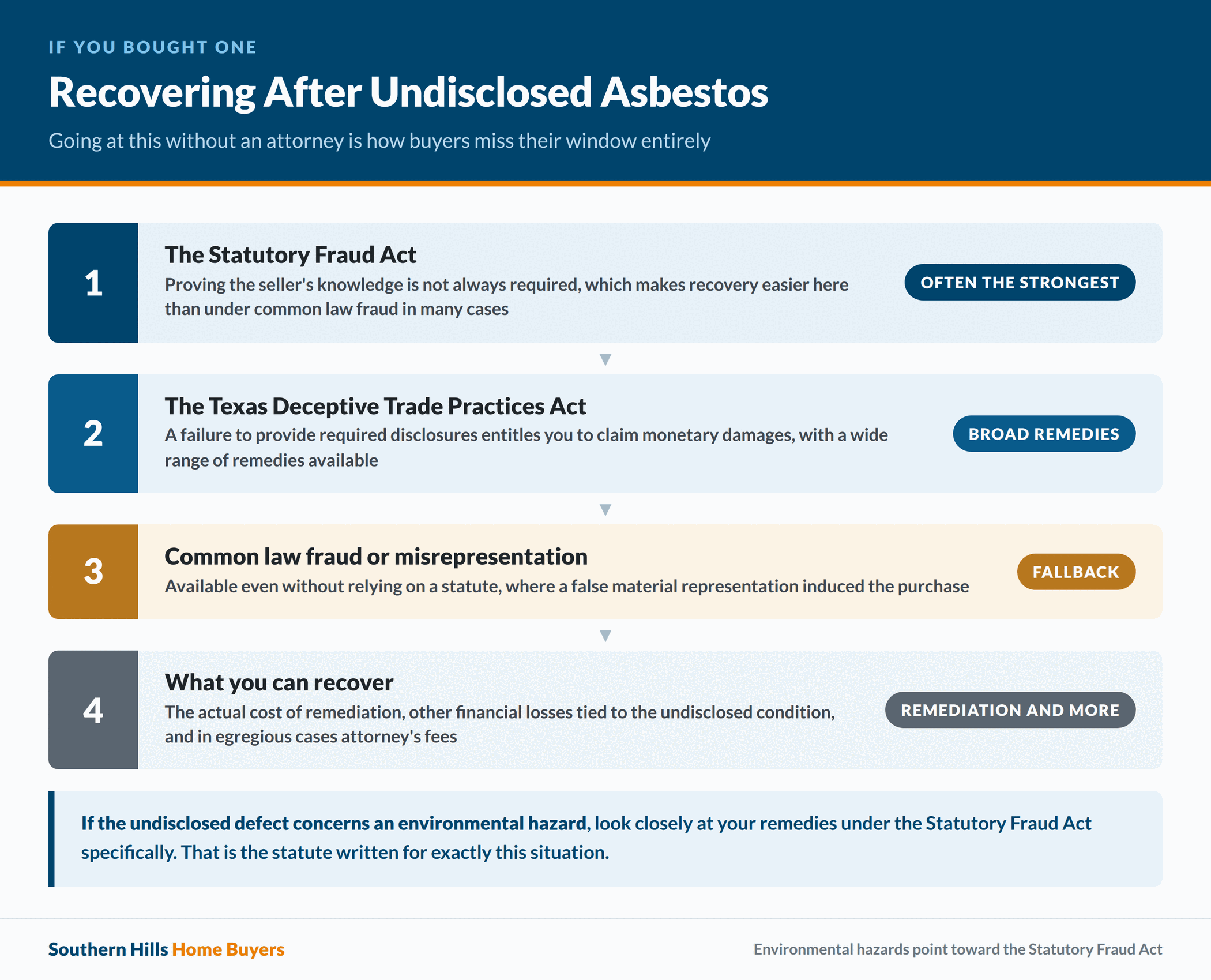
If the defects your seller failed to disclose concern environmental hazards, look hard at your remedies under the Statutory Fraud Act. Proving the seller’s knowledge of a condition is not always required under the Statutory Fraud Act. Recovery under the Statutory Fraud Act is often easier than recovery based on common law fraud. That difference matters more than it sounds, because what a seller knew is the hardest thing in the case to prove.
Remedies available under these frameworks can include the actual cost of remediation, other financial losses tied to the undisclosed condition, and in egregious cases, attorney’s fees. The Texas Deceptive Trade Practices Act provides for a wide range of remedies, including actual damages that compensate the buyer for financial losses and exemplary damages that punish egregious misconduct.
A man called on a Thursday afternoon a few years back. He had accepted a job transfer to Denver and had exactly five weeks to be out of his Waxahachie home. Under a layer of laminate he’d pulled up in the kitchen, he found asbestos floor tile, and the inspection report from when he bought the place never mentioned it. His garage held a full woodworking setup he had never gotten around to using. Money wasn’t his biggest concern. The timeline was. His real estate attorney walked him through the options, and he ended up selling directly rather than fighting the previous seller on a compressed clock. Southern Hills Home Buyers works with situations like his regularly, where speed and certainty matter more than squeezing out the last dollar. If that sounds like where you are, reach out and have a conversation.
Frequently Asked Questions
Do You Have to Disclose Asbestos When Selling a House in Texas?
Yes, if you know about it. Texas Property Code Section 5.008 requires sellers to complete a written Seller’s Disclosure Notice covering known environmental hazards, and asbestos is listed explicitly. If you have had testing done, received a report, or heard about asbestos from a contractor or an earlier inspection, that knowledge belongs on the form. Testing before you list isn’t required. You cannot disclose around information you already hold.
Do Realtors Have to Disclose Asbestos in Texas?
Your listing agent carries independent disclosure obligations and can face legal liability for withholding known material facts from buyers. If your agent is aware of asbestos on the property, whether from an earlier inspection report, from a conversation with you, or from any other source, they are required to disclose it. Their duty runs alongside yours, not instead of it.
Will 30 Minutes of Asbestos Exposure Hurt You?
A single brief exposure to asbestos fibers at low concentrations is not the same thing as the occupational exposure linked to diseases like mesothelioma and lung cancer. Serious health risks, asbestosis and cancer among them, track with repeated or prolonged exposure over time. Often that means work environments where people breathed high concentrations of fibers daily. No level of asbestos exposure is considered completely without risk, though, and any disturbed asbestos-containing material belongs in the hands of a licensed professional rather than treated as a minor inconvenience.
Can I Remove Asbestos Myself in Texas?
Legally, in most cases yes. The Texas Asbestos Health Protection Rules cover public and commercial buildings, and single-family homes and buildings of four units or fewer sit outside them, so the state does not require you to hire a licensed contractor to work on your own house. That is a licensing answer, not a safety answer. Both OSHA and the Environmental Protection Agency set strict protocols for containment, worker protection, and proper disposal of hazardous materials. Cutting or tearing out asbestos-containing material without containment releases fibers you cannot see and cannot un-breathe, and improper disposal can still put you crossways with your city. Most homeowners come out ahead paying a licensed abatement contractor.
Your Next Move on a Texas House With Asbestos
If you’ve got a house with asbestos in Texas and you’re trying to work out your next move, you don’t have to sort it out alone. Maybe you want to talk through the disclosure process. Maybe you want to understand what an as-is sale looks like, or just get a straight answer from somebody who has bought houses in this exact situation. We’re here. No pressure, no obligation, just a real conversation about your options.
Selling a House With Asbestos in the Dallas-Fort Worth Metroplex
Plenty of Metroplex housing stock predates 1980, which puts a lot of these houses in scope. As of July 2026 the median listing price across the Dallas-Fort Worth-Arlington metro ran about $439,000, with a median of roughly 54 days on market, according to Federal Reserve Economic Data. Weigh a $20,000 abatement bill you recover only part of against that timeline plus the carrying costs that come with it. A direct sale often nets out closer than sellers expect it to.
We buy houses with asbestos siding, tile and insulation throughout the Metroplex, and we handle the remediation ourselves after closing. If the property sits in the city, we are the cash home buyers in Dallas who take these on. We also buy in Fort Worth, Garland, Mesquite, Irving and Grand Prairie.
Got an Abatement Quote You Do Not Want To Pay? Talk To Us First
Before you commit five figures to abatement, find out what the house is worth to a buyer who does not need it done. We will look at the property and give you a straight number on it as it sits, so you can set that next to remediate-then-list with real figures instead of guesses. Southern Hills Home Buyers has closed on houses across the Dallas-Fort Worth Metroplex with asbestos siding, popcorn ceilings and original tile. No pressure and no obligation. You can also read other frequent questions here.
Ready to get started? Reach out to Southern Hills Home Buyers or fill out the form below and we will get back to you with a straight answer, usually the same day.